Why Ethereum staking matters in 2026
When Ethereum completed The Merge in September 2022, it switched from energy-intensive proof-of-work mining to proof-of-stake consensus. Since that moment, every new ETH block has been validated by stakers — people who lock ether as economic collateral to earn the right to propose and attest blocks. Staking is now the backbone of Ethereum's security model and one of the most popular ways to earn yield on ETH.
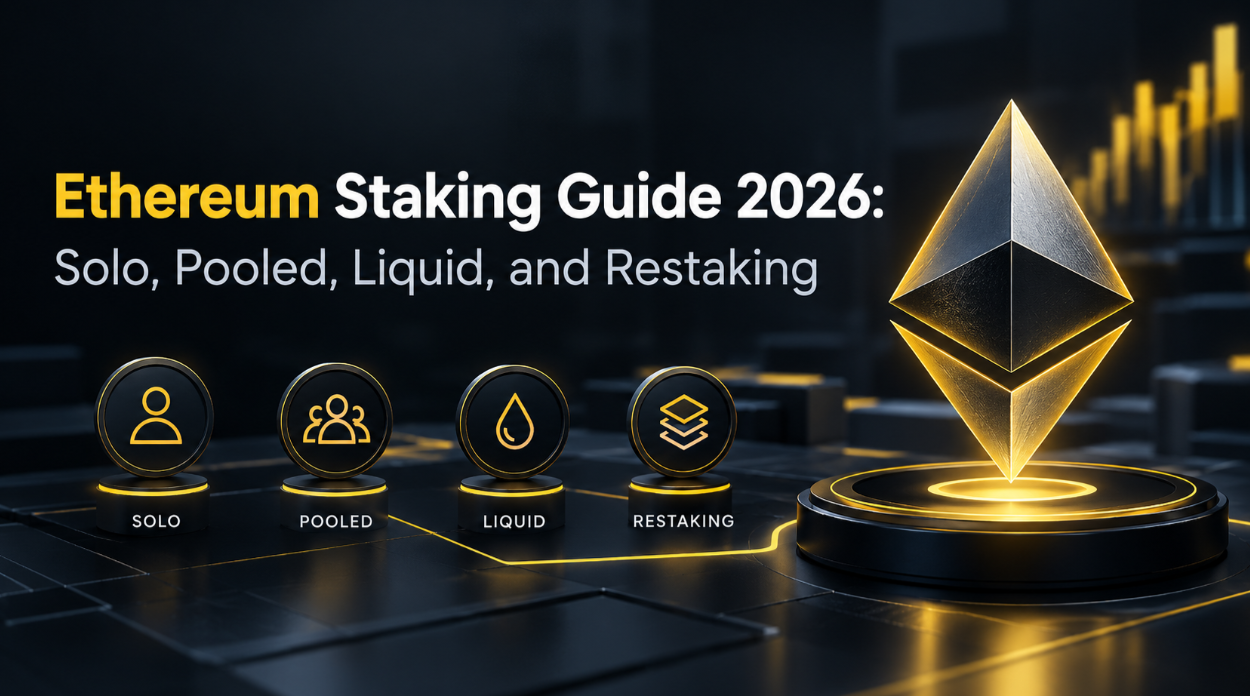
As of 2026, over 34 million ETH is staked across more than one million validators. The network pays stakers roughly 3.5–4.5% APY in the form of newly issued ETH plus priority fees from transactions. That yield is not fixed — it decreases as more validators join because the issuance is spread across a larger base. Understanding all four staking paths — solo, pooled, liquid, and restaking — is essential before committing any funds.
How Ethereum proof-of-stake works
Ethereum's consensus layer runs on validators. Each validator requires exactly 32 ETH deposited to the official deposit contract. Validators are randomly selected to propose new blocks and to attest (vote on) blocks proposed by others. Correct behaviour earns rewards; malicious or negligent behaviour is punished through slashing (a forced reduction in stake) or inactivity leaks (gradual penalty for being offline).
The protocol issues ETH to reward participation. Base rewards scale with the inverse square root of total staked ETH: the more ETH staked, the lower the per-validator reward. This formula keeps the network secure without over-paying. On top of base rewards, validators also receive MEV (maximal extractable value) — tips from sophisticated transaction ordering via MEV-boost relays — which has historically added 30–100% on top of base APY depending on network activity.
Solo staking: maximum decentralisation, maximum control
Solo staking means running your own validator node with 32 ETH. You control the private keys, keep all rewards, and contribute directly to Ethereum's decentralisation. It is the purest form of staking and the one Ethereum Foundation actively encourages.
- Requirements: 32 ETH, a dedicated computer with 4-core CPU, 16 GB RAM, 2 TB NVMe SSD, and reliable broadband (25+ Mbps symmetrical). Total hardware cost ~$300–$600. Running costs ~$20–$50/month in electricity.
- Uptime expectations: Validators earn reduced rewards for every epoch they are offline. Staying above 95% uptime keeps penalties negligible. A home machine on a UPS with auto-restart achieves this easily.
- Slashing risk: Slashing only occurs for double-signing (proposing two conflicting blocks) or surround-voting. Using a single validator key on a single machine with proper key management makes slashing practically impossible.
- Client diversity: Run a minority client (Teku, Nimbus, Prysm, or Lighthouse for consensus; Besu, Nethermind, or Erigon for execution). Client diversity strengthens the network; a supermajority bug in one client could correlate-slash validators.
Solo staking is ideal for long-term ETH holders who can commit 32 ETH for months to years. Withdrawals are enabled since the Shanghai upgrade, but there is a queue: during high exit demand, unstaking can take days to weeks.
Pooled staking: participate with less than 32 ETH
Most holders do not have 32 ETH. Pooled staking services let multiple users contribute smaller amounts that are aggregated into full validators. The pool operator handles node infrastructure; you deposit any amount and receive a share of the rewards.
The simplest pooled option is a centralised exchange staking product (Coinbase, Binance, Kraken). These are easy to use but reintroduce custodial risk: the exchange controls your ETH and the validator keys. They also typically take a 25–35% commission on rewards.
Non-custodial pooled staking via permissionless node operators — such as the DVT-based systems using distributed validator technology — allows pooling without giving any single party control over the full key. Staking pools built on DVT networks let a committee of node operators jointly hold a threshold-signed validator key, eliminating single points of failure.
Liquid staking: stETH, rETH, and tradeable yield
Liquid staking protocols solve the illiquidity problem of staking. When you deposit ETH into a liquid staking protocol, you receive a liquid receipt token that represents your staked position plus accrued rewards. You can trade, lend, or use this token in DeFi while still earning staking yield.
The two dominant liquid staking tokens are Lido DAO's stETH and Rocket Pool's rETH. stETH rebases daily — the balance in your wallet increases each day to reflect earned rewards. rETH is non-rebasing: its price appreciates against ETH over time. Both are fully redeemable for ETH (with withdrawal queues during high demand).
- stETH (Lido): Largest liquid staking protocol with ~33% of all staked ETH. Accepts any amount. Integrated into Aave, Curve, and dozens of DeFi protocols. 10% fee on rewards. Lido uses a set of permissioned node operators, raising decentralisation concerns.
- rETH (Rocket Pool): Permissionless node operator network. Operators stake 8 ETH minimum plus RPL collateral to run a minipool. More decentralised than Lido. 14% fee on rewards. Smaller liquidity depth than stETH.
- Other liquid tokens: cbETH (Coinbase), wBETH (Binance), swETH (Swell), and many others. Liquidity and DeFi integrations vary significantly.
The risk of liquid staking is smart contract risk on the protocol and slashing risk spread across the operator pool. stETH depegged to 0.94 ETH in 2022 during the 3AC/Celsius crisis when forced sellers overwhelmed liquidity. Understanding secondary-market liquidity depth before entering is essential.
Restaking: earning more yield on staked ETH
Restaking is the next layer of Ethereum's staking architecture. The core idea: validators or liquid stakers opt in to extend their cryptoeconomic security to other protocols (called Actively Validated Services, or AVSs) beyond Ethereum itself. In return they earn additional yield from those AVSs.
EigenLayer is the leading restaking protocol. Stakers can restake native ETH (solo validators), liquid staking tokens (stETH, rETH), or EigenLayer's own LST. As of 2026, EigenLayer has over $15 billion in restaked assets securing dozens of AVSs — oracle networks, rollup data availability layers, cross-chain bridges, and more.
Restaking yield depends on which AVSs you opt into and their demand for security. Current blended restaking APY through EigenLayer adds roughly 0.5–2% on top of base staking yield, though this varies with AVS activity. The trade-off is compounding slashing risk: validators that opt into restaking can be slashed both by Ethereum consensus rules and by AVS-specific rules.
Comparing the four staking paths
- Solo staking: 3.5–5.5% APY, 32 ETH minimum, full control, maximum decentralisation, highest technical overhead.
- Pooled staking: 2.8–4.5% APY after fees, any amount, custodial risk varies, low technical overhead.
- Liquid staking: 3–5% APY after protocol fee, any amount, DeFi composability, smart contract risk.
- Restaking: Base staking APY + 0.5–2% extra, requires staked position first, AVS slashing risk, higher complexity.
Risks every staker must understand
No staking path is risk-free. The common risks across all methods:
- ETH price risk: Staking rewards are denominated in ETH. If ETH price falls sharply, your USD-denominated return can be negative even with positive APY.
- Slashing risk: A software bug or key compromise causing double-signing can slash your deposit. Liquid staking spreads this risk but does not eliminate it.
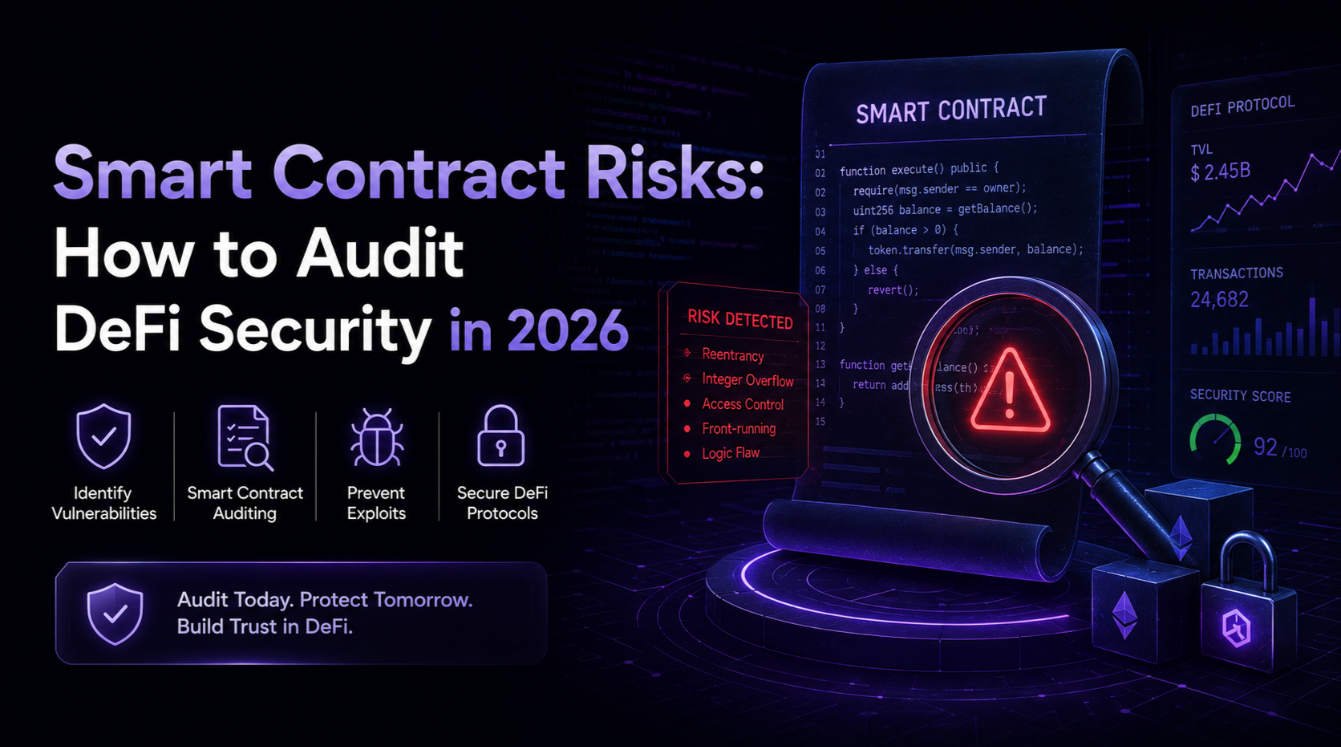
- Smart contract risk: Liquid and restaking protocols depend on audited contracts. A critical vulnerability could drain protocol funds.
- Withdrawal queue risk: During high exit demand, unstaking can queue for days. You cannot exit instantly.
- Regulatory risk: Some jurisdictions have moved to classify staking rewards as income at receipt, or have imposed licencing requirements on staking service providers.
How to start staking ETH today
- Decide your path: solo (32 ETH + hardware) vs liquid staking (any amount, instant).
- For liquid staking: acquire ETH via a regulated exchange, withdraw to a self-custody wallet like MetaMask (see our
- MetaMask review
- ), then deposit to Lido or Rocket Pool at their official frontends.
- For solo staking: follow the official Ethereum Launchpad at launchpad.ethereum.org — it walks through client selection, key generation, and the deposit process step-by-step.
- Monitor your validator performance via beaconcha.in. Set up alerting for missed attestations.
- Review your tax position. In most jurisdictions, staking rewards are taxed as income at the fair market value when received.
The future of Ethereum staking
Ethereum's roadmap includes several upgrades that will affect staking. Single-slot finality aims to reduce the time for blocks to become irreversible from ~15 minutes to a single slot (~12 seconds). Validator consolidation (EIP-7251) will allow validators to hold more than 32 ETH, reducing the validator count without reducing security. These changes will reduce overhead for solo stakers and improve the network's scalability without sacrificing decentralisation.
For the complete picture on Ethereum's price and market outlook, see our ETH price forecast and the Ethereum market overview.
This article is for educational purposes only. Not financial advice. Staking involves risk including the loss of principal. Always conduct your own research before committing funds.