Why L2 fees are so cheap — and what makes them go up
Layer 2 networks can process transactions for fractions of a cent because they offload execution from Ethereum mainnet while posting only a compressed summary of transactions back to L1. But "cheap" is relative — L2 fees fluctuate depending on L1 blob prices, L2 network congestion, and the specific rollup's fee model. Understanding how fees work helps you time transactions and avoid surprises.
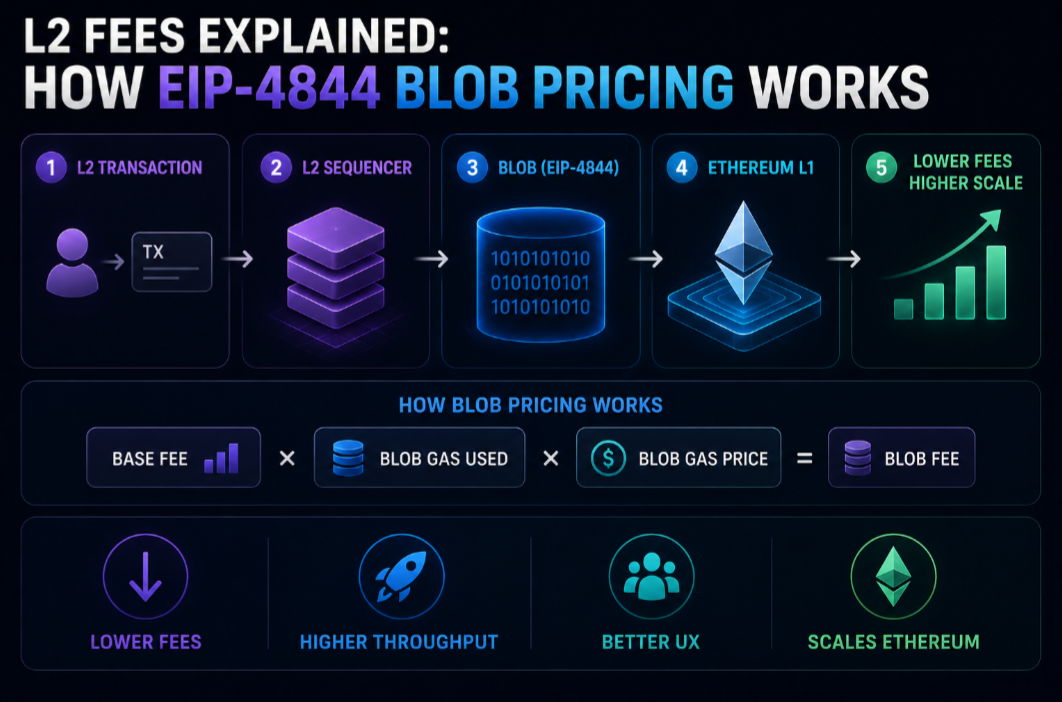
Before March 2024, rollups posted transaction data in Ethereum calldata — expensive, permanent storage read by Ethereum nodes forever. EIP-4844 (Proto-Danksharding) introduced blob-carrying transactions, a new lower-cost data lane. Blobs are large (~128 KB) data packets attached to Ethereum blocks, available for 18 days (sufficient for fraud proofs and ZK verification), then pruned. The immediate effect was a 10–20× fee reduction on all major rollups overnight.
What is EIP-4844 and how blob transactions work
EIP-4844 created a new transaction type called blob-carrying transaction (type 3). Each transaction can carry up to 2 blobs; each Ethereum block can hold up to 6 blobs (target: 3). Blobs are not accessible to the EVM — they cannot be read by smart contracts directly. They exist in a separate data layer and are referenced by a KZG commitment (a cryptographic hash).
For rollups, blobs replaced calldata as the channel for posting transaction batches to L1. The rollup sequencer posts a blob containing compressed transaction data. The rollup's smart contract on L1 stores only the KZG commitment — a 48-byte fingerprint — rather than the full data. Fraud provers on Optimistic rollups can request the full blob data from Ethereum nodes during the 18-day window. ZK rollups use the commitment to verify the proof references the correct data.
- Blob size: 128 KB per blob, up to 6 per block (target 3).
- Data retention: 18 days (~4096 Ethereum blocks), then pruned. Only the KZG commitment remains permanently.
- EVM access: Blobs are NOT accessible to smart contracts — data cannot be read on-chain.
- Base fee: Blob space has its own EIP-1559-style fee market (base fee + tip), independent of regular ETH gas.
The blob fee market: how prices are set
Blob fees follow an EIP-1559-style mechanism with a target of 3 blobs per block. If the 12-second block consistently fills fewer than 3 blobs, the blob base fee decreases. If blocks consistently use more than 3 blobs (up to the 6-blob maximum), the blob base fee increases exponentially.
The blob base fee is measured in wei and multiplies by the number of bytes in the blob. In practice, rollup costs are mostly driven by blob fees when L1 is not congested. During the first weeks after EIP-4844, blob fees were near-zero (sub-1 gwei) because blob demand was low. As more rollups and data-heavy applications adopt blobs, the fee rises.
Key formula: L2 data cost per transaction = (blob base fee × blob size) / transactions per blob. A blob at 5 gwei blob base fee containing 3,000 transactions costs roughly $0.003 per transaction in data fees. Execution fees on the L2 itself add another $0.001–0.005 depending on the chain.
How rollups calculate your transaction fee
Your total fee on an L2 like Arbitrum or Optimism has two components:
- L2 execution fee: The cost of running the transaction's computation on the L2. This is set by the L2's own gas price, which is typically very low (0.01–0.1 gwei on Arbitrum). Your gas usage × L2 gas price = execution fee.
- L1 data fee: The cost of including your transaction data in the L1 blob batch. Rollups estimate this in advance and add it to your transaction cost. On Arbitrum, this is shown as "L1 gas" in the fee breakdown.
The L1 data fee can dominate total costs during L1 congestion spikes. If blob fees spike 10× during a busy Ethereum period (e.g., a major NFT mint or airdrop claiming event), L2 fees rise proportionally. This is why L2 fees are not completely insulated from Ethereum activity — they share the data layer.
EIP-4844 vs calldata: the numbers
Before EIP-4844, rollups posted data in calldata at 16 gas per non-zero byte. A 100-transaction batch posting 10 KB of compressed data cost roughly 160,000 gas — at 30 gwei, about $0.45 at $3,000 ETH per batch, or $0.0045 per transaction. After EIP-4844, the same data in a blob at 1 gwei blob fee costs about $0.003 per batch — 10–15× cheaper.
The improvement is most dramatic during Ethereum congestion. When regular gas prices spike to 100+ gwei, calldata costs become enormous. Blob fees have their own independent market and can stay low even when regular gas is high, because different applications compete in different fee markets.
Full Danksharding: the next phase of blob scaling
EIP-4844 is Proto-Danksharding — a stepping stone. Full Danksharding will increase blob capacity from 6 per block to 64+ per block and introduce Data Availability Sampling (DAS), allowing Ethereum nodes to verify blob availability without downloading the full data. This enables node operation on commodity hardware even with 64 blobs per block.
When full Danksharding activates (expected mid-to-late 2020s on current Ethereum roadmap), rollup data availability costs will fall another 10–20×. At that point, even complex DeFi transactions on L2s will cost well under $0.001. Our Ethereum price forecast covers how full Danksharding affects ETH as a settlement asset.
Alternative data availability: EigenDA, Celestia, Avail
Some rollups use alternative DA layers instead of Ethereum blobs. Mantle uses EigenDA (built by EigenLayer) for its data availability layer. EigenDA is a decentralised storage network secured by ETH restaking via EigenLayer. The cost of EigenDA is lower than Ethereum blobs because it is not constrained by Ethereum block space. The trade-off: EigenDA introduces additional trust assumptions beyond Ethereum's base layer.
Celestia and Avail are standalone blockchains optimised entirely for data availability. They offer very high throughput and low cost for DA but introduce their own trust and decentralisation assumptions. For DeFi users, the practical impact is lower fees on chains that use these DA layers — but with a slightly weaker security model compared to pure Ethereum DA.
How to estimate your L2 transaction cost
Most L2 wallets (MetaMask, Rabby) show estimated transaction fees before you sign. For a more detailed breakdown:
- Arbitrum: arbiscan.io transaction details show "L1 Gas Used" and "L2 Gas Used" separately.
- OP Mainnet: optimistic.etherscan.io shows "L1 Fee" and "L2 Fee" breakdown per transaction.
- Fees.wtf and L2Fees.info aggregate current fee estimates across chains.
- Blob fee tracker: blobscan.com shows current blob base fee, usage, and historical data.
For high-value DeFi transactions, check the current blob fee before proceeding. During L1 quiet periods (nights, weekends in Western time zones), blob fees are typically 50–80% lower than peak business hours.
Tips for minimising L2 fees
- Batch your transactions: Execute multiple actions in one transaction using protocols that support batching (Uniswap Universal Router, Aave's batch actions).
- Transact during low-blob-fee periods: Monitor blobscan.com for fee trends. Weekend nights (UTC) are typically cheapest.
- Use chains with alternative DA: For non-critical transactions, chains using EigenDA or Celestia (Mantle, Manta) have structurally lower data fees.
- Prefer larger transaction sizes: The L1 data fee is a per-transaction cost spread across your entire transaction value. A $10 swap pays the same L1 overhead as a $10,000 swap — fees are relatively cheaper at scale.
- Use account abstraction for gas efficiency: On zkSync Era, account abstraction allows paying gas in USDC instead of ETH and batching multiple approvals + swaps in one transaction.
What happens to L2 fees when Ethereum is congested?
During extreme Ethereum congestion events — large NFT mints, major airdrops, crisis liquidations — blob fees can spike sharply. L2 fees rise proportionally because rollups must include their blob batch in a timely manner to maintain liveness. During the peak of a major DeFi liquidation cascade, L2 fees can temporarily rise 5–20× above normal.
For most retail users, this is not a problem — even a 20× spike on Arbitrum means fees go from $0.005 to $0.10, still far below mainnet. But for bots and high-frequency protocols, fee spikes matter and protocols build blob-fee awareness into their transaction scheduling.
The long-term trajectory: near-zero data costs
The combination of full Danksharding (64+ blobs per block), continuous improvements in compression algorithms (Brotli-level compression is already used by most rollups), and ZK proof efficiency gains points toward a future where L2 transactions cost well under $0.0001. The economic floor will shift from data cost to L2 execution cost — and that is being competed away by chain operators seeking users.
This article is for educational purposes only. Fee estimates are based on conditions as of 2026 and will change over time.