The fragmentation problem: why assets get stuck on individual L2s
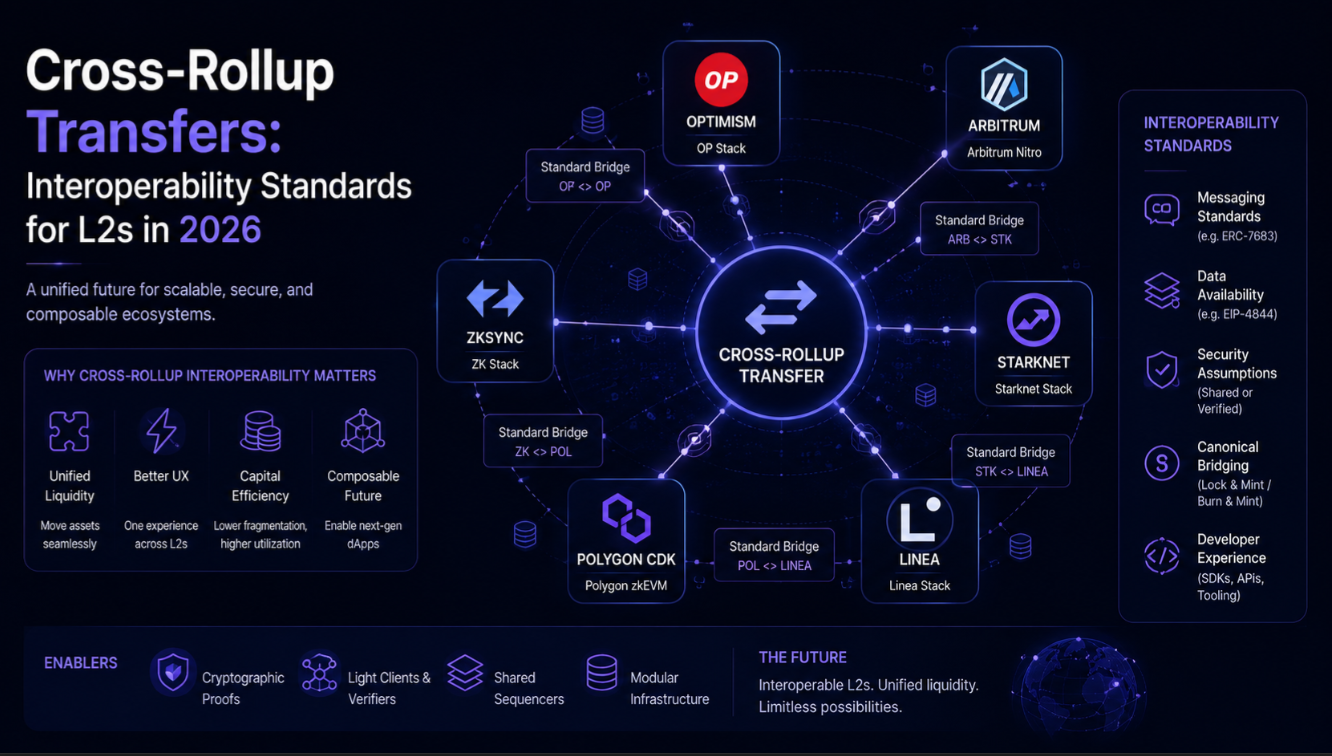
The Ethereum Layer 2 ecosystem has grown into dozens of chains — Arbitrum, Optimism, Base, zkSync Era, Starknet, Polygon zkEVM, Mantle, Scroll, Linea, and more. Each chain has its own liquidity pools, bridging infrastructure, and user base. Moving assets between them is slow, costly, and risky — a fundamental friction that limits the composability and user experience of the multi-chain world.
This fragmentation is the defining infrastructure challenge for Ethereum scaling in 2026. If every L2 is an island, the benefits of scaling are diluted — users must pick one chain and stay there, or pay significant bridging costs and delays to move between them. Interoperability standards aim to make the multi-L2 ecosystem function like a single seamless environment.
The current state: how cross-L2 transfers work today
Today, most cross-rollup transfers follow one of two paths. The first is routing through Ethereum mainnet: withdraw from L2A to L1 (7 days on Optimistic rollups), then deposit to L2B. This is the most trust-minimised route but impractical for frequent use due to time and cost.
The second path is third-party liquidity bridges: protocols like Across Protocol, Hop Protocol, and Stargate Finance maintain liquidity pools on both L2s and swap atomically. When you send 1 ETH from Arbitrum to Base via Across, a liquidity provider on Base sends you 1 ETH immediately (minus a fee), while the L2A side settles later via the canonical bridge. This is fast (1–4 minutes) but relies on liquidity provider solvency and bridge contract security.
- Native L2-to-L2 transfer (today): Must route through L1. 7+ days for Optimistic rollups, hours for ZK rollups.
- Liquidity bridges (Across, Hop, Stargate): Fast (minutes), small fee, liquidity provider risk.
- Cross-chain messaging (LayerZero, Wormhole, Axelar): Flexible token + message transfer, trust assumptions depend on relay configuration.
ERC-7683: cross-chain intents standard
ERC-7683 is an Ethereum standards proposal (co-authored by Uniswap and Across) that defines a unified cross-chain intent format. Instead of specifying exactly how a transfer should be routed, users sign an "intent" — a declaration of desired outcome: "I want 1 ETH on Base in exchange for 1 ETH on Arbitrum, within 5 minutes, at maximum 0.1% fee." Fillers (order book participants) compete to fulfil intents optimally.
ERC-7683 standardises the data structure for cross-chain intents across different bridge protocols. This means a single front-end can route to multiple fillers (Across, UniswapX, CoW Protocol) that all speak the same intent language, creating competition and better pricing for users. Across Protocol's fill model is the primary reference implementation.
The OP Superchain: native L2-to-L2 messaging
Optimism's Superchain architecture goes further than third-party bridges. The OP Stack's interoperability specification enables native L2-to-L2 message passing between chains built on the same stack (OP Mainnet, Base, Mode, Zora, and dozens of others). Instead of routing through L1, a message from Base to OP Mainnet can be verified using the shared L1 contract that both chains settle to.
Supersim, Optimism's interop testnet, enables developers to test cross-chain contracts that call each other natively. The eventual goal is "interop clusters" — groups of OP Stack chains where a transaction on one chain can atomically trigger a state change on another chain in the same block. This is the most ambitious native interop vision in deployment as of 2026.
- Shared bridge: All OP Stack chains use the same L1 bridge contract, enabling message verification without separate bridge deployments.
- Native token bridging: ETH and OP-standard tokens bridge natively between Superchain members without third-party bridges.
- Cross-chain composability: Contracts on different Superchain members can call each other atomically in future interop spec versions.
Polygon AggLayer: ZK-aggregated cross-chain liquidity
Polygon zkEVM's AggLayer provides a different approach: it aggregates ZK validity proofs from multiple chains into a single proof submitted to Ethereum. Chains that participate in AggLayer share a unified state root on L1, enabling cross-chain operations without waiting for individual chain finality.
In practical terms, AggLayer aims to make liquidity on different Polygon CDK chains interchangeable. A user on one AggLayer chain can use liquidity from another AggLayer chain without a separate bridge transaction, because both chains' states are simultaneously verified by the aggregated ZK proof. This is a genuine innovation that eliminates the "island" problem for chains within the AggLayer ecosystem.
Shared sequencers: ordering transactions across chains
Shared sequencers are a new infrastructure layer that orders transactions across multiple rollups simultaneously. Espresso Systems and Astria are the leading shared sequencer projects. By using a shared sequencer, two different rollups can coordinate transaction ordering — enabling atomic cross-chain transactions where either both sides execute or neither does.
Atomic cross-chain swaps — the ability to swap Token A on Arbitrum for Token B on zkSync Era in a single atomic transaction with no counterparty risk — become possible with shared sequencers. This is currently not available in production but is the next frontier for cross-rollup DeFi. Espresso's testnet has demonstrated atomic cross-chain MEV extraction, an early proof of concept.
LayerZero: the general-purpose cross-chain messaging layer
LayerZero is a cross-chain messaging protocol that connects over 70 chains including all major L2s. It passes arbitrary messages and token transfers using a decentralised verifier network (DVN — Decentralised Verifier Network) that can be customised by application developers. Different dApps using LayerZero can configure different security levels: more DVNs = higher security, higher cost.
Omnichain Fungible Tokens (OFT) is LayerZero's token standard for assets that exist natively across chains simultaneously. Instead of locked-and-minted bridged tokens, an OFT has a single canonical supply distributed across chains — when you send from Chain A to Chain B, tokens are burned on A and minted on B via the OFT contract. This eliminates wrapped token risk. Major protocols including Stargate Finance, Radiant Capital, and the ZRO token itself use OFT.
Wormhole: bridging beyond Ethereum
Wormhole is a cross-chain messaging protocol focused on connecting EVM chains with non-EVM ecosystems — Solana, Sui, Aptos, and others — in addition to all major Ethereum L2s. It uses a Guardian network of 19 validators to sign cross-chain messages. The $320m Wormhole bridge hack in 2022 (later replenished by Jump Crypto) forced a security redesign; the current version uses Native Token Transfers (NTT) rather than locked bridges for supported assets.
For DeFi users wanting to move assets from Solana or other non-EVM chains to L2s, Wormhole is the primary infrastructure. The zkWormhole proof system (under development) will replace the Guardian multisig with ZK validity proofs, dramatically improving the trust model.
The trust spectrum: from fully trustless to federated
Different cross-chain solutions occupy different positions on the trust spectrum:
- Most trustless: Native L1 routing (Ethereum settlement) — no additional trust, slowest.
- Near-trustless: Polygon AggLayer, OP Superchain native messaging — trust in the rollup's own security model.
- Cryptographically verified: ZK light clients (zkSync, Succinct's SP1) — ZK proofs verify source chain state on destination.
- Economic security: Across (optimistic settlement), LayerZero with many DVNs — large economic stake defends against attack.
- Federated/multisig: Legacy bridges (older Wormhole, Multichain) — depend on honest majority of a small validator set.
The trend is clear: the industry is moving from federated multisig bridges toward cryptographically verified or natively trustless interop. ZK light clients — where a destination chain runs a ZK proof verifier that checks the source chain's consensus — are the end state and are being deployed by Succinct Labs, zkBridge, and others.
What native L2 interop means for DeFi
When native interop matures — whether through OP Superchain, AggLayer, or shared sequencers — DeFi will change fundamentally. Today, a Uniswap position exists on one chain and cannot directly access liquidity from another. With native interop, a position on Arbitrum could atomically use liquidity from Optimism, Mantle, or any other interop-connected chain.
This "superfluid liquidity" model eliminates the liquidity fragmentation problem. Instead of competing for the same TVL, chains can specialise — one chain optimises for derivatives, another for lending, another for stable swaps — and share liquidity through atomic interop. Our Ethereum price forecast models how interop-driven L2 growth compounds ETH settlement demand over time.
Practical guide: the safest way to move assets cross-rollup today
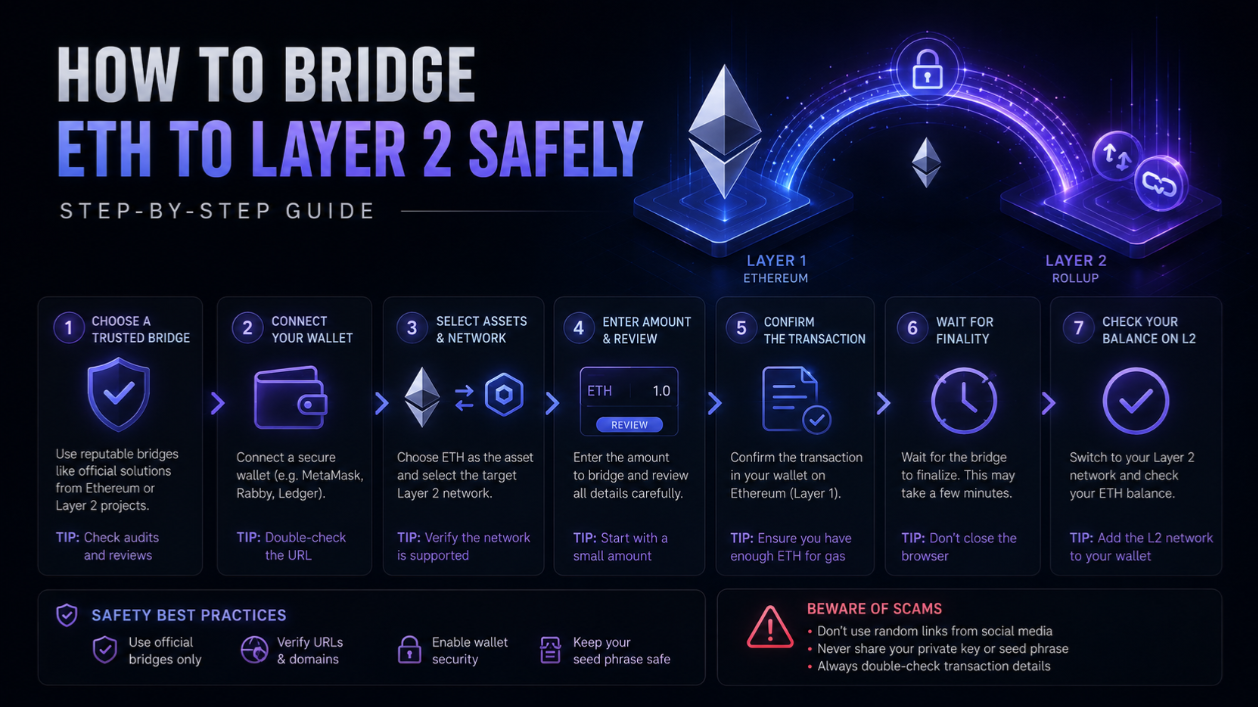
- Same ecosystem (OP Superchain): Use native Superchain bridge for ETH and OP-standard tokens — free, fast, most secure within the ecosystem.
- Arbitrum ↔ Base/OP: Use Across Protocol — most capital efficient, routes via canonical bridge for settlement, 1–4 minute completion.
- ETH ↔ zkSync/Scroll: Use canonical ZK bridge for large amounts (hours, highest security); Across for smaller amounts needing speed.
- USDC specifically: Use Circle CCTP-based bridges (Across uses CCTP internally) for native USDC without wrapped token risk.
- Non-EVM (Solana → L2): Wormhole NTT for protocol-level transfers; Allbridge or Portal for smaller amounts.
- Large amounts ($10,000+): Always use native bridges or well-audited protocols with long track records. Never use unaudited bridges for large sums.
This article is for educational purposes only. Cross-chain bridges carry smart contract risk. The interoperability standards described are evolving rapidly and may change significantly.