What are liquid staking tokens and why they exist
Liquid staking tokens (LSTs) are tokenised representations of staked ETH. When you deposit ETH into a liquid staking protocol, you receive an LST in return — a transferable ERC-20 token that accrues staking rewards and can be used across DeFi while your underlying ETH earns consensus-layer yield. LSTs solve the fundamental tension of proof-of-stake: your ETH earns rewards but is normally locked and illiquid.
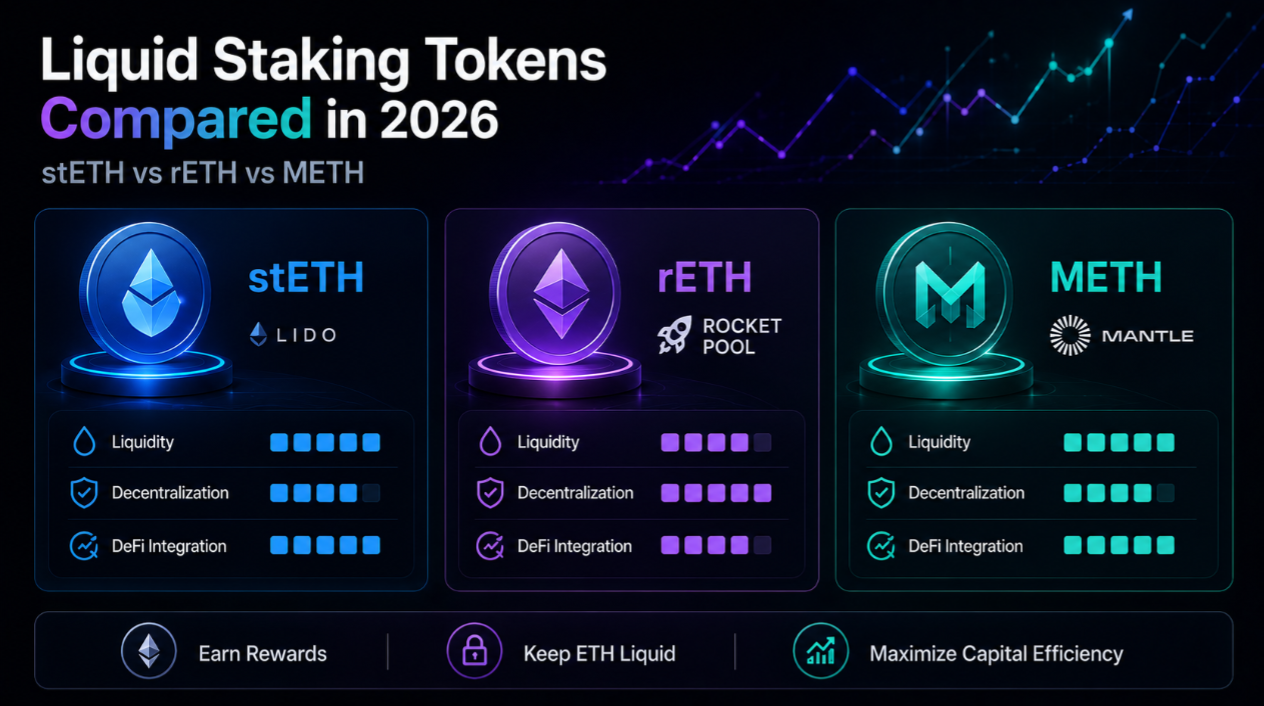
The three largest LSTs in 2026 are stETH (Lido), rETH (Rocket Pool), and METH (Mantle ETH). Together they represent over 60% of all staked ETH. Each takes a different approach to decentralisation, fee structure, and reward accrual mechanics. Choosing the right LST depends on your DeFi strategy, risk tolerance, and views on validator decentralisation.
stETH: the market leader by Lido
Lido DAO is the largest liquid staking protocol with over $20 billion in staked ETH as of 2026. When you deposit ETH to Lido, you receive stETH (staked ETH) at a 1:1 ratio. stETH is a rebasing token — your balance increases daily as staking rewards accrue. If you deposit 10 ETH, your wallet balance grows to 10.04 ETH, 10.08 ETH, etc. over time.
stETH is the most liquid LST. It has deep pools on Curve (the ETH/stETH pool is among the largest on the protocol), is accepted as collateral on Aave, MorphoBlue, and Euler, and is supported on virtually every DeFi protocol. This liquidity is its primary advantage: you can exit a large stETH position quickly with minimal slippage at any time without waiting for validator exits.
The trade-offs of stETH are concentration risk and the rebasing mechanism. Lido runs a curated set of professional node operators, which critics argue creates centralisation (Lido has held 30%+ of all staked ETH at times). The rebasing mechanic can also cause tax complications in some jurisdictions, as each daily rebase may be a taxable event. wstETH (wrapped stETH) is a non-rebasing version that addresses the DeFi composability and tax issues — the exchange rate appreciates instead of balance increasing.
rETH: the decentralisation-first alternative by Rocket Pool
Rocket Pool takes a different approach: anyone can become a node operator by depositing 8 ETH (down from 16 ETH after the Atlas upgrade) and an equivalent value in RPL tokens as insurance collateral. The protocol pairs operator deposits with user deposits to form complete 32 ETH validator sets. This means rETH is backed by thousands of independent mini-pool operators, far more decentralised than Lido's curated set.
rETH is a non-rebasing exchange rate token. Your rETH balance stays constant; instead the ETH-per-rETH exchange rate increases over time as rewards accumulate. This makes it simpler for tax accounting (no daily income events — only a gain/loss on the exchange rate difference when you exit) and easier for smart contract integration.
rETH typically yields slightly less than stETH because Rocket Pool node operators earn a commission from the pooled deposit yield (their reward for putting up the 8 ETH + RPL). In exchange for this fee, users get more decentralised validator backing. Read the full Lido review and compare it to Rocket Pool's approach on our staking ratings page.
METH: Mantle's institutional-grade LST
METH is Mantle's liquid staking token for Ethereum, launched in late 2023 and rapidly growing to become the third-largest LST. METH is backed by a diversified set of professional node operators selected by the Mantle governance. It is a non-rebasing exchange rate token, similar to rETH in mechanics.
METH's competitive advantage is its integration with the Mantle L2 ecosystem — METH is deeply integrated into Mantle DeFi for leveraged staking, lending, and liquidity provision. For users already operating on the Mantle network, METH offers tighter integrations and additional yield boosts through Mantle's protocol incentives. For Ethereum mainnet DeFi, its liquidity remains thinner than stETH or rETH.
cbETH and ankrETH: other notable LSTs
Coinbase's cbETH is the most regulated LST — issued by a US-listed public company, making it attractive to institutions and US users who prefer a known counterparty. cbETH charges a 25% commission on staking rewards, the highest of any major LST, but offers the most compliance-friendly option. It is non-rebasing.
ankrETH (Ankr) and frxETH (Frax) are smaller but notable LSTs offering competitive yields and integration with specific DeFi ecosystems. frxETH in particular has deep integration with Curve and Convex, making it popular for yield stacking strategies.
Comparing LST yields in 2026
- stETH (Lido): ~3.8% APR after Lido's 10% protocol fee. Daily rebasing. Deepest liquidity of any LST.
- rETH (Rocket Pool): ~3.6–3.7% APR. Non-rebasing. Variable based on node operator commission (average ~14% of yield).
- METH (Mantle): ~4.0–4.2% APR with Mantle incentives included. Non-rebasing. Best used within the Mantle ecosystem.
- cbETH (Coinbase): ~3.1–3.2% APR after 25% commission. Non-rebasing. Most regulated.
- Solo staking: ~4.0–4.5% APR. Keeps the full yield. Requires 32 ETH and technical operation.
LST liquidity and the depeg risk
LSTs are only useful if they maintain their peg to ETH. In May 2022, stETH briefly traded at a 6% discount to ETH when Celsius was forced to liquidate large stETH positions to meet user withdrawals. Post-Shapella (April 2023), stETH discounts have stayed within 0.1–0.3% of parity because validators can now fully exit and redeem.
In extreme market conditions, if many holders simultaneously try to exit through the secondary market (rather than validator exit queues), temporary discounts remain possible. The exit queue adds friction: during peak withdrawal demand, waits can stretch to weeks. For large institutional positions, the secondary market liquidity of stETH remains its most critical attribute.
Using LSTs in DeFi
The most common DeFi strategies with LSTs in 2026 include:
- Collateral on Aave/MorphoBlue: Deposit wstETH as collateral, borrow USDC at 4–6% APR, use the borrowed USDC to buy more ETH — a leveraged staking loop.
- Curve/Balancer LP: Provide liquidity in stETH/ETH or rETH/ETH pools to earn swap fees on top of staking yield.
- EigenLayer restaking: Deposit stETH or rETH into EigenLayer to secure additional protocols (AVSs) and earn restaking rewards on top of base staking yield.
- Pendle PT/YT splitting: Use Pendle Finance to split the yield component from the principal, allowing fixed-rate staking or leveraged yield speculation.
Risks specific to liquid staking
Beyond standard staking risks (slashing, smart contract bugs), LSTs introduce additional layers of risk:
- Smart contract risk: Both the staking protocol and any DeFi protocol you use the LST in carry independent smart contract risk. A bug in Lido's contracts or in Aave could affect your position.
- Oracle risk: DeFi protocols using LSTs as collateral rely on price oracles. Oracle manipulation or failure could trigger unfair liquidations.
- Governance risk: Protocol parameters (fees, node operator set, slashing coverage) are governed by token holders and can change.
- Regulatory risk: Regulators in the US and EU have scrutinised liquid staking as a potential unregistered securities offering. Regulatory changes could affect protocol operations.
LST yields and protocol details change rapidly. Always verify current rates on-chain or via the official protocol dashboards. This is not financial advice.