Why compare Cardano, Solana, and Cosmos staking
Ethereum dominates the liquid staking narrative, but Cardano, Solana, and Cosmos each offer staking mechanics that differ fundamentally from Ethereum's validator model. They vary in minimum stake requirements, lock-up periods, slashing rules, delegation mechanics, and typical yields. Understanding these differences helps multi-chain investors maximise yield and minimise risk across their portfolios.
All three use delegated proof-of-stake (DPoS) or liquid proof-of-stake in some form, meaning most token holders do not run nodes but delegate to operators who do. The staking experience is far more accessible than Ethereum solo staking — no 32 ETH minimum, no technical setup. The trade-offs are different: more centralisation around top validators, different governance implications, and varying slashing (or no-slashing) policies. Compare these to the Lido DAO and EigenLayer ecosystems for a full cross-chain perspective.
Cardano staking: no lock-up, no slashing
Cardano (ADA) uses a delegated proof-of-stake system called Ouroboros. ADA holders delegate their stake to stake pools — there is no lock-up period, no slashing, and no technical requirement. Delegated ADA remains in your wallet at all times; you are simply directing your staking power to a pool of your choice. Rewards are distributed at the end of each 5-day epoch.
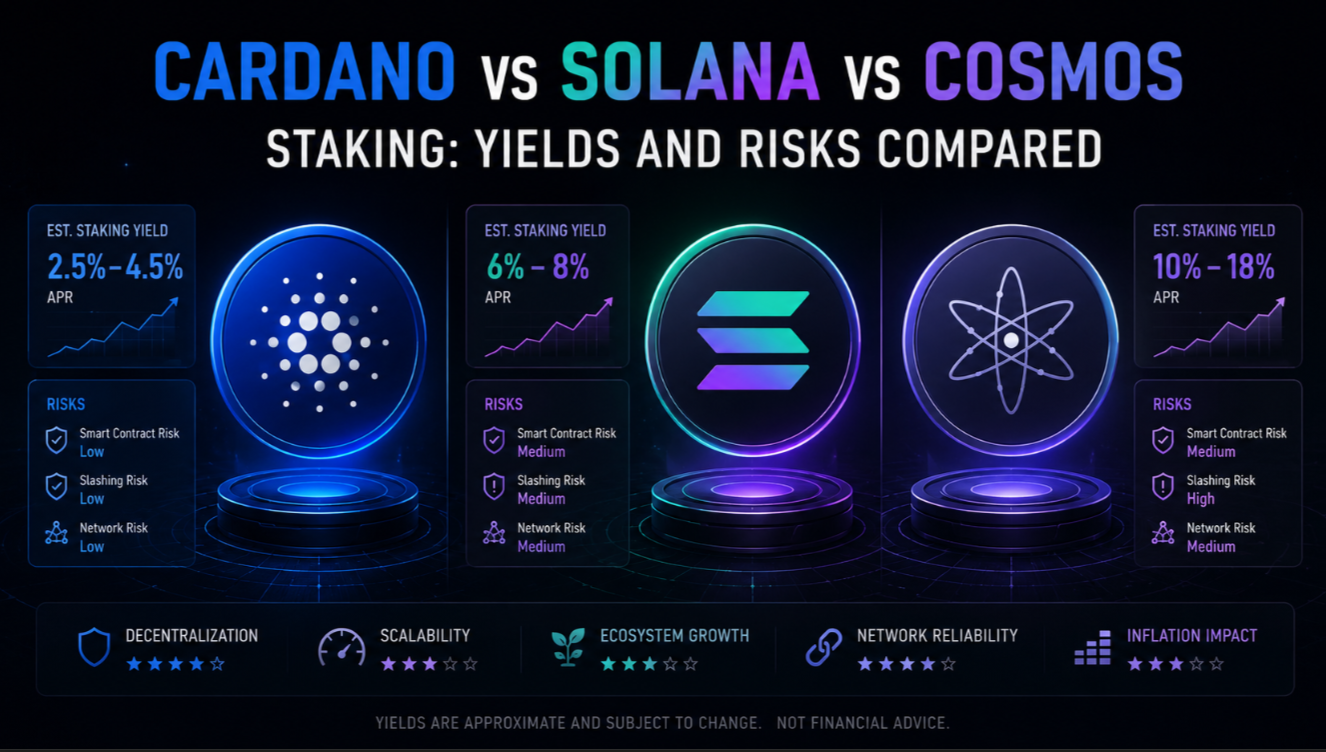
Cardano staking yield in 2026 sits at approximately 3.0–4.5% APR. The yield varies by pool performance, pool size, and protocol-level parameters. The protocol automatically penalises over-saturated pools (pools above the k-parameter size threshold earn lower rewards per ADA delegated), encouraging stake distribution across many pools.
- Minimum stake: No minimum. Even 1 ADA can be delegated.
- Lock-up: None. You can redelegate or undelegate at any time; changes take effect after 2 epochs (~10 days).
- Slashing: None. Cardano's protocol does not slash delegator funds for pool misbehaviour.
- Reward timing: First rewards arrive after 3 epochs (~15 days) from initial delegation due to the epoch cycle.
- Typical yield: 3.0–4.5% APR, paid in ADA.
The absence of slashing in Cardano is a deliberate design choice. Instead of punishing misbehaving pools, the protocol uses economic incentives: pools that underperform or go offline produce fewer blocks and earn fewer rewards, indirectly penalising delegators. This creates softer risk compared to Ethereum but means large-scale attacks are easier (no catastrophic downside for a malicious pool operator beyond lost future rewards).
Cardano liquid staking: DJED, Liqwid, and emerging LSTs
Cardano's native staking is already liquid (no lock-up), but traditional LSTs have been slower to emerge compared to Ethereum. The Liqwid Finance protocol issues qADA — a tokenised staked ADA position that earns yield while remaining usable as DeFi collateral. Wingriders and Minswap offer liquidity provision with ADA staking rewards layered on top.
Cardano DeFi TVL remains substantially smaller than Ethereum or Solana, limiting the utility of LSTs for sophisticated strategies. The ecosystem is growing rapidly after the Chang hard fork in 2024 enabled on-chain governance.
Solana staking: high yield, but with slashing
Solana (SOL) uses a delegated proof-of-stake model where token holders delegate to validators. Unlike Cardano, Solana does implement slashing for provable double-signing, though as of 2026 the slashing mechanism is still being progressively activated and not all violations trigger the full penalty. The network has 1,900+ active validators, one of the highest counts among major PoS networks.
Solana staking yields in 2026 are approximately 6.5–8.5% APR, significantly higher than Ethereum or Cardano. This reflects Solana's current token inflation schedule, which distributes a defined issuance rate among stakers. As the inflation rate decreases per schedule (targeting 1.5% terminal inflation by ~2031), yields will gradually compress.
- Minimum stake: Minimum ~0.001 SOL (effectively none) for delegation.
- Lock-up (warm-up/cool-down): Stake activation and deactivation both require one epoch (~2–3 days) to become effective. Not a lock-up per se, but withdrawal is not instant.
- Slashing: Implemented but still in phased activation. Currently active for double-signing on mainnet. Major validators have not been slashed as of 2026.
- Reward timing: Rewards credited at end of each epoch (~2.5 days). Compounding is not automatic — you must manually stake additional rewards or use an LST.
- Typical yield: 6.5–8.5% APR (inflation-driven), paid in SOL.
Solana liquid staking: mSOL, jitoSOL, and bSOL
Solana has a mature liquid staking ecosystem. The major LSTs are mSOL (Marinade Finance), jitoSOL (Jito Labs, includes MEV rewards), and bSOL (BlazeStake). All three are non-rebasing exchange rate tokens, similar to rETH.
jitoSOL is notable for including MEV rewards from Jito's block engine, giving it a yield premium over basic delegation (typically 0.3–0.8% additional APR). The trade-off is that jitoSOL validators participate in a centralised MEV relay, raising some concerns about validator set homogeneity and sandwich attack facilitation.
Solana LSTs are deeply integrated into the Solana DeFi stack — accepted as collateral on Solend and MarginFi, providing liquidity in Orca and Raydium pools. The combination of high base yield + DeFi strategies makes Solana one of the most productive staking ecosystems in 2026. Compare staking options on our staking ratings page.
Solana network risk: historical outages
Solana's high performance comes with a history of network instability. The network suffered multiple multi-hour outages in 2021–2022 due to memory exhaustion and spam floods. While significant engineering improvements have reduced downtime substantially since 2023, Solana remains a higher-risk network infrastructure compared to Ethereum from a validator's perspective.
Stakers do not directly bear financial loss from outages (no slashing for downtime), but LST holders using Solana LSTs as DeFi collateral face liquidation risk if prices drop during an outage when they cannot top up collateral or exit positions.
Cosmos staking: the interchain hub model
Cosmos Hub (ATOM) uses Tendermint BFT delegated proof-of-stake with a maximum validator set of 180 active validators. Delegating ATOM to a validator earns staking rewards and governance voting power. Unlike Cardano, Cosmos does implement slashing — double-signing results in a 5% slash of delegated stake, and extended downtime triggers a 0.01% slash (far lower).
The critical feature of Cosmos is the unbonding period: 21 days. Delegated ATOM cannot be transferred or sold for 21 days after initiating an undelegation. This is a genuine liquidity lock-up and a significant UX trade-off compared to Cardano or Ethereum LSTs.
- Minimum stake: No minimum.
- Lock-up: 21-day unbonding period — hard lock. Liquid staking via Stride or pSTAKE removes this.
- Slashing: 5% slash for double-signing (affects delegators proportionally). 0.01% for downtime after jailing threshold.
- Reward timing: Rewards accumulate continuously and can be claimed at any time.
- Typical yield: 14–20% APR in ATOM (highly variable, driven by inflation and validator commission rates).
Cosmos liquid staking: stATOM, qATOM
The 21-day unbonding period makes Cosmos one of the most compelling use cases for liquid staking. Stride (stATOM) and Quicksilver (qATOM) allow staking ATOM while maintaining liquidity. stATOM trades freely and is usable as DeFi collateral across the Cosmos IBC ecosystem — in Osmosis liquidity pools, on Mars Protocol for lending, and in various Cosmos chain DeFi apps.
Cosmos liquid staking unlocks the full yield while eliminating the unbonding lock. The trade-offs are smart contract risk (Stride and Quicksilver are additional protocol layers) and the fact that stATOM or qATOM may trade at a discount during market stress if unbonding queues lengthen.
Yield and risk comparison table
- Cardano ADA: 3.0–4.5% APR. No slashing. No lock-up. Low technical barrier. Low DeFi composability.
- Solana SOL: 6.5–8.5% APR (inflation-driven). Slashing active. 2–3 day epoch cooldown. Rich DeFi ecosystem. Historical network instability.
- Cosmos ATOM: 14–20% APR. Double-sign slashing 5%. 21-day unbonding. High yield but highest inflation dilution. Liquid staking removes unbonding risk.
- Ethereum ETH: 3.5–4.5% APR solo. Slashing for double-signing only. No lock-up post-Shapella (via withdrawal queue). Deepest LST ecosystem.
Which chain is best for staking in 2026
There is no single best chain — the choice depends on your portfolio and goals:
- Risk-averse holders: Cardano for no slashing and no lock-up; Ethereum via Lido for deepest LST liquidity.
- Yield maximisers: Cosmos ATOM via Stride for highest APR (but assess ATOM's inflation dilution), or Solana jitoSOL for high real yield.
- DeFi participants: Solana or Ethereum — deepest lending and liquidity markets for LSTs.
- Governance participants: Cosmos Hub and Cardano (post-Chang) — the most active on-chain governance ecosystems in 2026.
For deeper analysis of specific staking providers, compare our ratings at staking ratings, and see the full Lido review and Coinbase review for the two largest staking providers.
Staking yields are subject to change based on network inflation schedules, total staked supply, and protocol governance decisions. This content is for educational purposes only and not financial advice.