What are rollups and why Ethereum needs them
Ethereum mainnet processes roughly 15–30 transactions per second. At peak demand, gas fees climb into tens or even hundreds of dollars per transaction, pricing out everyday users. Rollups solve this by executing transactions off-chain in batches and posting only compressed proof data back to Ethereum. The result: 10–100× more throughput at a fraction of the cost, while inheriting Ethereum's security guarantees.
Two major rollup architectures have emerged as the dominant scaling approaches: Optimistic rollups and Zero-Knowledge (ZK) rollups. Both inherit Ethereum's base-layer security, but they differ fundamentally in how they prove the validity of off-chain execution. Understanding that difference is essential for choosing the right chain for your use case.
How Optimistic rollups work
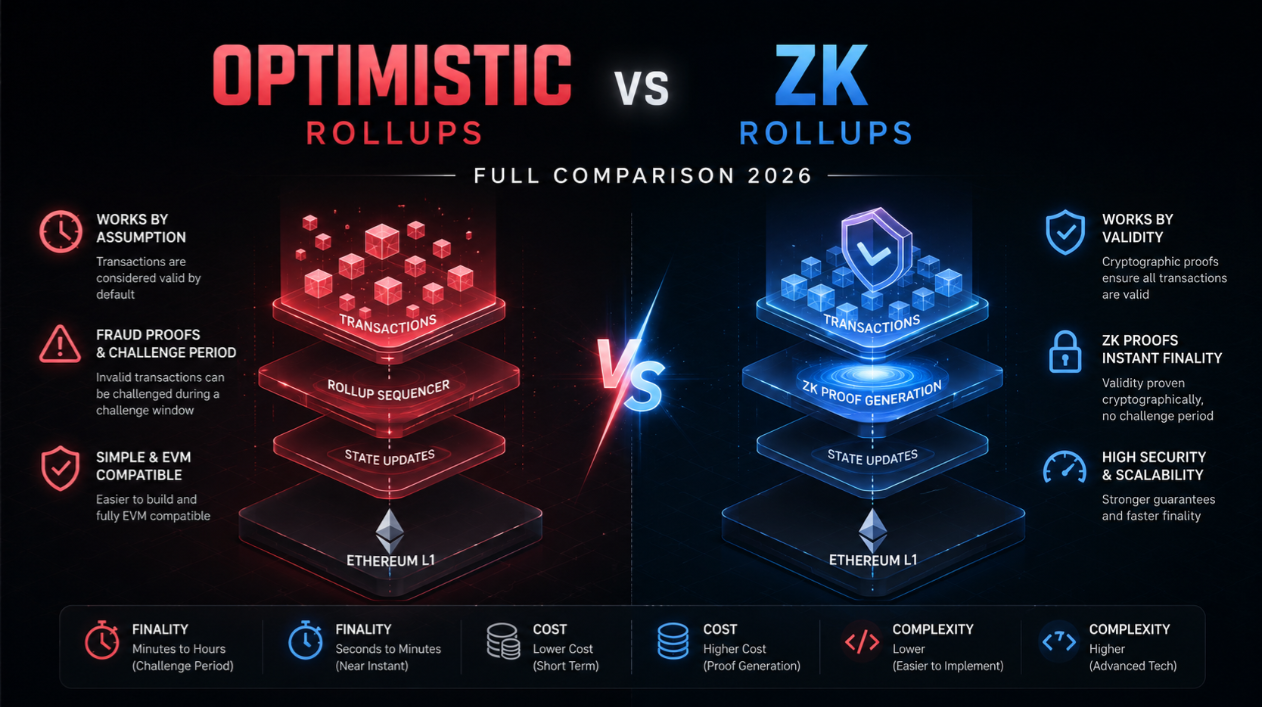
Optimistic rollups — used by Arbitrum and Optimism — take an "innocent until proven guilty" approach. The sequencer posts transaction batches to Ethereum and declares the resulting state root as valid. No immediate proof is generated. Instead, a seven-day challenge window opens during which anyone can submit a fraud proof if they detect an invalid state transition.
During the challenge window, a verifier runs the disputed transaction locally, generates the fraud proof, and submits it to an Ethereum smart contract. If the proof is valid, the fraudulent state root is rejected and the sequencer is penalised (slashed). If no fraud proof is submitted within seven days, the state is considered final and withdrawals become available.
- Withdrawal time: 7 days to L1 (unless using a fast bridge with liquidity providers).
- Proof type: Fraud proof — generated only when challenged.
- EVM compatibility: Very high — Arbitrum One and Optimism mainnet are near-identical to EVM, enabling easy contract migration.
- Current examples: Arbitrum One, OP Mainnet, Base, Blast, Mantle.
How ZK rollups work
ZK rollups use cryptographic validity proofs — most commonly SNARK or STARK proofs — to mathematically prove that every transaction in a batch was executed correctly. The proof is generated off-chain by a prover and verified on-chain by an Ethereum smart contract in a single transaction. No challenge window is needed because the math guarantees correctness.
The cryptographic proof compresses the verification of thousands of transactions into a single constant-size proof. Ethereum's verifier contract checks this proof in one transaction. If the proof is valid, the state root is immediately final. Withdrawals can complete within minutes rather than days.
- Withdrawal time: Minutes to hours (proof generation time + L1 finality).
- Proof type: Validity proof (SNARK/STARK) — generated for every batch.
- EVM compatibility: Varies — zkEVM chains (zkSync Era, Polygon zkEVM, Scroll) aim for full bytecode compatibility; others require custom compilers.
- Current examples: zkSync Era, Polygon zkEVM, Scroll, Starknet, Linea.
Security model: fraud proofs vs validity proofs
The deepest difference between the two architectures is trust. Optimistic rollups are secure as long as at least one honest verifier is watching and willing to submit fraud proofs within the challenge window. In practice this means you must trust that someone is monitoring the chain. The seven-day window exists precisely to give that watcher enough time.
ZK rollups require zero trust in any external party. The cryptographic proof is sufficient — if the Ethereum verifier accepts the proof, the state is mathematically correct. There is no monitoring requirement, no challenge period, and no assumption of honest actors beyond the cryptographic assumptions underlying the proof system itself.
ZK rollups offer a fundamentally stronger security model: mathematical certainty replaces economic incentives. But that mathematical certainty comes at a computational cost.
Transaction finality and withdrawal times
For users, finality matters most when withdrawing back to Ethereum mainnet. On an Optimistic rollup, native withdrawals require waiting the full seven-day challenge window. Third-party bridges (Hop Protocol, Across, Synapse) offer fast exits by fronting liquidity and charging a small fee — typically 0.04–0.1% — in exchange for immediate ETH on L1.
On ZK rollups, the withdrawal delay is reduced to proof generation time plus L1 confirmation: typically 15 minutes to a few hours for SNARK-based systems. Starknet's STARK proofs can take longer to generate but offer post-quantum security. As proof generation hardware improves, ZK withdrawal times are shrinking toward near-real-time.
EVM compatibility: the developer experience gap
EVM compatibility is the practical measure of how easy it is to deploy existing Ethereum contracts without modifications. Optimistic rollups win here today: Arbitrum's Nitro stack and OP Stack are bytecode-compatible with the EVM — you can deploy any Solidity contract with zero changes. This is why most major DeFi protocols launched on Arbitrum and Optimism first.
ZK rollups have historically lagged on EVM compatibility because generating ZK proofs for arbitrary EVM opcodes is computationally expensive and technically difficult. zkSync Era, Polygon zkEVM, and Scroll have all released zkEVM implementations that aim for equivalence at different levels of the EVM specification. As of 2026, zkEVM compatibility has improved dramatically, but edge cases and precompile gaps still exist on some chains.
Gas costs and blob pricing in 2026
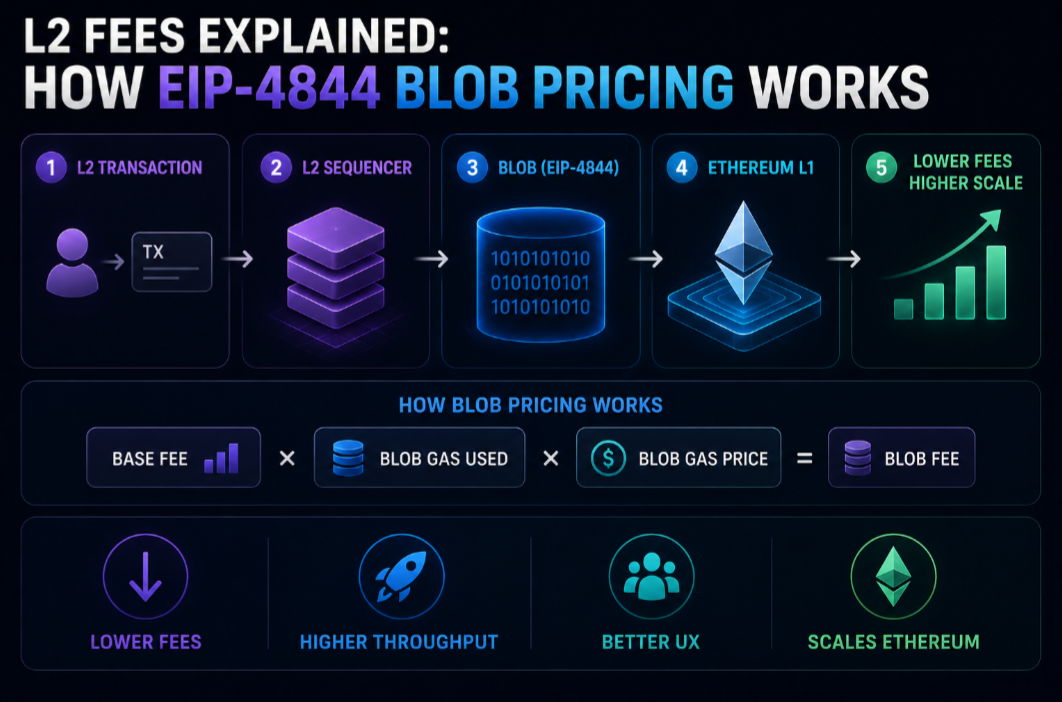
EIP-4844 (Proto-Danksharding), activated in March 2024, introduced blob transactions — a new, cheaper data lane on Ethereum specifically for rollup data. Blobs are large data packets (~128 KB) that are pruned from Ethereum nodes after ~18 days but are available long enough for fraud proofs and proof verification. Rollup costs dropped 10–20× overnight after EIP-4844 activation.
In 2026, both Optimistic and ZK rollups use blob space for data availability. Optimistic rollups post raw transaction data in blobs (so fraud provers can reconstruct state). ZK rollups post proof data and compressed state diffs. At typical blob prices, a token swap on Arbitrum costs $0.001–0.01, and on zkSync Era a similar range. See our detailed guide on L2 fee mechanics and blob pricing for a full breakdown.
Decentralisation and sequencer risk
In 2026, most rollups still rely on a single, centralised sequencer operated by the team. The sequencer orders transactions, can technically censor users (though escape hatches exist on most chains), and is a single point of failure. If the sequencer goes offline, no new transactions are processed until it recovers.
Decentralising the sequencer is a top priority across both rollup types. Arbitrum's decentralised sequencer roadmap, Optimism's Superchain model with shared sequencing, and Espresso Systems' shared sequencer all aim to distribute this role. ZK rollups face the same centralisation challenge — proving is also currently centralised on most chains.
Ecosystem and liquidity: where protocols live in 2026
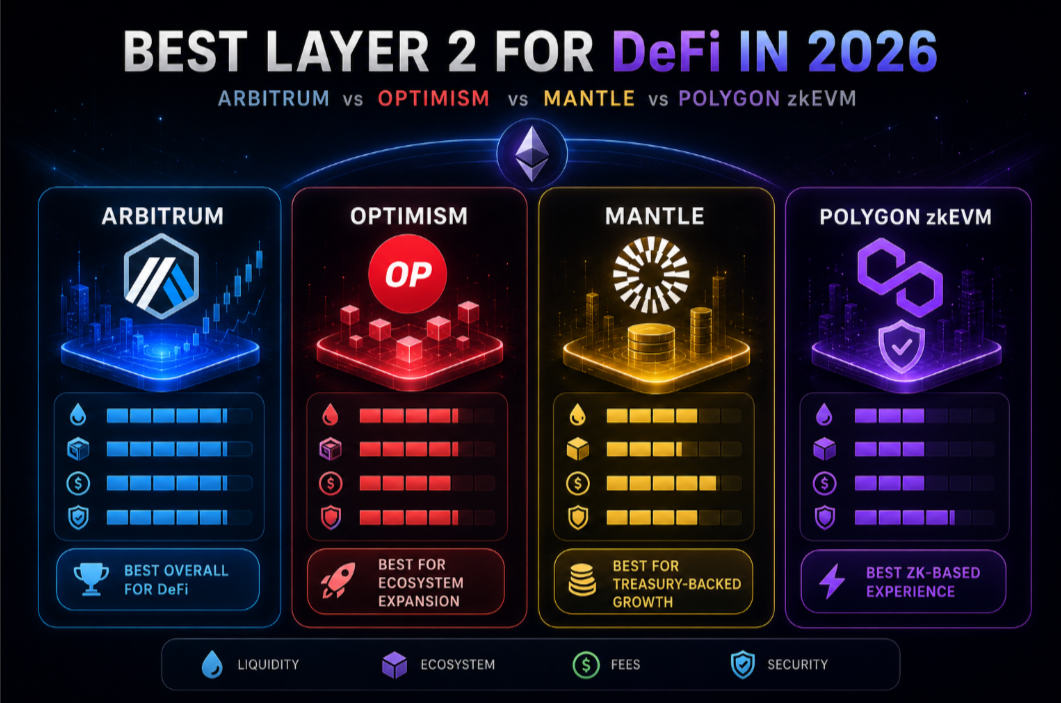
Arbitrum remains the largest L2 by TVL in 2026, hosting over $20 billion across lending protocols, DEXs, and perpetuals. Optimism's Superchain (OP Mainnet + Base + Mode + Zora) collectively handles more transactions than Arbitrum. zkSync Era and Scroll have grown rapidly among privacy-conscious users and developers.
Polygon zkEVM benefits from Polygon's existing ecosystem and AggLayer technology, which aggregates ZK proofs across chains for unified cross-chain liquidity. Mantle has captured significant TVL through its treasury-backed incentive programmes.
When to use Optimistic vs ZK rollups
- Use Optimistic rollups (Arbitrum, OP) when: You need the broadest protocol and tooling support, want near-identical EVM behaviour, are willing to use fast bridges for withdrawals, or are migrating an existing Ethereum dApp.
- Use ZK rollups (zkSync, Scroll, Starknet) when: Fast finality and native withdrawals matter (exchanges, payment apps), you value the stronger security model, or you are building new applications that can leverage ZK-native features.
- Long-term outlook: ZK proofs are becoming faster and cheaper. As zkEVM compatibility matures and proof generation cost falls, ZK rollups are expected to overtake Optimistic rollups on most metrics. Full Danksharding will expand blob capacity dramatically, benefiting both architectures.
The road ahead: full Danksharding and ZK coprocessors
Ethereum's full Danksharding roadmap will expand blob capacity from 3–6 blobs per block to 64+, reducing data availability costs by another 10–20× for all rollups. ZK coprocessors — systems that generate proofs for arbitrary off-chain computations and anchor results on-chain — will extend ZK technology beyond transaction validity into complex data processing and AI inference.
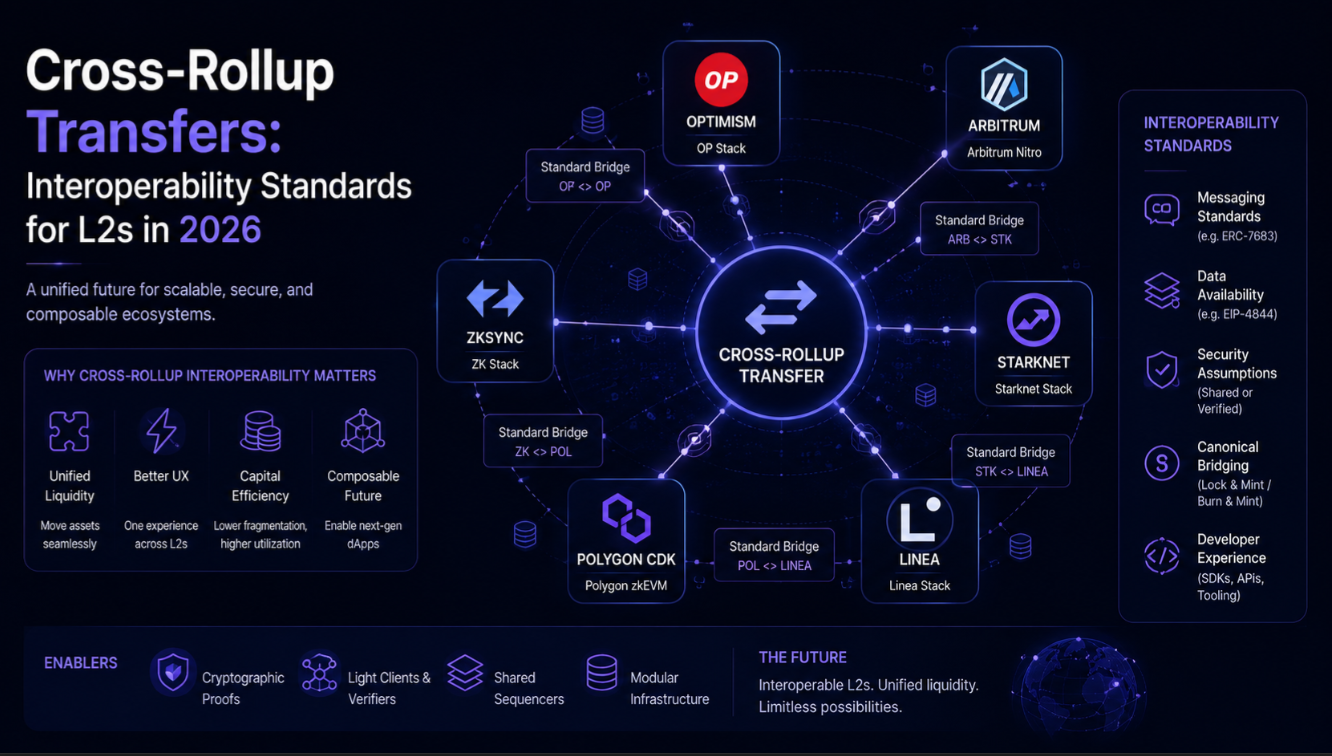
The long-term vision is a multi-rollup ecosystem connected by interoperability standards (see our guide on cross-rollup transfers and interop standards) where assets and users move freely between Optimistic and ZK chains. The divide between the two architectures may eventually narrow as hybrid approaches (Optimistic proofs with ZK escape hatches) emerge.
Summary: Optimistic vs ZK rollups at a glance
- Security: ZK (mathematical proof) > Optimistic (economic incentive + watchers)
- EVM compatibility: Optimistic (full, today) > ZK (improving, most chains near-full)
- Withdrawal time: ZK (minutes) vs Optimistic (7 days native, fast bridges available)
- Proof cost: Optimistic (low, no proofs unless challenged) vs ZK (higher, every batch)
- Ecosystem maturity: Optimistic (larger today) vs ZK (fast-growing, catching up)
- Long-term trajectory: ZK expected to dominate as proof costs fall
This article is for educational purposes only. Not financial advice. Always research before making decisions about which chain to use or invest in.