Why tokenized Treasuries became the breakout RWA product
When US interest rates climbed above 5% in 2023-2024, a simple arbitrage opened up inside DeFi. Stablecoins sitting in lending protocols or DAO treasuries earned near-zero yield, while US Treasury bills — the safest dollar-denominated instrument on earth — returned 5%+ per year. Tokenized T-bill products collapsed the gap: a DeFi user could hold on-chain dollar exposure that automatically accrued real sovereign yield without leaving their wallet. By 2026, tokenized Treasuries represent the single largest RWA category, with over $8 billion in on-chain value.
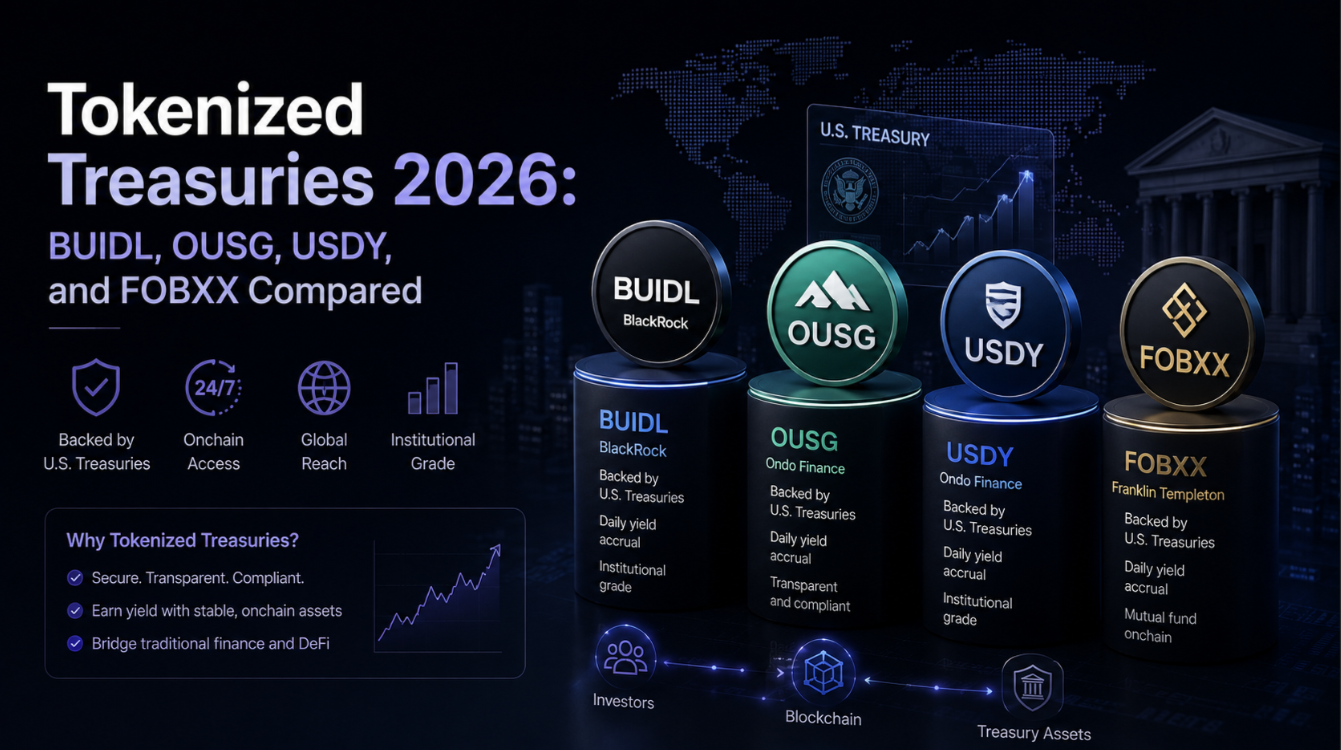
Three products dominate the category: BlackRock BUIDL, Ondo Finance OUSG and USDY, and Franklin Templeton FOBXX. Each uses a different structure, targets a different user type, and offers different trade-offs on yield, liquidity, and DeFi composability. This article compares them head-to-head.
BlackRock BUIDL: the institutional benchmark
BlackRock USD Institutional Digital Liquidity Fund (BUIDL) is a tokenized money-market fund launched on Ethereum in March 2024 in partnership with Securitize. It invests exclusively in US Treasury bills, repo agreements, and cash. The fund targets a stable $1.00 NAV per token and distributes accrued yield daily as new tokens minted to holders' wallets.
- Minimum investment: $5 million — BUIDL is explicitly institutional.
- Eligible investors: Qualified purchasers (US) and equivalent international classifications. Full KYC/AML required via Securitize.
- Yield mechanism: Daily yield accrual rebased as additional BUIDL tokens. No separate yield distribution — your balance grows.
- Liquidity: Same-day redemption into USDC via an on-chain liquidity facility funded by Circle. This is a key differentiator — most tokenized funds require T+1 or T+2 redemption.
- Chain: Ethereum mainnet (ERC-20, permissioned).
- AUM: Over $2.5 billion as of early 2026, making it the largest single tokenized fund.
BUIDL's significance is symbolic as much as practical. BlackRock is the world's largest asset manager. Its entry into tokenized funds signalled to traditional finance that blockchain-based securities infrastructure was production-ready. Several major banks now use BUIDL as collateral for derivatives and repo transactions.
Ondo Finance OUSG: the DeFi bridge
Ondo Finance's OUSG (Ondo Short-Term US Government Bond Fund) is a tokenized fund investing primarily in the iShares Short Treasury Bond ETF (SHV) on BlackRock's platform. Where BUIDL targets institutions, OUSG was designed to bridge traditional Treasury exposure into DeFi.
- Minimum investment: $5,000 for eligible investors — much lower than BUIDL.
- Eligible investors: Accredited investors (US) and non-US persons. KYC via Ondo's compliance layer.
- Yield mechanism: Rebasing: OUSG supply increases daily to reflect accrued yield. NAV stays near $1.00.
- Chains: Ethereum, Polygon, Solana, Mantle — multi-chain deployment for DeFi access.
- DeFi integration: OUSG can be used as collateral in Ondo's own Flux Finance lending protocol. A curated DeFi composability layer.
For Ondo token holders and price forecasts, see our Ondo Finance price forecast and Ondo market data. The ONDO governance token gives holders influence over Ondo's product roadmap and fee parameters.
Ondo USDY: the yield-bearing stablecoin
USDY (US Dollar Yield Token) is Ondo's second product and structurally different from OUSG. Rather than a rebasing fund share, USDY is designed as a yield-bearing stablecoin backed by short-dated US Treasuries and bank demand deposits. Its price appreciation (rather than rebasing) accumulates yield over time.
- Structure: Senior secured notes issued by a bankruptcy-remote SPV. T-bills and deposits are the collateral. The senior/subordinated structure provides extra protection to USDY holders.
- Minimum: $500 — the most accessible tokenized Treasury product for retail-adjacent users.
- Non-US users: USDY is explicitly available to non-US persons without accreditation requirements in eligible jurisdictions — broadening access beyond OUSG.
- DeFi composability: Because USDY appreciates in price (rather than rebasing), it behaves more like a standard ERC-20 for DeFi protocols. It has been integrated into Pendle, Morpho, and several Solana DeFi protocols.
Franklin Templeton FOBXX: the oldest tokenized fund
Franklin OnChain US Government Money Fund (FOBXX) launched in 2021 on Stellar, making it the first US-registered mutual fund to use a public blockchain for transaction processing. It later expanded to Polygon and Base.
- Structure: A fully registered SEC mutual fund — the same legal structure as any money-market fund in a brokerage account.
- Minimum: $20 investment minimum — the lowest of any major tokenized Treasury product.
- Yield: Targets the SEC 7-day yield benchmark for government money-market funds — currently around 4.8–5.1%.
- Liquidity: Daily redemption at NAV, standard mutual fund rules apply.
- Access: US investors only (mutual fund structure). Available through Franklin Templeton's Benji app.
FOBXX is notable for being the most regulated tokenized fund — a genuine mutual fund operating under the Investment Company Act of 1940, not a private placement. This makes it less flexible for DeFi integration but more legally robust for US retail investors.
BUIDL vs OUSG vs USDY vs FOBXX: side-by-side comparison
- Minimum investment: BUIDL $5M · OUSG $5K · USDY $500 · FOBXX $20
- Target investor: BUIDL institutional · OUSG accredited DeFi · USDY global retail · FOBXX US retail
- Legal structure: BUIDL private fund · OUSG private fund · USDY SPV notes · FOBXX registered mutual fund
- Chains: BUIDL Ethereum · OUSG multi-chain · USDY multi-chain · FOBXX Stellar/Polygon/Base
- DeFi composability: BUIDL low · OUSG medium (Flux Finance) · USDY high (Pendle, Morpho) · FOBXX low
- Same-day liquidity: BUIDL yes (USDC facility) · OUSG T+1 · USDY T+1 · FOBXX T+1 mutual fund
Which product should you use?
The right product depends on your investor profile, jurisdiction, and intended use case.
- Institutional treasury management: BUIDL — BlackRock's scale, same-day USDC redemption, and collateral acceptance at prime brokers.
- DeFi protocol treasury: OUSG on Ethereum (via Flux Finance) or USDY on Solana/Mantle for composability.
- Non-US retail seeking yield: USDY — lowest structural barrier, multi-chain, appreciating price model works with standard DeFi tooling.
- US retail, simplest option: FOBXX via the Benji app — standard mutual fund with $20 minimum and SEC registration.
Yield comparison and fee structures
All four products track short-term US Treasury yields. As of early 2026, the Fed Funds rate sits at approximately 4.5%, and 3-month T-bills yield around 4.5–4.8%. After management fees, expected net yields are:
- BUIDL: ~4.5–4.7% net (management fee ~0.20%)
- OUSG: ~4.3–4.6% net (management fee ~0.35%)
- USDY: ~4.4–4.7% net (management fee ~0.25%)
- FOBXX: ~4.8–5.0% net (mutual fund expense ratio ~0.10–0.15%)
FOBXX's registered-fund structure allows for lower fees, while OUSG's multi-chain infrastructure costs are passed through to investors via a higher management fee.
Risks specific to tokenized Treasury products
- Counterparty/custodian risk: Even with T-bills as backing, the fund manager, custodian, or redemption agent can fail. Regulatory action or insolvency would freeze redemptions.
- Peg stability: BUIDL and OUSG target a stable $1.00 NAV. USDY appreciates in price. None of these are algorithmic stablecoins — backing is real — but a run on redemptions could briefly cause secondary market trading below NAV.
- Regulatory changes: Interest rate cuts reduce T-bill yields, compressing the product's appeal versus plain stablecoins. If rates fall to near-zero again, the entire tokenized Treasury value proposition weakens.
- Chain and contract risk: Smart contract bugs, bridge hacks on multi-chain deployments, or sequencer failures on L2 chains are additional risks not present in traditional mutual funds.
The broader tokenized Treasury ecosystem
Beyond the four flagship products, the tokenized Treasury market includes Mountain Protocol's USDM, Superstate's USTB, Open Eden's TBILL, and Backed Finance's bIB01. Competition is intensifying, fees are compressing, and DeFi integration is deepening. This is the most institutionally mature corner of the RWA market and likely the template for how broader tokenized securities infrastructure develops over the next decade.
Summary
Tokenized US Treasuries are the most developed and lowest-risk RWA category. BUIDL dominates institutional adoption, USDY leads DeFi composability, OUSG serves the accredited crypto-native investor, and FOBXX is the most regulated option for US retail. Each product routes real sovereign yield on-chain, but each wraps it in different legal structures, redemption mechanics, and fee profiles. Match the product to your investor profile and use case — not just the headline yield number.
This article is for informational purposes only. It does not constitute investment advice. Tokenized fund products may be restricted in your jurisdiction. Consult a qualified financial adviser before investing.