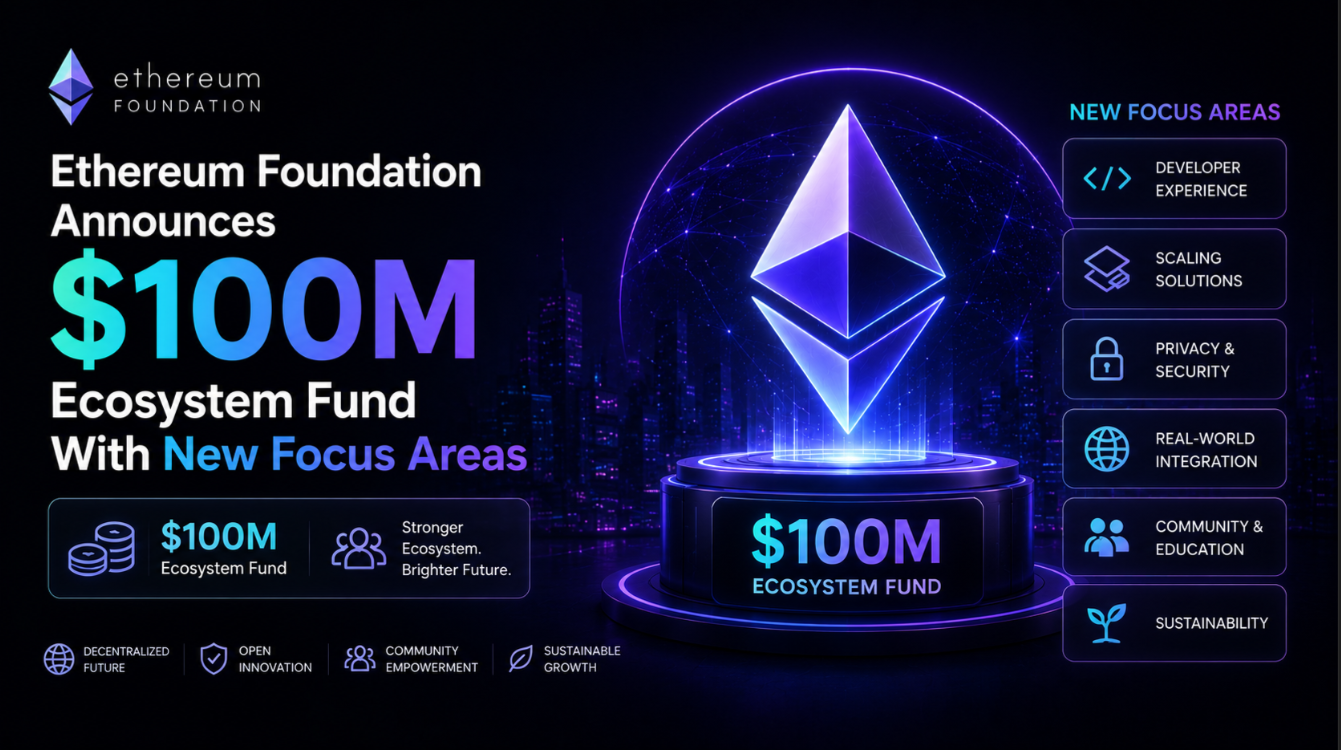
The Ethereum Foundation (EF) has announced a restructured grant programme committing $100 million to ecosystem development over the next 24 months. The announcement, made at EthCC Brussels, marks a significant shift in EF's funding posture: moving from its traditionally research-centric model toward product-layer investments in developer tooling, zero-knowledge infrastructure, and user-facing privacy applications.
Background: Why the Foundation Is Changing Strategy
The EF has faced sustained criticism over the past two years for being slow to fund practical developer tooling relative to academic protocol research. Critics — including prominent Ethereum application developers — argued that while the protocol layer was world-class, the developer experience for building on Ethereum lagged behind Solana and other ecosystems that invested heavily in SDKs, documentation, and onboarding.
The structural response came in early 2026 when the EF underwent an internal reorganisation, separating its "Protocol Support" team from a new "Ecosystem Growth" function. The $100 million fund is the first major output of the latter team, led by former a16z crypto operating partner Tomáš Všetečka, who joined the Foundation in November 2025.
Fund Structure: Three Pillars
The $100 million is divided across three strategic pillars:
- ZK tooling and infrastructure ($40M): Grants for teams building production-grade ZK proof libraries, developer-friendly ZK virtual machines, and formal verification tools. Priority recipients include projects that make ZK circuits accessible to Solidity developers without cryptographic expertise.
- Developer experience ($35M): Funding for documentation, testing frameworks, debugging tools, and educational content. The EF has partnered with four bootcamp providers to create Ethereum-specific curricula targeting 10,000 new developers by end of 2027.
- Privacy applications ($25M): Grants for teams building privacy-preserving DeFi applications, private credential systems, and compliant privacy tooling that satisfies regulatory requirements while preserving user anonymity.
ZK Infrastructure: The Technical Priority
The largest allocation — $40 million toward ZK tooling — reflects where the Foundation sees the highest return on investment. Zero-knowledge proofs are the enabling technology for the next generation of Ethereum applications: private transactions, verifiable off-chain computation, and Type-1 ZK-EVMs. But current tooling requires PhDs to use effectively.
The EF's ZK grants will specifically target:
- Circom/Noir alternative that compiles from Solidity or a Solidity-like syntax
- Formal verification tools that automatically generate ZK proofs of smart-contract correctness
- Hardware acceleration libraries compatible with consumer GPUs, reducing proving costs
- Cross-chain ZK bridge infrastructure compatible with L2s including those on
- Arbitrum
Developer Experience: Competing With Solana and Sui
Ethereum's developer ecosystem is the largest in crypto by absolute numbers — over 10,000 monthly active developers by Electric Capital's count — but growth has been slower than Solana's in percentage terms over the past 18 months. The EF's DX investment is a direct competitive response.
Specific initiatives announced include:
- A rewritten Foundry documentation site with interactive examples and gas optimisation guides
- A unified Ethereum development starter kit supporting TypeScript, Python, and Rust clients
- Monthly "EF Office Hours" — live developer Q&A sessions streamed on YouTube
- Bug bounty expansions to $1M per critical vulnerability in core infrastructure
The four bootcamp partnerships — Alchemy University, Chainshot, Metana, and Road to Web3 — will receive curriculum co-development grants and agreed to make Ethereum the primary teaching chain for their 2026–2027 cohorts.
Privacy Infrastructure: Regulatory-Ready Tools
The $25 million privacy pillar is the most politically nuanced allocation. Post-Tornado Cash sanctions, Ethereum's privacy tooling landscape contracted sharply as developers feared regulatory exposure. The EF's position is that privacy and regulatory compliance are not mutually exclusive — the fund will only support projects that incorporate compliance hooks such as view-key disclosure or selective de-anonymisation under court order.
This "compliant privacy" stance has divided the community. Cypherpunk-oriented Ethereum users argue that selective de-anonymisation defeats the purpose of privacy tech. The EF counters that zero funding for any privacy infrastructure is worse than supporting compliant versions that can survive legal scrutiny and serve the majority of users who are not evading sanctions.
Impact on ETH Price and Long-Term Value
Direct grant spending does not immediately impact ETH price, but the secondary effects are significant. Better developer tooling attracts more builders; more builders deploy more contracts; more contracts drive more user activity; more activity burns more ETH through EIP-1559. The $100M investment is best understood as a bet that compounding developer growth is the most durable source of ETH value appreciation over a multi-year horizon. See the Ethereum forecast for long-range price scenarios accounting for developer growth assumptions.