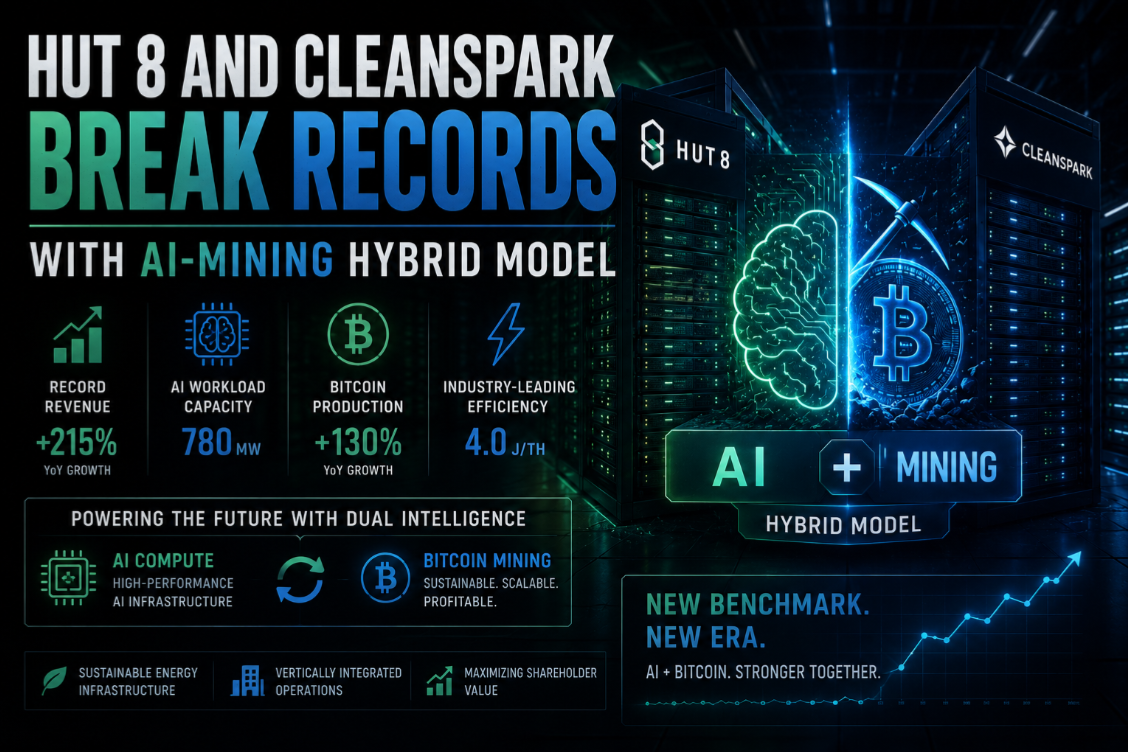
Quarterly earnings season for Bitcoin miners in early 2026 delivered a striking theme: the companies reporting the strongest numbers were not necessarily those with the most hash rate, but those that had successfully blended Bitcoin mining with artificial intelligence computing. Hut 8 and CleanSpark stood out as the clearest examples of this hybrid strategy paying off in reported financials. The trend signals a structural shift in what a 'Bitcoin mining company' actually means — and creates new ways to analyse exposure to Bitcoin's price cycle.
Hut 8: From Pure-Play Miner to Diversified HPC Operator
Hut 8 began its pivot to high-performance computing in 2022, well before the AI compute boom made the strategy fashionable. The company's acquisition of US Bitcoin Corp in 2023 gave it a footprint of energy-dense data centres in Alberta and several US states — facilities already configured for high-power-density rack deployments compatible with GPU servers.
By Q4 2025, Hut 8's HPC segment — which includes AI training and inference, rendering, and enterprise cloud — contributed approximately 35% of total quarterly revenue. In absolute terms, HPC revenue grew 140% year-over-year, driven by new contracts with AI startups requiring burst compute for model training. The company's Bitcoin mining segment, running at approximately 9 EH/s, produced the remaining 65% of revenue but with higher variability tied to BTC price and difficulty.
The hybrid model's operational logic is elegant: the same power infrastructure serves both workloads. Transformers, cooling systems, and network interconnects are shared. When BTC hash price (revenue per EH/s per day) dips below HPC margins, Hut 8 dials down mining and routes power to GPU racks. When BTC is strong, the balance shifts back. This optionality gives management a lever that pure-play miners lack entirely.
CleanSpark's Leaner Approach to AI Integration
CleanSpark took a more conservative hybrid path, focusing on maximising Bitcoin mining efficiency first while building AI capacity as a secondary layer. The company operates exclusively in the United States, with sites concentrated in Georgia and Wyoming chosen for stable grid access and favourable regulatory environments. Its mining fleet, now at approximately 35 EH/s, is one of the most homogeneous in the industry — almost entirely Bitmain S21 XP machines — delivering industry-leading fleet efficiency.
CleanSpark's AI segment, launched in mid-2025, focuses on inference workloads rather than training. Inference jobs — running trained models to generate outputs — are shorter in duration, more predictable in power draw, and easier to schedule alongside mining operations. The company targets AI contracts that fill off-peak power windows, minimising conflict with mining during peak BTC hash price periods.
- Q1 2026 total revenue: $312M (record high)
- Mining segment: ~$256M (82%)
- AI/HPC segment: ~$56M (18%)
- Net income: $89M (vs. $12M Q1 2025)
- BTC mined: 1,840 BTC at average realised price of ~$92,000
Why Record Earnings Now? The Confluence of Factors
Record earnings at both companies in early 2026 are not solely attributable to the hybrid model. Three factors aligned: BTC price elevated above $85,000 through most of Q1; the efficiency gap between new-gen ASICs and retired hardware compressed unit production costs; and AI compute pricing stayed elevated as demand from LLM operators, autonomous agent infrastructure, and video generation companies continued to outpace supply of GPU clusters.
The combination produced operating margins that would have seemed implausible two years ago. CleanSpark's all-in mining cost per BTC (including depreciation, power, and overhead) fell below $28,000 — a margin of roughly $64,000 per coin at Q1 average prices. Investors tracking the longer-term picture can compare these economics against the Bitcoin price forecast and the broader guide to crypto mining economics in 2026.
Core Scientific's CoreWeave Deal: The Template Everyone Is Copying
The single most influential deal in the mining-AI convergence was Core Scientific's 12-year, $8.7 billion HPC hosting contract with CoreWeave, announced in mid-2024. Core Scientific agreed to convert approximately 200 MW of its existing mining capacity to CoreWeave's GPU hosting, receiving fixed monthly payments regardless of AI or Bitcoin market conditions. The deal effectively converted a volatile, commodity-exposed mining operation into a quasi-utility with predictable cash flows.
Every major mining company's investor relations team has been fielding questions about their CoreWeave equivalent ever since. Hut 8, CleanSpark, Cipher Mining, and Bit Digital have all announced smaller-scale AI hosting agreements in the months following the announcement. The contract structure varies — some are revenue-sharing, some are cost-plus, some are fixed-fee — but the underlying logic is identical: use excess power infrastructure to earn AI revenue during Bitcoin troughs.
Risks and Limits of the Hybrid Model
The AI-mining hybrid model carries distinct risks that pure-play investors should not underestimate. First, AI compute pricing is highly cyclical: the current elevated GPU margins reflect a supply shortage that chipmakers NVIDIA, AMD, and Intel are aggressively addressing. When GPU supply catches up with demand — potentially in 2027-2028 — AI hosting margins could compress significantly, removing the buffer that currently offsets mining volatility.
Second, serving AI customers requires a different operational profile than mining: lower latency networking, stricter uptime SLAs, and customer support capabilities that mining companies have not historically maintained. Execution risk in the transition is real. Third, some mining company valuations have already priced in substantial AI revenue that has not yet materialised, creating downside risk if contract signings slow.
Despite these risks, the hybrid model represents the most credible answer to the question that has dogged Bitcoin mining stocks for years: what happens to your business after several more halvings reduce block rewards to near zero? For platforms to access Bitcoin and mining stocks, see