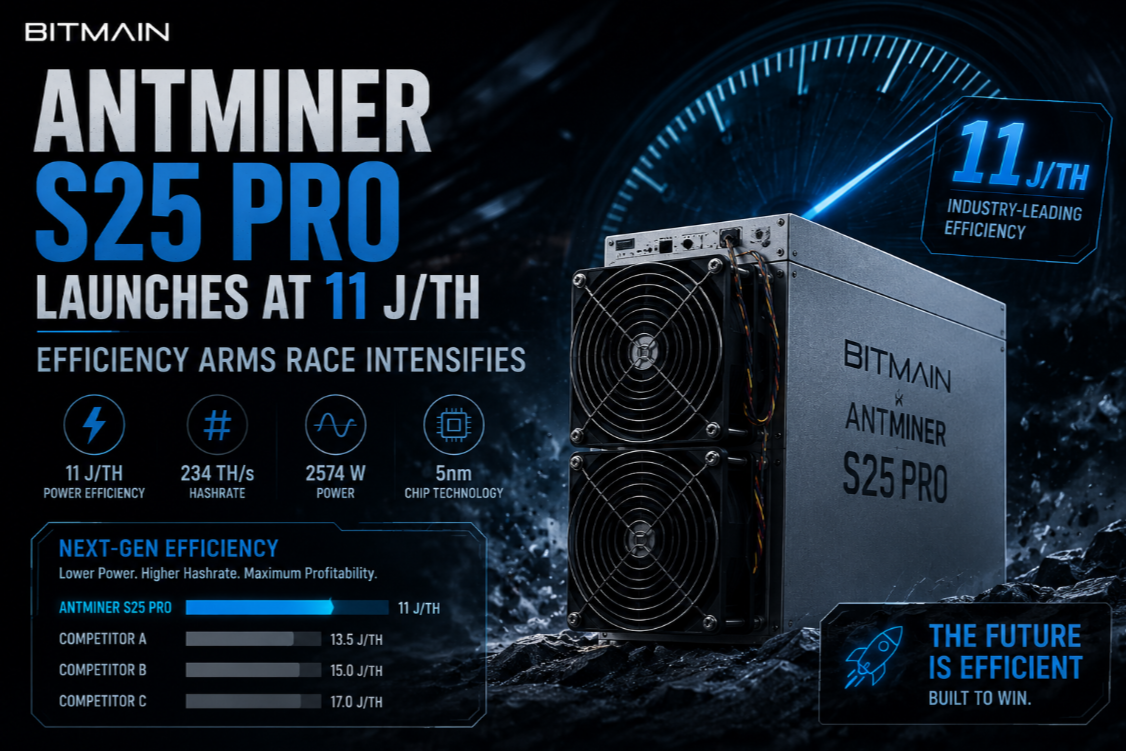
Bitmain unveiled the Antminer S25 Pro at its annual product showcase in April 2026, announcing a rated efficiency of 11 joules per terahash — the best figure ever achieved by a production Bitcoin ASIC at scale. The announcement triggered immediate attention across the mining industry, with publicly listed miners rushing to model the impact on fleet economics and capital expenditure timelines. For how efficiency improvements affect Bitcoin's overall network security, see the Bitcoin market page and the detailed guide at crypto mining in 2026.
The Physics and Engineering Behind 11 J/TH
Achieving 11 J/TH required Bitmain to advance on three simultaneous engineering fronts. First, chip fabrication: the S25 Pro uses a custom SHA-256 ASIC manufactured on TSMC's 3nm node — the same process used in Apple's A17 Pro and M3 chips. Smaller transistors reduce leakage current and allow higher clock frequencies at lower voltage, directly reducing energy per hash.
Second, chip architecture: Bitmain's engineers redesigned the hashing pipeline to reduce the number of clock cycles required per SHA-256 round, effectively doing more useful work per transistor per cycle. Third, power delivery: the S25 Pro uses a new voltage regulator module (VRM) design that reduces power conversion losses from approximately 8% to under 5%, recovering efficiency that is lost between the wall socket and the hash chip.
The result is a machine rated at 400 TH/s with a 4.4 kW power draw — meaning a standard 40-machine rack running S25 Pro units consumes 176 kW while producing 16 PH/s (petahashes per second). For a site running at $0.04/kWh, the electricity cost per BTC mined at current difficulty falls to approximately $22,000.
Competitive Response: MicroBT and the Arms Race
Bitmain's announcement came weeks after MicroBT previewed its competing M70S machine, which targets 13 J/TH at 380 TH/s. The gap between 11 and 13 J/TH is significant: over 100,000 machines running for a year, the more efficient units save approximately $70 million in electricity at $0.04/kWh. Large miners negotiate hardware contracts months or years in advance, meaning the S25 Pro vs M70S decision will shape fleet economics for the 2027-2029 period.
The efficiency arms race has real consequences beyond manufacturer rivalry. Each generation of more efficient hardware raises the network's minimum viable energy cost — the floor below which even the newest machines cannot profitably mine. Paradoxically, greater efficiency does not reduce Bitcoin's total energy consumption: as long as BTC price stays elevated and new capacity comes online, the network converges to a new, higher equilibrium hash rate that consumes similar or greater total power.
- S25 Pro (Bitmain): 400 TH/s @ 4.4 kW = 11.0 J/TH — April 2026 launch
- M70S (MicroBT): 380 TH/s @ 4.9 kW = 12.9 J/TH — Q3 2026 expected
- S21 XP Hyd (Bitmain, current): 335 TH/s @ 5.0 kW = 14.9 J/TH
- M66S (MicroBT, current): 298 TH/s @ 4.2 kW = 14.1 J/TH
- S19j Pro (legacy): 104 TH/s @ 3.1 kW = 29.8 J/TH
Impact on Public Mining Company Capex Cycles
The S25 Pro announcement landed mid-cycle for most large miners who had already committed to S21 XP deployments throughout 2025-2026. The dilemma facing CFOs is classic technology capex: do you accelerate S25 Pro orders now and strand partially depreciated S21 XP inventory, or do you run the existing fleet to its economic life and begin the S25 Pro transition in 2027?
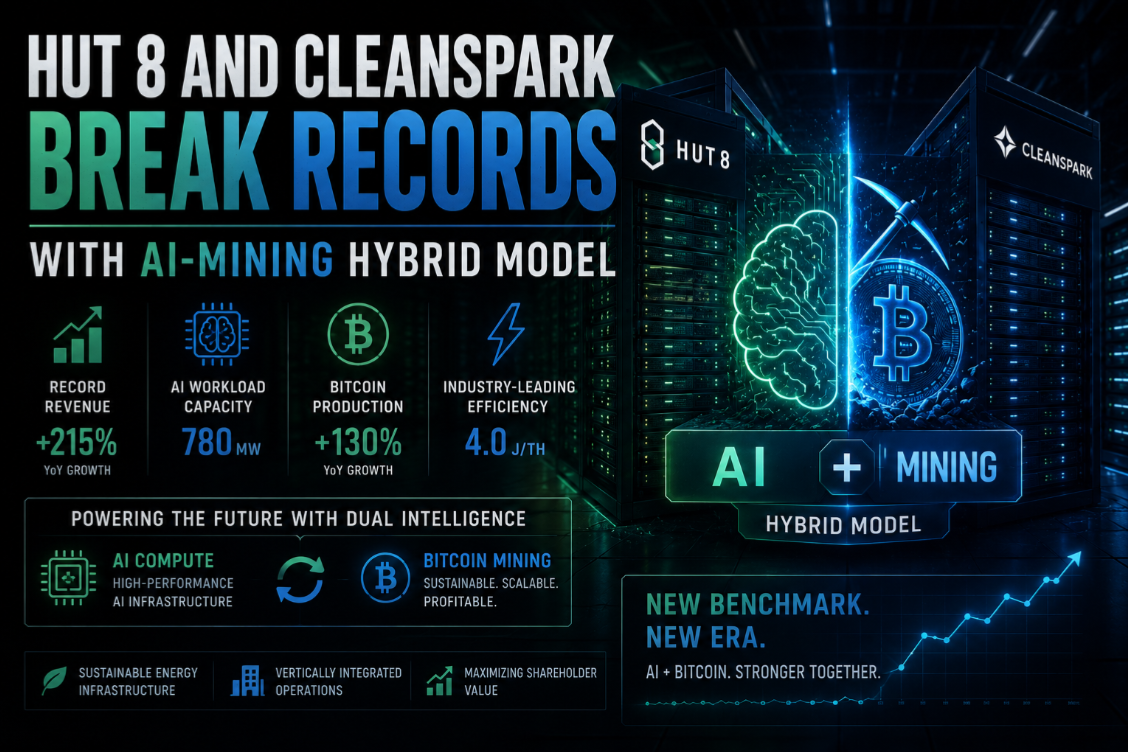
Marathon Digital, which recently crossed 60 EH/s, has indicated it will order S25 Pro units for incremental capacity additions rather than replacing existing S21 XP machines ahead of schedule. CleanSpark and Hut 8 have taken similar positions. The approach minimises near-term capital intensity while still capturing the efficiency gain on new megawatts deployed. For more on the mining competitive landscape, see the Bitcoin price forecast which incorporates mining cost as a price floor input.
Implications for Home Miners and Small Operations
The S25 Pro's launch effectively closes the door on profitable home mining for anyone without access to sub-$0.05/kWh electricity. At residential rates of $0.12-0.15/kWh, even an S25 Pro produces negative cash flow at current difficulty and BTC prices. The machines are also not designed for home environments: 400 TH/s generates substantial heat and noise, requiring purpose-built ventilation that most residential settings cannot accommodate.
The consolation for small-scale participants is that Litecoin and other Scrypt-algorithm coins remain accessible to consumer-grade hardware. For those interested in mining alternative coins with lower difficulty, see the
Energy Transition and the S25 Pro's Carbon Footprint
Despite the efficiency improvement, environmental critics note that the S25 Pro's reduced J/TH will attract additional mining capacity to the network rather than reducing total consumption. The industry's own data suggests that approximately 52% of mining now uses renewable or low-carbon energy sources — a figure that has grown steadily but that critics argue remains insufficient given the network's absolute energy scale.
Bitmain's own marketing positions the S25 Pro as a sustainability milestone, and for individual operators it genuinely reduces per-bitcoin carbon emissions. The systemic picture is more complex: a machine that lowers breakeven costs enables mining in regions with cheaper but dirtier grid power. The net environmental effect depends on where the incremental capacity deploys — a question no ASIC manufacturer controls after sale.