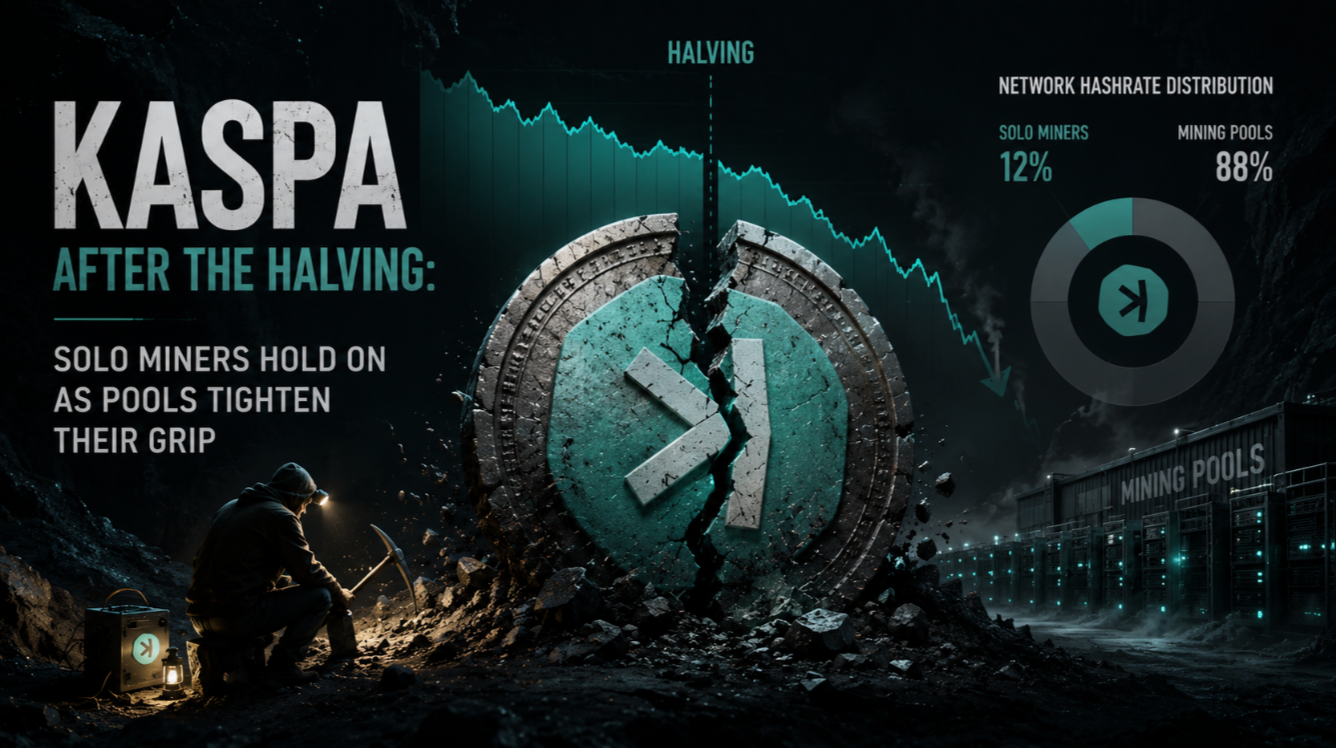
Kaspa's April 2026 emission reduction — widely referred to by the community as a "halving" despite the network's smooth chromatic emission curve — has fundamentally redrawn the economics of KAS mining. Solo miners, once a meaningful force on the network thanks to Kaspa's one-second block time and lower variance model, continue to find blocks but face a shrinking share as professional mining pools deploy ASIC hardware at scale. The shift mirrors patterns seen in Bitcoin's mining history, with important structural differences. For a broader comparison, see the Kaspa market page and the guide to crypto mining in 2026.
Kaspa's BlockDAG Architecture: Why It Matters for Miners
Before examining post-halving dynamics, it helps to understand what makes Kaspa's mining model structurally different. Bitcoin's linear blockchain means that two miners who find blocks simultaneously will have one block orphaned — the winner is the one whose block propagates to more nodes first. This orphan rate disadvantages small solo miners because their blocks are more likely to be orphaned when competing against larger mining farms with better connectivity.
Kaspa's BlockDAG (GhostDAG protocol) resolves this by accepting all simultaneously-found blocks and ordering them in a DAG structure. Miners are rewarded even for "parallel" blocks that would be orphaned on Bitcoin. The result is much lower variance for small miners: a miner with 0.1% of hash rate on Kaspa wins rewards far more regularly than an equivalent miner on Bitcoin, because Kaspa's one-second blocks mean 86,400 opportunities per day versus Bitcoin's 144.
This architecture was a genuine breakthrough for solo mining accessibility. In Kaspa's first two years, solo miners with GPU rigs could earn consistent income at modest hash rates — an experience Bitcoin had stopped offering to small participants by 2016.
What Changed After the Emission Reduction
The April 2026 emission reduction halved the per-block reward from approximately 146 KAS to 73 KAS. At the pre-reduction KAS price of roughly $0.14, this cut daily revenue per EH/s from about $180 to $90. For GPU miners running at $0.06-0.08/kWh electricity, the reduction pushed most machines below breakeven overnight.
The GPU exodus was rapid. Within two weeks of the emission reduction, approximately 35% of GPU hash rate had left the network, as measured by the difficulty adjustment. The difficulty dropped proportionally, partially compensating remaining miners — but ASIC operators who had lower electricity costs and higher efficiency were the principal beneficiaries of the GPU exit.
- Pre-halving network hash rate: approximately 2.8 PH/s
- Post-halving hash rate (two weeks later): approximately 1.8 PH/s
- Difficulty reduction: ~35%, partially restoring miner revenue
- GPU miners remaining: estimated 15% of total hash rate (down from 40%)
- ASIC share of network: now approximately 85% (up from 60%)
Solo Miners: Who Is Still Standing and How
Despite the industry shift toward pools, a community of solo Kaspa miners persists — and for good reasons rooted in the network's architecture. A solo miner operating a 5-machine ASIC farm at 50 PH/s (roughly 1.7% of current network hash rate after the GPU exodus) expects to win approximately 1,400 blocks per day — translating to about 102,200 KAS daily or roughly $14,300 at current prices. At $0.04/kWh power costs, this operation runs profitably with direct variance management.
The psychological and practical appeal of solo mining on Kaspa versus Bitcoin is striking: a solo miner never waits weeks or months for a lucky block. The one-second block time means rewards flow daily, even for relatively small operations. This makes cash flow management tractable — operators can cover electricity bills from mining income rather than needing capital reserves to bridge multi-week dry spells.
For readers new to Kaspa's mining economics, the Kaspa market page provides current network hash rate, difficulty, and KAS price data alongside a comparison with Bitcoin's mining network.
Pool Dominance and Decentralisation Concerns
The flip side of the ASIC transition is accelerating pool concentration. The top five Kaspa mining pools now control approximately 78% of network hash rate — a figure that would have been unthinkable eighteen months ago when the GPU mining community was more fragmented. F2Pool and Antpool together hold roughly 40%, raising decentralisation concerns that echo long-standing debates in Bitcoin mining.
Pool concentration on Kaspa is arguably less dangerous than equivalent concentration on Bitcoin because of the GhostDAG protocol's natural resistance to selfish mining strategies. A mining pool that attempts to withhold blocks to gain a competitive advantage on Kaspa cannot exploit the timing games that are possible on linear chains. The DAG structure makes most known selfish mining attacks economically irrational. However, censorship resistance — the ability to prevent specific transactions from confirming — remains a concern at high pool concentration levels.
The Kaspa development community is actively monitoring pool concentration and has discussed protocol-level mechanisms to discourage excessive centralisation, including adjustments to the DAG ordering algorithm that would reduce the advantage of well-connected large pools over distributed smaller ones.
Investment Outlook: Kaspa Post-Halving vs Bitcoin Post-Halving
Bitcoin's post-halving price history is well-documented: each of the four halvings to date has been followed (with variable lag) by significant price appreciation as reduced new supply collides with growing demand. Kaspa's first major emission reduction follows the same supply-side logic, but from a much earlier stage in the network's adoption curve. The Bitcoin price forecast section of this site models halving supply dynamics in detail; comparable analysis for Kaspa applies similar framework to a smaller, higher-growth-potential network.
The key risk for Kaspa mining investment post-emission-reduction is ASIC obsolescence: the KAS ASIC market is young, and next-generation hardware could displace current-generation machines within 18-24 months, compressing ROI windows. Miners who purchased KAS ASICs at premium prices in 2024-2025 are now racing to break even before superior hardware arrives. This dynamic is familiar from Bitcoin mining history — the first movers in any ASIC cycle capture the best economics; latecomers buy hardware that may never achieve payback.
Despite these risks, Kaspa's unique architecture, active developer community, and growing smart contract roadmap position it as one of the more technically credible projects in the proof-of-work mining space. For those seeking broader context on where to buy and store KAS, consult the