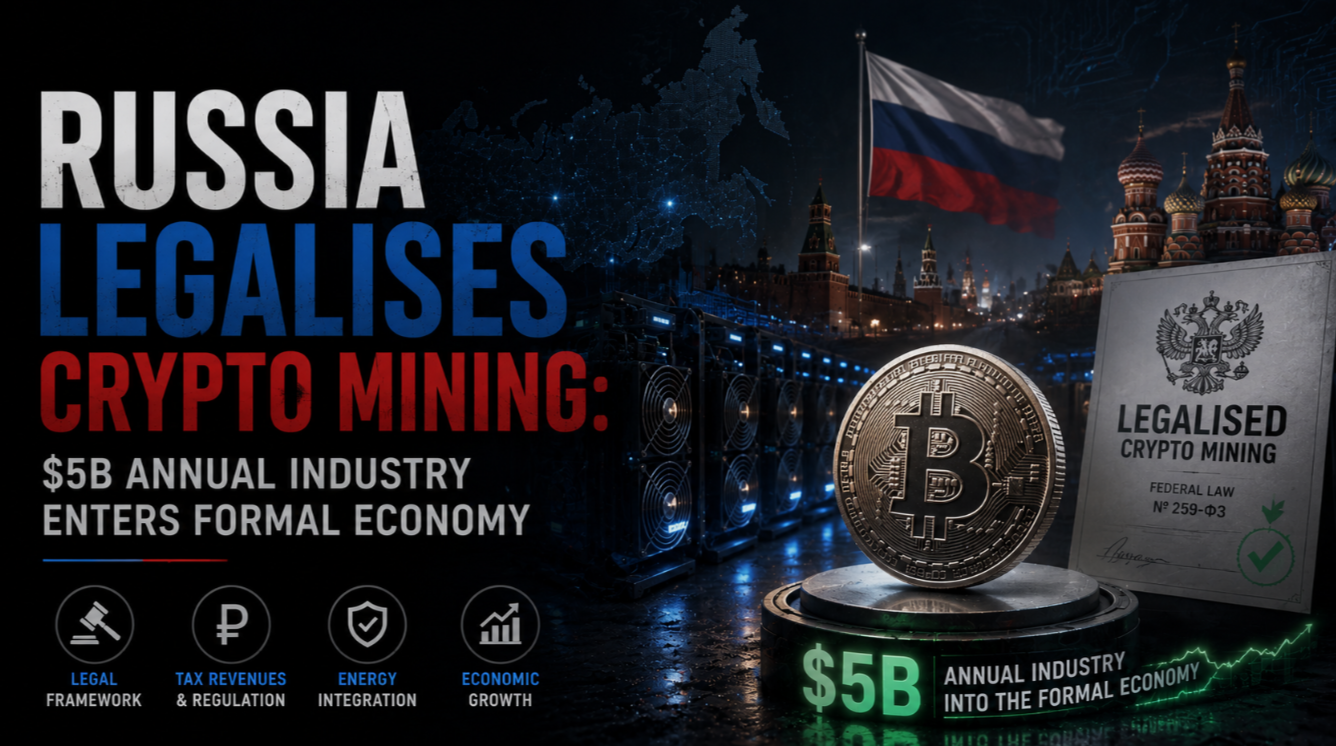
Russia enacted comprehensive Bitcoin mining legislation in April 2026, bringing an industry estimated at $5 billion in annual turnover from the legal grey zone into the formal economy. The law — officially titled Federal Law No. 347-FZ "On the Regulation of Digital Currency Mining" — establishes a registration framework, tax treatment, energy allocation system, and export mechanism for mined cryptocurrencies. The move is the most significant jurisdictional development in global mining since China's 2021 ban triggered a massive hash rate redistribution. For the price implications, see the Bitcoin market page and the Bitcoin price forecast.
What the Law Actually Says
The legislation runs to 84 articles and covers several distinct areas. First, registration: any entity wishing to mine commercially must register with the Federal Tax Service and obtain a mining operator licence from Rosfinmonitoring (the financial intelligence unit). The registration process includes AML compliance procedures — KYC for beneficial owners, source-of-funds declarations, and transaction reporting thresholds.
Second, energy allocation: large-scale mining (above 1 MW of connected load) is restricted to designated industrial zones in eleven regions identified as having power surplus: primarily Siberia, the Urals, the Russian Far East, and certain Arctic territories. Operators in these zones receive priority grid access at discounted industrial tariffs — reportedly as low as $0.02/kWh at several Siberian hydro sites — in exchange for generating taxable revenue and employment.
Third, the export mechanism: mined cryptocurrency can be exchanged for foreign currency through authorised operators. This creates a supervised pathway for mining revenue to contribute to Russia's foreign exchange reserves — a significant motivation for the Kremlin given the ongoing pressure on the rouble from sanctions.
Context: From Prohibition Proposals to Legalisation
Russia's path to mining legalisation was neither linear nor inevitable. In early 2022, the Central Bank of Russia issued a proposal to ban cryptocurrency mining entirely on energy and financial stability grounds. The proposal was defeated in the Duma after intense lobbying from the mining industry, energy sector players, and regional governments that had already seen significant mining investment. A compromise — restricted but legal — became the preferred framework.
Subsequent years saw several draft laws that died in committee before the current framework emerged from an inter-ministerial working group involving the Finance Ministry, the Central Bank, the Energy Ministry, and the FSB. The final text reflects compromises between these stakeholders: the Central Bank won AML provisions and export controls; the Finance Ministry won tax revenue mechanisms; the Energy Ministry won regional restrictions; and the mining industry won legal status and access to industrial electricity tariffs.
Russia's Mining Geography: Why Siberia Dominates
Russia's mining concentration in Siberia is not accidental. The region hosts some of the world's largest hydroelectric complexes — the Krasnoyarsk, Bratsk, and Ust-Ilimsk dams on the Yenisei and Angara rivers — producing enormous quantities of power that have historically been underutilised given limited local industrial demand. The cold climate reduces cooling costs by 30-40% compared to temperate or warm regions, and the remote locations mean operations have minimal impact on urban electricity grids.
- Krasnoyarsk Krai: largest concentration, ~30% of Russian mining capacity
- Irkutsk Oblast: second largest, known for cheapest electricity in Russia
- Karelia and Murmansk: hydroelectric surplus, cold Arctic climate
- Sverdlovsk Oblast (Urals): industrial zones, gas-powered generation
- Primorsky Krai (Far East): growing hub, proximity to Asian hardware supply chains
Global Hash Rate Implications
Russia currently represents an estimated 5-7% of Bitcoin's global hash rate. Formalisation is expected to grow that share meaningfully by removing legal uncertainty that had deterred foreign capital and limited domestic operators to grey-market scale. Industry analysts project Russian hash rate reaching 10-12% of the global total within three years — potentially making Russia the second-largest mining jurisdiction after the United States. This growth will be captured in the difficulty adjustments tracked on the Bitcoin market page.
The global hash rate distribution matters for Bitcoin's decentralisation. A world where the United States holds 35-40% and Russia holds 10-12% concentrates mining power in two geopolitically opposed jurisdictions. In a worst-case scenario involving a coordinated policy decision by both governments, the network's censorship resistance could theoretically be stressed. In practice, the game-theoretic incentives of mining — operators profit from an honest chain — make coordinated attack extremely unlikely, but the concentration remains a discussion point among security researchers.
For Individual Miners and International Investors
The law creates a new pathway for international mining companies to establish Russian operations through local subsidiaries. Several firms have already announced intent to invest: a Kazakh miner with existing Siberian relationships signed a letter of intent for 200 MW of new capacity within a week of the law's passage. Chinese equipment manufacturers see Russia as a significant new export market, particularly for immersion-cooled systems suited to the remote Siberian deployment environment.
For individuals interested in the mining opportunity, the crypto mining guide 2026 covers how to evaluate jurisdiction, hardware, and electricity contracts. The Bitcoin market page and Litecoin market page provide current network difficulty data for comparative analysis.
Tax Revenue and Geopolitical Dimensions
The Finance Ministry projects that formalised mining will contribute approximately 180 billion roubles ($2 billion at current exchange rates) annually in tax revenue once the sector reaches steady-state compliance. This is not trivial against a backdrop of constrained fiscal receipts from oil and gas exports. For regional governments in Siberia, mining companies represent a new category of industrial tenant that pays electricity bills, employs local staff, and contributes municipal taxes — an economic development tool that requires minimal public subsidy.
The geopolitical dimension is equally significant. Bitcoin mined in Russia and sold through authorised channels generates hard currency — dollars, euros, or yuan — that is not directly subject to the same sanctions mechanisms as traditional financial flows. While the scale is too small to materially offset sanctions impact, it establishes a proof-of-concept for cryptocurrency as a partial sanctions circumvention tool that Western policymakers are watching closely.