What is crypto mining?
Crypto mining is the process by which new transactions are validated and added to a blockchain, and new coins are issued to participants as compensation. In proof-of-work (PoW) networks like Bitcoin, miners compete to solve a computationally intensive mathematical puzzle — finding a hash below a target difficulty — by repeatedly varying a nonce value until a valid solution is found. The first miner to broadcast a valid block earns the block reward plus all transaction fees included in that block.
The "work" in proof-of-work is intentional: it creates an economic cost that makes rewriting the blockchain's history prohibitively expensive. An attacker wanting to reverse a confirmed transaction would need to redo the work for that block and every block after it, faster than the entire honest network continues to build forward. This design — costly to produce, cheap to verify — is the security foundation of Bitcoin and dozens of other PoW networks.
In 2026, Bitcoin's combined network hash rate exceeds 800 exahashes per second (EH/s), produced by hundreds of thousands of specialized ASIC machines running continuously around the world. Mining has evolved from a hobbyist activity (early Bitcoin could be mined on a laptop CPU in 2009) into a capital-intensive industry dominated by large data centers. However, smaller PoW coins and cloud mining products still offer realistic entry points for retail participants. For live price context, see the Bitcoin market page.
Proof of Work vs Proof of Stake: the core difference
The two dominant blockchain consensus mechanisms — proof of work (PoW) and proof of stake (PoS) — represent fundamentally different approaches to who gets to validate transactions and what the cost of dishonesty is.
- Proof of Work (PoW) — Validators (miners) expend real-world energy and hardware to compete for block production rights. Security is anchored in physical capital: electricity, machines, facilities. The barrier to attack is measured in hardware acquisition cost and ongoing power bills. Bitcoin, Litecoin, Monero, Kaspa, and Bitcoin Cash are the most prominent PoW networks in 2026.
- Proof of Stake (PoS) — Validators lock up (stake) cryptocurrency tokens as collateral to participate in block production. Security is anchored in financial capital: the threat of losing staked tokens (slashing) deters misbehavior. Ethereum (post-Merge), Solana, Cardano, and most newer Layer 1 networks use PoS.
The debate between PoW and PoS is ongoing. PoW proponents argue that energy expenditure creates unforgeable costliness — security that cannot be conjured from nothing. PoS proponents argue that PoS is more capital-efficient, environmentally friendlier, and delivers equivalent economic security without physical resource consumption. For this guide, the focus is PoW mining because PoS participation (staking) follows entirely different mechanics.
Key point: mining is exclusively a PoW activity. Ethereum and Solana cannot be mined post-2022 — only staked. This guide covers coins that can still be profitably mined in 2026.
Bitcoin mining after the 2024 halving
The April 2024 Bitcoin halving reduced the block reward from 6.25 BTC to 3.125 BTC per block. Halvings occur approximately every 210,000 blocks (~4 years) and are hard-coded into Bitcoin's protocol. The 2024 halving was the fourth in Bitcoin's history. See the Bitcoin price forecast for long-range price projections and historical halving impact analysis.
The immediate effect of the halving was a 50% reduction in newly issued coins — and therefore a 50% reduction in mining revenue at constant BTC price. Miners who were already operating near breakeven were forced offline. This is by design: the halving is followed (historically) by a price appreciation cycle that restores and eventually exceeds pre-halving revenue in fiat terms. By mid-2025, Bitcoin's price had recovered sufficiently to return most ASIC operators to profitability.
The longer-term implication is structural: as block subsidies decline over successive halvings, transaction fees must constitute a growing share of miner revenue to maintain network security. In 2026, transaction fees represent roughly 15%–25% of total block revenue depending on network congestion. The Ordinals and Runes protocol activity on Bitcoin (which began in 2023–2024) has permanently elevated the base fee floor compared to earlier cycles, providing a partial offset to declining subsidies.
- Current block reward: 3.125 BTC (post-April 2024 halving)
- Next halving: approximately April 2028, reducing reward to 1.5625 BTC
- Block interval: ~10 minutes, ~144 blocks per day
- Daily BTC issuance in 2026: ~450 BTC/day (~$42M at $93,000 BTC price)
- Network hash rate: 800+ EH/s — all-time high as of 2026
Top ASIC miners in 2026: Bitmain S21 Pro, MicroBT M70, Canaan Avalon
Application-Specific Integrated Circuits (ASICs) are custom chips designed exclusively to compute SHA-256 hashes as fast as possible per watt consumed. The three dominant ASIC manufacturers in 2026 are Bitmain (China/UAE), MicroBT (China), and Canaan Creative (China). Each has a flagship model targeting the premium efficiency tier, where hash rate per joule determines long-run profitability.
- Bitmain Antminer S21 Pro — Hash rate: 234 TH/s. Power consumption: 3,510 W. Efficiency: 15.0 J/TH. The S21 Pro is the most widely deployed next-generation ASIC, representing Bitmain's dominance in the premium segment. At $6,000–$7,500 retail, it offers strong hash rate density for data-center deployments. Bitmain's vertical integration (chip design, fabrication via TSMC 5nm, assembly) gives it a structural cost advantage.
- MicroBT Whatsminer M70 — Hash rate: 246 TH/s. Power consumption: 3,444 W. Efficiency: 14.0 J/TH. The M70 edges out the S21 Pro on efficiency and hash rate, making it the preferred choice for miners optimizing for electricity cost minimization. MicroBT uses Samsung 3nm process nodes for the M70 series. List price $7,000–$8,500. MicroBT has gained significant market share from Bitmain since 2022 due to consistent delivery and competitive efficiency.
- Canaan Avalon A15 Series (A1566) — Hash rate: 185 TH/s. Power consumption: 3,145 W. Efficiency: 17.0 J/TH. Canaan is the third-largest ASIC manufacturer and positions the Avalon series as a mid-range value option. The A1566 is less efficient than the S21 Pro or M70 but retails at $4,500–$5,500 — a lower capital entry point. Canaan also produces the Avalon Nano and Mini series for small-scale and home mining.
When evaluating ASICs, focus on efficiency (joules per terahash, J/TH) over raw hash rate. Lower J/TH means lower electricity cost per bitcoin mined — which determines the breakeven price threshold. At $0.06/kWh, the M70 breaks even at approximately $35,000 BTC; the A1566 breaks even at approximately $55,000 BTC. A difference of 3 J/TH across a 100-machine operation represents ~$250,000/year in electricity savings.
How to calculate mining profitability: the electricity formula
Mining profitability reduces to a single core equation: Revenue minus Electricity Cost equals Gross Profit. Every other variable (pool fees, maintenance, depreciation) adjusts from there. The electricity component dominates operational costs — typically 60%–80% of total costs for well-run operations.
The basic daily profitability formula per machine:
- Daily revenue = (Machine TH/s ÷ Network Total TH/s) × 144 blocks/day × Block reward in BTC × BTC price
- Daily electricity cost = (Machine Watts ÷ 1,000) × 24 hours × Electricity rate ($/kWh)
- Daily gross profit = Daily revenue − Daily electricity cost
Example calculation for the Bitmain S21 Pro at current 2026 conditions:
- Hash rate: 234 TH/s = 0.000234 EH/s
- Network hash rate: 800 EH/s
- Network share: 0.000234 ÷ 800 = 0.0000003 (0.00003%)
- Daily BTC earned: 0.0000003 × 144 blocks × 3.125 BTC = 0.000135 BTC/day
- At $93,000 BTC: $12.55/day revenue
- Power cost at $0.06/kWh: (3,510 W ÷ 1,000) × 24 × $0.06 = $5.05/day
- Gross profit: $12.55 − $5.05 = $7.50/day (~$2,738/year)
- Payback period at $7,000 machine cost: ~2.6 years
Electricity rate is the most critical variable. At $0.10/kWh (US residential average), the same machine earns $4.14/day — 45% less. At $0.12/kWh, gross profit drops to $2.55/day — a 66% reduction. This is why industrial mining operations target electricity rates of $0.02–$0.05/kWh through long-term power purchase agreements (PPAs), co-location deals, or behind-the-meter renewable energy sources. Home miners paying retail electricity rates typically cannot compete with industrial operations on Bitcoin, though niche PoW coins with lower difficulty may still be viable.
Mining pools vs solo mining: F2Pool, Antpool, Foundry USA
Solo mining Bitcoin in 2026 is statistically equivalent to buying a single lottery ticket every 10 minutes. With a single S21 Pro contributing 234 TH/s against a 800 EH/s network, your probability of finding a block in any given 10-minute window is roughly 1 in 3.4 billion. Expected time to find a solo block: approximately 23,000 years. Solo mining Bitcoin is not a realistic strategy for any individual operator.
Mining pools aggregate hash rate from thousands of machines, find blocks at a predictable rate, and distribute rewards proportionally to each participant's contributed hash rate. Pool participants earn smaller, consistent payouts rather than infrequent large ones — transforming a probabilistic lottery into a steady income stream. The pool operator charges a fee (typically 1%–4% of rewards) for this service.
- Foundry USA — The largest Bitcoin mining pool by hash rate in 2026 (~30% of total network hash rate). Operated by Digital Currency Group's Foundry Digital subsidiary. Popular with North American institutional miners. Payout method: FPPS (Full Pay Per Share, which includes transaction fee income). Fee: 0%–2% depending on tier. Foundry also provides equipment financing and hosting services.
- Antpool — Operated by Bitmain, consistently ranks in the top 3 pools. Global hash rate share ~15%–18%. Supports Bitcoin, Litecoin, Bitcoin Cash, and other PoW coins. Payout: PPLNS (Pay Per Last N Shares). Fee: 0% for PPLNS with 4% transaction fee share. Strong uptime and global server infrastructure across Asia, Europe, and North America.
- F2Pool — One of the oldest pools (founded 2013), with consistent top-5 hash rate ranking. Supports 40+ PoW coins including Bitcoin, Litecoin, Kaspa, and Monero. Fee: 2.5% (PPS+ payout method). F2Pool's multi-coin support makes it the go-to pool for miners running diverse hardware or testing new PoW coins. Interface available in English and Chinese.
Payout methods matter: PPS (Pay Per Share) guarantees a fixed payment per valid share regardless of whether the pool finds a block — eliminating variance at the cost of a higher fee. PPLNS (Pay Per Last N Shares) pays only when the pool finds a block, with each miner's reward proportional to recent shares — lower fee but higher variance. FPPS adds transaction fee income to PPS payouts. For new miners, PPS or FPPS provides predictable cash flow; larger operators often prefer PPLNS to reduce fees at scale.
Other mineable PoW coins in 2026: Litecoin, Kaspa, Monero, Bitcoin Cash
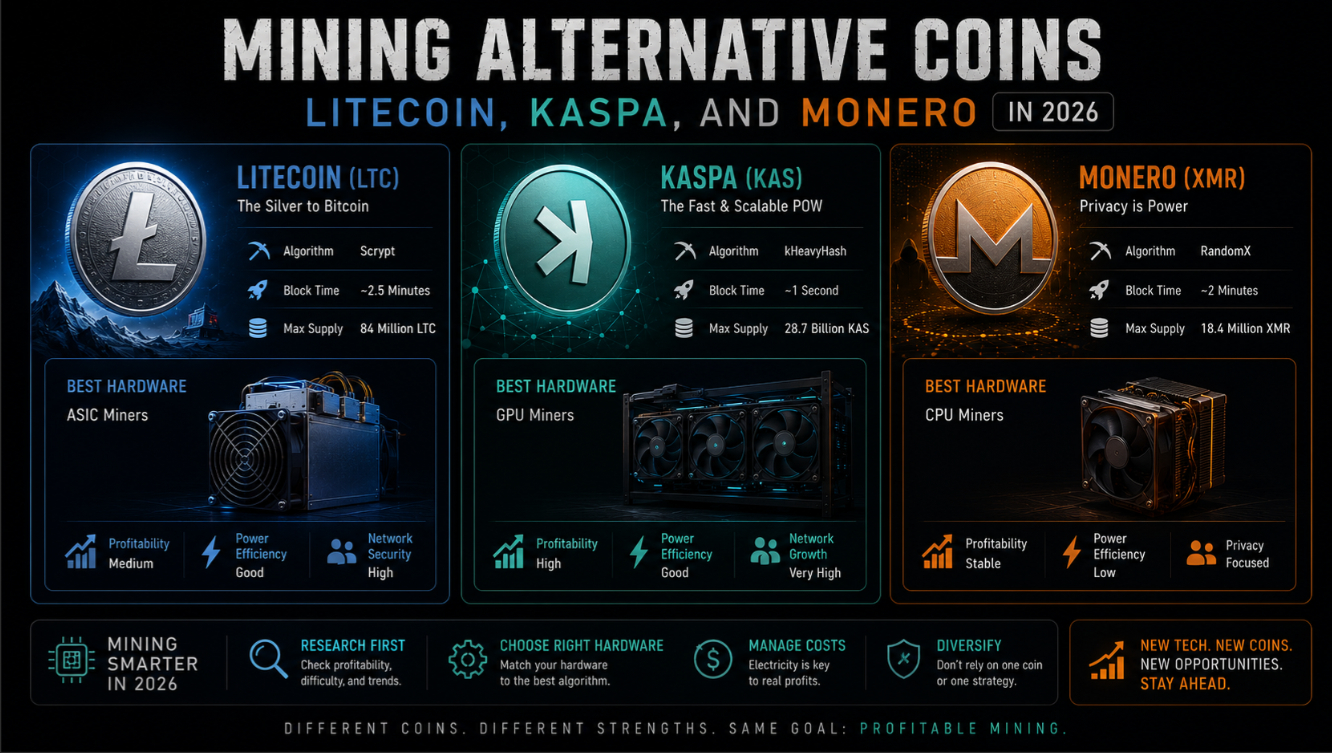
Bitcoin is not the only profitable PoW network in 2026. Several alternative coins use different hashing algorithms with distinct hardware requirements, difficulty dynamics, and profitability profiles. Diversifying into altcoin mining or GPU/CPU-mineable coins can offer better returns for smaller operators who cannot compete with industrial-scale ASIC farms on Bitcoin.
- Litecoin (LTC) — Uses Scrypt algorithm, ASIC-mined. Litecoin undergoes its own halvings (most recent: August 2023, reducing reward to 6.25 LTC/block). With lower network difficulty than Bitcoin, Litecoin remains accessible to mid-tier ASICs. Merge-mining with Dogecoin (AuxPoW) means many LTC miners simultaneously earn DOGE rewards at no extra cost. See the Litecoin market page for current price and network data.
- Kaspa (KAS) — Uses kHeavyHash algorithm, GPU and ASIC-mined (dedicated Kaspa ASICs emerged in 2024). Kaspa is unique in using a DAG (Directed Acyclic Graph) blockDAG structure called GHOSTDAG, enabling block rates of 1 block per second with finality in under 10 seconds. This architecture makes Kaspa compelling for small miners due to lower orphan rates and more frequent payouts. See the Kaspa market page for current data.
- Monero (XMR) — Uses RandomX algorithm, intentionally CPU-mineable and ASIC-resistant. Monero changes its PoW algorithm periodically to invalidate ASIC development. RandomX is optimized for general-purpose CPUs with large L3 caches — modern server CPUs (AMD EPYC, Intel Xeon) are competitive with GPUs. Monero mining offers privacy-coin exposure without ASIC hardware investment. See the Monero market page.
- Bitcoin Cash (BCH) — Uses SHA-256 algorithm (same as Bitcoin), meaning Bitcoin ASICs can mine BCH directly. BCH's lower difficulty relative to Bitcoin (due to much less total hash rate) can produce higher per-TH/s revenue for miners willing to hold BCH or immediately convert. BCH underwent its own halving in April 2024. Many large mining operations point a fraction of their capacity at BCH during periods of favorable relative difficulty.
Profitability for each coin shifts daily with price and difficulty. Use tools like WhatToMine, NiceHash Profitability Calculator, or Minerstat to compare real-time profitability across PoW coins for your specific hardware. A diversified PoW portfolio — mining BTC, BCH via merge, and rotating GPU capacity between KAS and XMR — is a common strategy among mid-size independent miners. See Binance review for context on where to sell mined coins with low fees.
Cloud mining and hashrate tokens: GoMining, Compass Mining
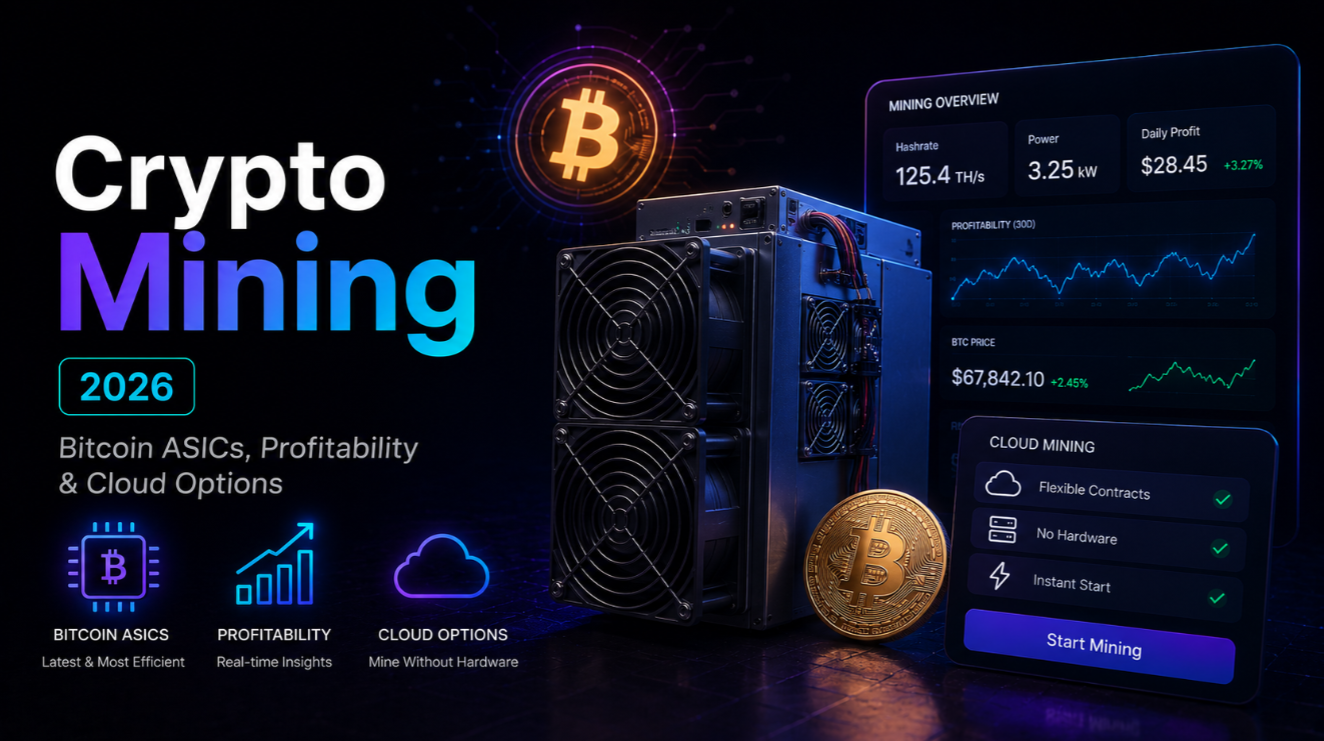
Not everyone can or wants to manage physical hardware. Cloud mining and hashrate tokens offer exposure to mining economics without owning machines — buying hash rate from operators who manage all hardware, facilities, electricity, and maintenance on your behalf. The trade-off is lower returns than direct operation (you pay a premium for convenience) and counterparty risk (you must trust the cloud mining provider).
- GoMining — GoMining tokenizes Bitcoin mining hash rate as NFTs and ERC-20 tokens on the Ethereum network. Each NFT represents a defined amount of hash rate hosted in GoMining's facilities. Token holders receive daily BTC payouts proportional to their represented hash rate, minus a maintenance fee. The token can be traded on secondary markets, giving holders liquidity that traditional cloud mining contracts lack. GoMining launched dedicated ASIC hosting in Iceland and other low-energy-cost jurisdictions. Yield depends on BTC price and network difficulty.
- Compass Mining — Compass is a marketplace model: it connects individual miners with co-location hosts (data centers) and ASIC vendors, acting as a logistics and management layer rather than a direct mining operator. Users purchase machines (shipped to a Compass-affiliated facility), pay a hosting fee ($0.06–$0.10/kWh equivalent), and receive BTC mining payouts. Compass provides a monitoring dashboard, machine health tracking, and customer support. The model gives users more control and transparency than pure cloud mining contracts.
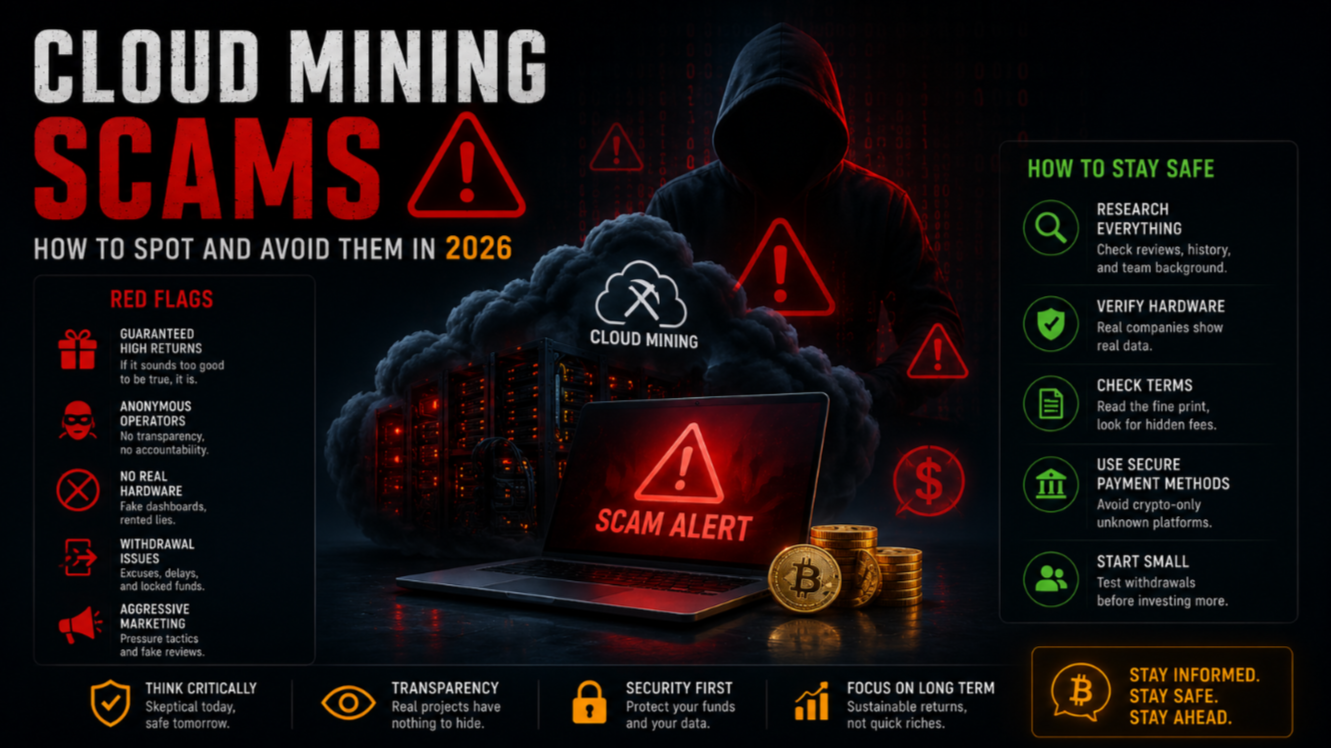
Traditional cloud mining contracts — where you purchase a fixed-term contract (e.g., 1-year, 500 GH/s) from a provider who mines on your behalf — have a poor track record. Many providers in the 2017–2021 era proved to be Ponzi schemes or became unprofitable as difficulty rose and simply stopped paying out. If considering a cloud mining contract, require verifiable proof of mining hardware ownership, audited hosting arrangements, and transparent fee structures. The GoMining and Compass models are more verifiable than opaque contract-based providers.
Red flags in cloud mining: guaranteed fixed returns regardless of BTC price, inability to independently verify hash rate, withdrawal restrictions, and operators without verifiable data-center infrastructure. Legitimate providers expose real-time hash rate dashboards tied to identifiable pool addresses.
Mining tax and legal considerations in 2026
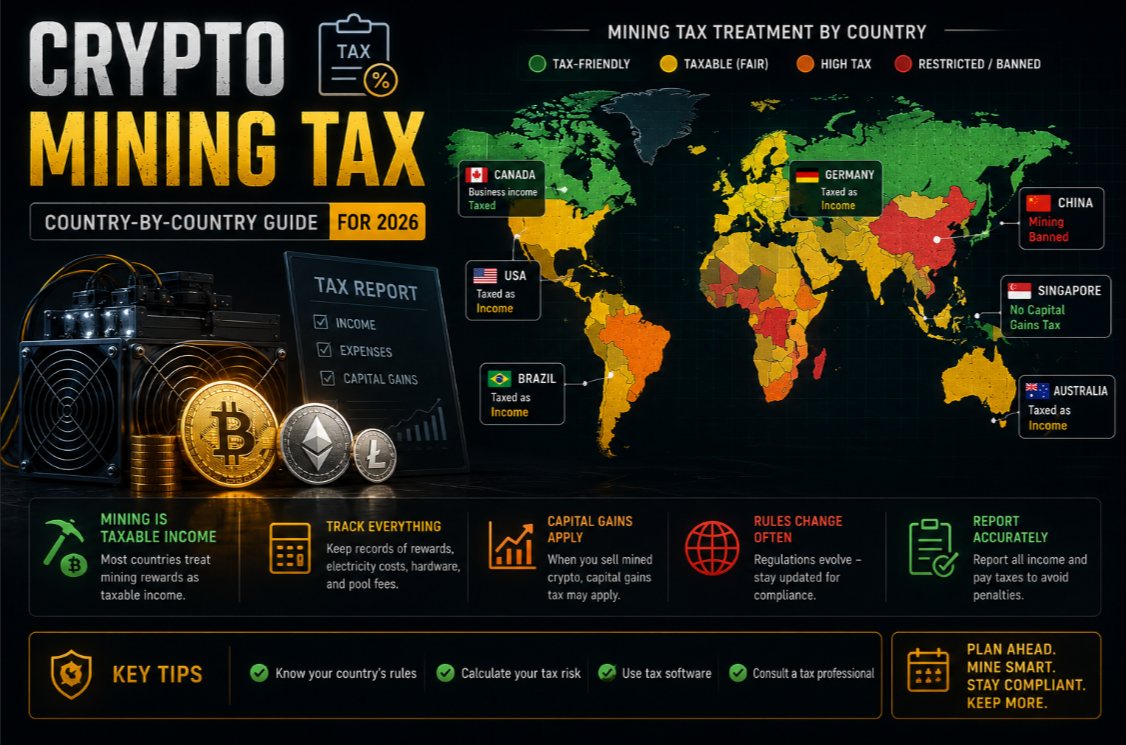
Crypto mining has distinct tax treatment compared to staking or passive investment. In most major jurisdictions, mining income is treated as self-employment or business income at the fair market value of coins at the time they are received. This section provides general information only — consult a qualified crypto tax professional for advice specific to your situation and jurisdiction.
- Income recognition — In the US, the IRS treats mined cryptocurrency as ordinary income at the time of receipt. For pool mining, each payout event is a taxable income event at the BTC spot price on the payout date. For solo miners, income is recognized when the block reward is received. Cloud mining payouts follow the same logic.
- Business expense deductions — Miners operating as a business (Schedule C in the US) can deduct electricity costs, hardware depreciation (Section 179 or MACRS for ASICs), hosting fees, internet, and home-office allocations. ASIC miners can typically depreciate hardware over 3–5 years or expense it immediately under bonus depreciation rules. These deductions significantly reduce the effective tax burden for profitable operations.
- Capital gains on disposal — When mined coins are sold or swapped, the disposal is a taxable event. Gain or loss equals sale price minus the cost basis (which is the fair market value at time of mining receipt). Short-term capital gains (held under 1 year) are taxed as ordinary income; long-term gains (held over 1 year) receive preferential rates in most jurisdictions.
- Legal status by jurisdiction — Mining is legal in most countries including the US, UK, EU member states, Canada, and Australia. China banned mining in 2021, driving significant hash rate migration to the US, Kazakhstan, and UAE. Some jurisdictions (Kosovo, Iran) have imposed temporary bans during energy crises. In the EU under MiCA (2025–2026), mining itself is not regulated, but asset issuance and custody services are.
- Energy and environmental regulations — US states increasingly regulate large mining operations under energy and environmental frameworks. Texas, Kentucky, and Wyoming have been miner-friendly; New York imposed a 2-year moratorium on new PoW mining using non-renewable energy (2022–2024). Monitor state-level and EU energy policy for operational risk.
Record keeping is critical: log every payout transaction hash, date, amount, and BTC spot price. Tax software platforms (Koinly, TaxBit, Coinledger) integrate with major mining pools via API to automate reward tracking. Set up automated records from your first payout — retroactively reconstructing mining income history is error-prone and auditable.
Mining risks: difficulty, hardware, price, and operational challenges
Mining is a capital-intensive business with multiple compounding risk factors. Understanding these risks before committing capital — especially to expensive ASICs — is essential for realistic expectations.
- Price risk — Mining profitability is directly proportional to BTC price. A 50% price decline at constant difficulty means a 50% revenue decline, potentially flipping profitable operations to losses overnight. Miners who purchased machines at the 2021 peak experienced exactly this in the 2022 bear market. Hedging strategies (BTC futures, options) exist but add complexity and cost.
- Difficulty risk — Bitcoin's difficulty adjusts every 2016 blocks (~2 weeks) to maintain the 10-minute block interval. As more hash rate joins the network, difficulty rises and each machine produces less BTC. From mid-2023 to mid-2026, network hash rate roughly doubled — halving individual miner output per TH/s without a corresponding price increase. Difficulty risk is asymmetric: large industrial miners can absorb it; small operators cannot.
- Hardware obsolescence — ASIC technology improves continuously. A top-tier machine today (S21 Pro at 15 J/TH) will be mid-range in 2 years when 10 J/TH machines reach the market. Machines that fall below the network efficiency median are increasingly likely to be uneconomical to run. The typical ASIC has an economic life of 3–5 years before it is outcompeted by newer generations.
- Electricity and hosting risk — Electricity contracts can be terminated, power prices can increase, and grid reliability varies by location. Hosting providers can go bankrupt, as several did in the 2022 bear market. Co-location agreements typically lack the legal protections of commercial real-estate leases. Redundant power sources and diversified hosting across multiple facilities reduces single-point failure risk.
- Regulatory risk — Government bans, energy restrictions, and tax rule changes can rapidly change mining economics. China's 2021 ban caused a 50% temporary drop in global hash rate. US regulatory actions targeting energy consumption could affect operations in certain states. Monitor policy developments in your jurisdiction.
- Counterparty risk (cloud mining) — Cloud mining contracts carry the risk of provider insolvency, fraud, or unilateral contract termination. Always prefer providers with independently verifiable hash rate, on-chain payment history, and audited infrastructure. Diversify across two or more cloud mining providers rather than concentrating in one.
Mining remains a viable business model in 2026 for operators with access to low-cost electricity ($0.04/kWh or less), efficient modern hardware (M70 or S21 Pro class), and the operational discipline to manage hardware health and electricity costs at scale. Retail participants are better served by cloud hashrate products or smaller PoW coins with GPU/CPU mining, where the capital requirement and competitive moat are lower. Understand your breakeven BTC price before purchasing any hardware, and stress-test against a 50% price decline scenario before committing capital.