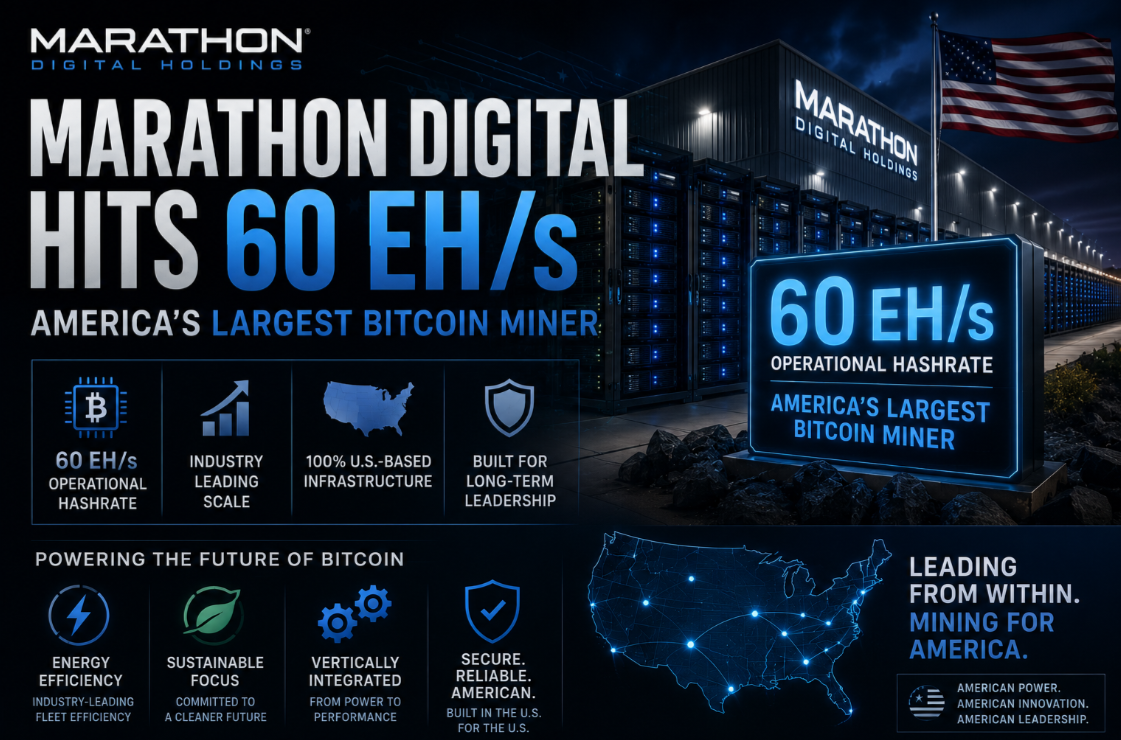
Marathon Digital Holdings reached 60 exahashes per second (EH/s) of installed Bitcoin mining capacity in April 2026, making it the world's largest publicly traded Bitcoin miner by hash rate. The milestone, achieved two quarters ahead of management's original 2026 target, reflects aggressive ASIC procurement, site expansion in the Middle East, and a strategic joint venture with a sovereign wealth fund in Abu Dhabi. For context on how Marathon's growth shapes network security, visit the Bitcoin market page.
The Road to 60 EH/s
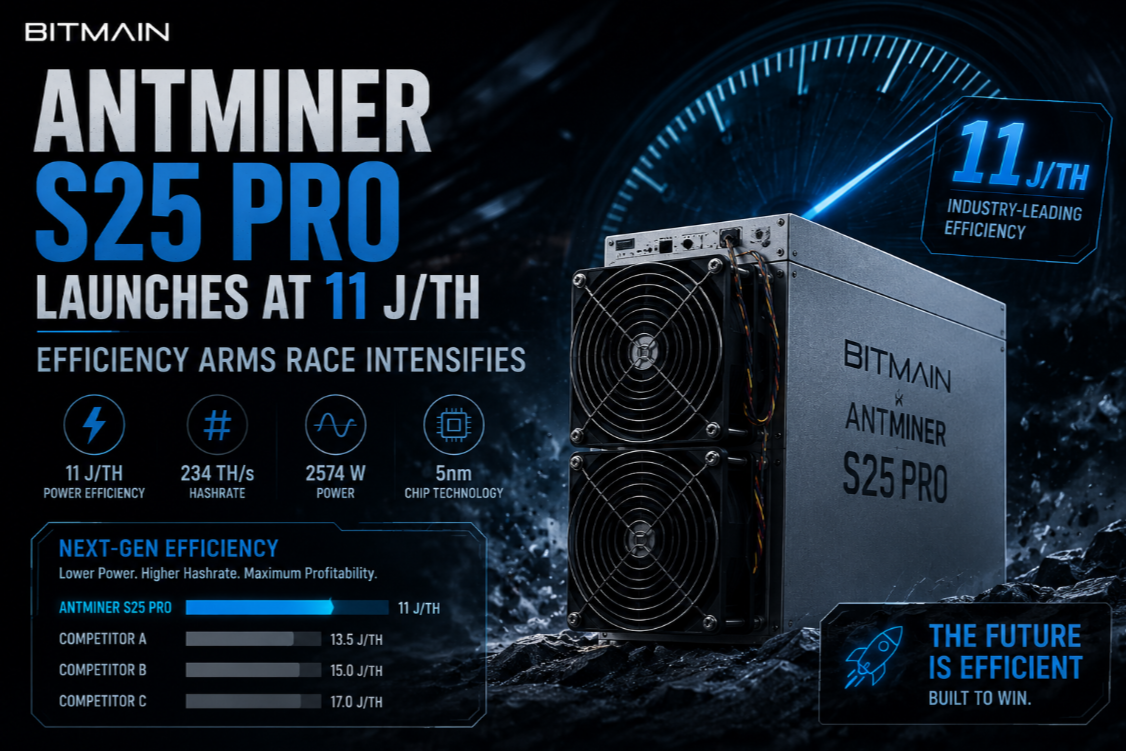
Marathon's growth story is a master class in capital markets-funded mining expansion. Starting from roughly 7 EH/s in early 2023, the company executed a multi-year fleet upgrade that retired most S19-generation machines in favour of Bitmain's S21 XP and S21 Pro ASICs — hardware that delivers 15-20 joules per terahash (J/TH) compared to 30+ J/TH for older machines. Each efficiency improvement directly widens the gap between revenue and operating cost at any given BTC price.
Financing came primarily through at-the-market equity offerings and convertible notes, a playbook borrowed from the corporate treasury Bitcoin world. Marathon raised approximately $1.8 billion between 2024 and early 2026 to fund hardware purchases, site development, and power infrastructure. Critics argue the dilution is excessive; management counters that locking in cheap electricity contracts and next-gen ASICs early creates durable competitive advantages that justify the equity cost.
The Abu Dhabi joint venture — a 50/50 partnership with a state-backed entity — contributed roughly 8 EH/s of capacity running on cheap natural gas flared from oil extraction. The deal exemplifies a broader trend of Gulf sovereign funds co-investing in Bitcoin mining as a way to monetise stranded hydrocarbon energy without increasing carbon emissions.
Fleet Composition and Efficiency Profile
Marathon's 60 EH/s fleet breaks down roughly as follows:
- Bitmain S21 XP Hyd (335 TH/s, 12 J/TH): ~40% of capacity — flagship efficiency
- Bitmain S21 Pro (234 TH/s, 15 J/TH): ~30% of capacity
- MicroBT M66S (298 TH/s, 14 J/TH): ~20% of capacity
- Older generation (S19 XP, M50S): ~10%, earmarked for retirement
The weighted average efficiency of approximately 13 J/TH means Marathon's breakeven BTC price at $0.04/kWh electricity sits around $38,000 — well below current prices. At $0.02/kWh on stranded-gas or flared-energy sites, the breakeven drops below $20,000, providing a margin of safety across virtually any plausible bear market scenario.
Impact on Bitcoin Network Difficulty and Small Miners
Marathon's 8% network share is a double-edged story for the Bitcoin ecosystem. On the positive side, higher hash rate means higher difficulty and a more secure network — making the cost of a 51% attack more expensive by billions of dollars. On the negative side, hash rate concentration in a small number of publicly listed US companies reintroduces single-points-of-failure risk that decentralised mining is supposed to eliminate. The Bitcoin price forecast models that use mining cost as a price floor input are updated to reflect Marathon's efficiency improvements.
Small solo miners and home mining operations have found it increasingly difficult to compete as the hash rate frontier moves to sub-13 J/TH machines. The economics for a home miner running a second-hand S19j Pro on residential electricity (typically $0.10-0.15/kWh) are deeply negative at current difficulty. Most hobbyist miners have migrated to smaller proof-of-work coins or accepted that Bitcoin mining is now an institutional-scale industry.
AI Computing as a Mining Hedge
Marathon has quietly built a GPU computing division alongside its ASIC operations. In periods when BTC price falls or difficulty spikes, GPU clusters can be redirected to AI inference and training workloads that generate dollar-denominated revenue without selling BTC. The strategy is still small relative to core mining operations — GPU revenue represented approximately 6% of total Q4 2025 revenue — but it establishes a template for diversification that several competitors are now copying.
For investors evaluating mining companies as a leveraged BTC play, the key metrics to track are hash price (revenue per EH/s per day), fleet efficiency (J/TH), and electricity cost. Up-to-date context on BTC price and network difficulty is available at the Bitcoin market overview and the guide to crypto mining in 2026.
Outlook: Can Marathon Reach 100 EH/s by 2027?
Management has guided for 100 EH/s by end of 2027 — a target that would require continued capital raises and no major setbacks in hardware delivery or site construction. Several risks could derail the timeline: ASIC supply constraints if Bitmain and MicroBT prioritise other customers, power grid permitting delays in new markets, and regulatory shifts in the United States that could restrict utility-scale mining.
Even at 100 EH/s, Marathon would represent roughly 10-12% of projected 2027 network hash rate — significant but not dominant. The more meaningful question for long-term investors is whether Marathon's balance sheet BTC holdings and low-cost energy contracts create a durable economic moat that survives multiple halving cycles, or whether the capital market treadmill eventually dilutes shareholders beyond the point of return.