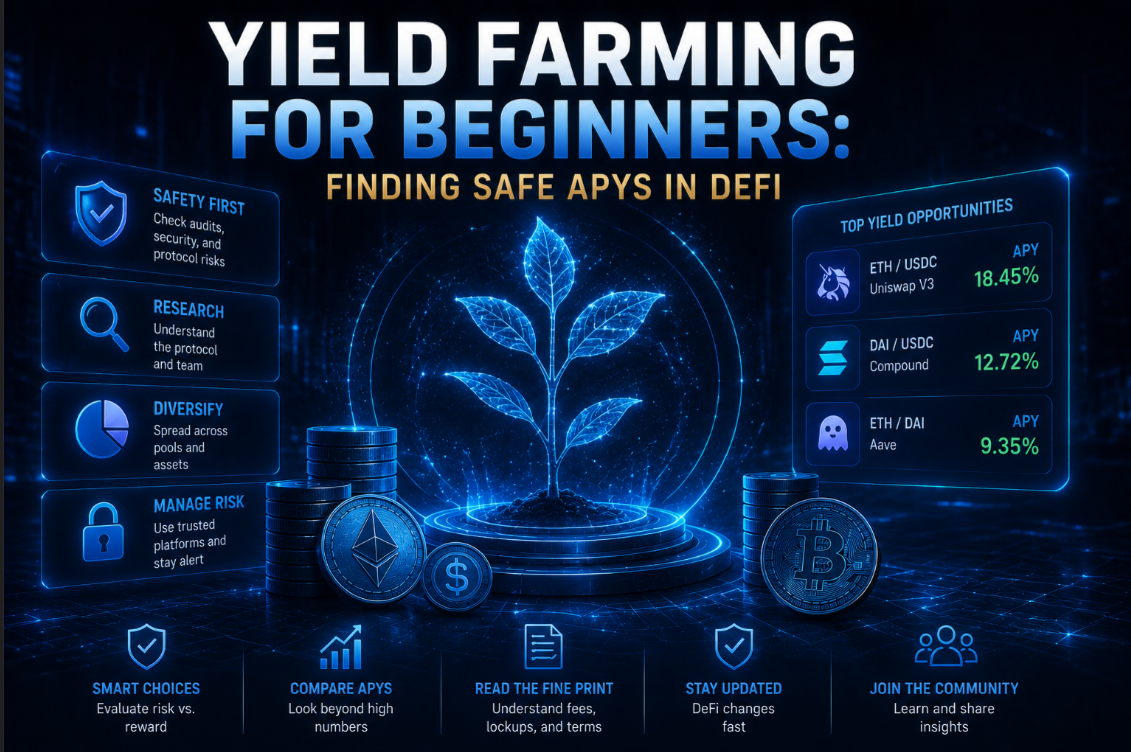
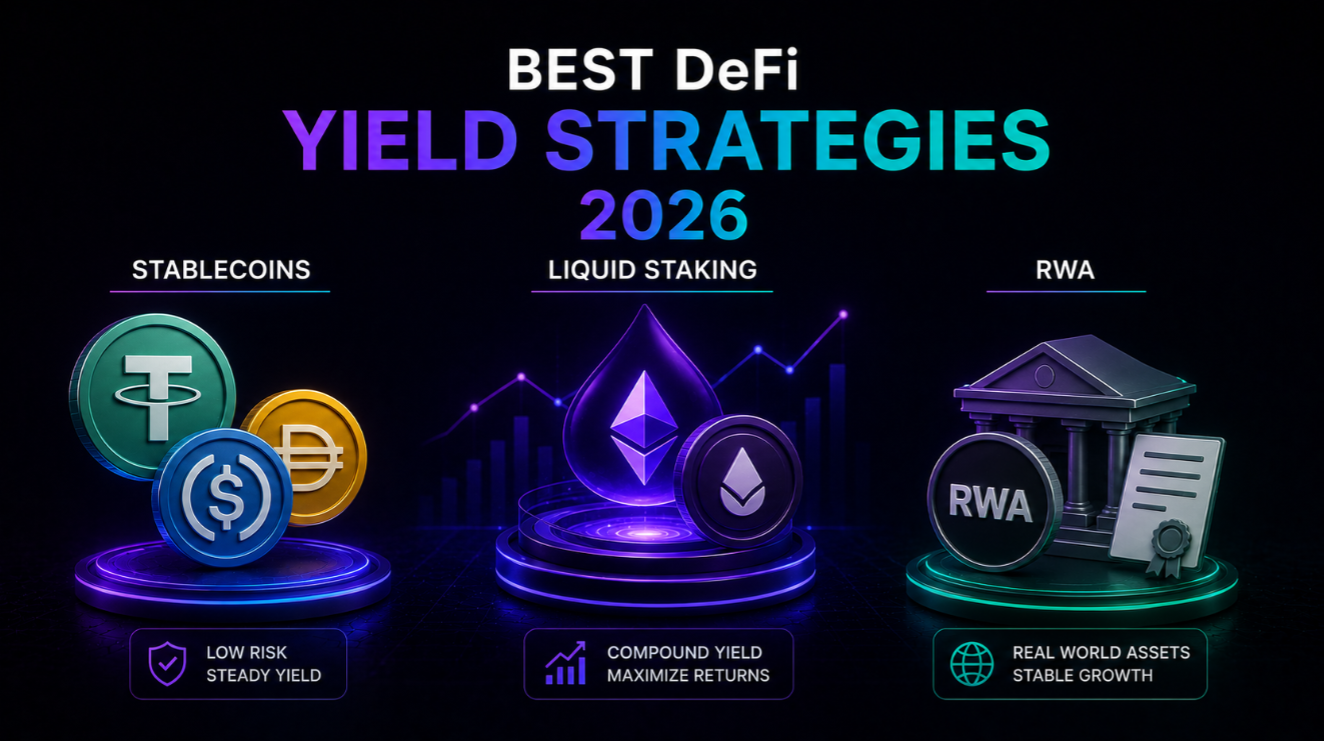
What is DeFi yield?
DeFi yield is the return you earn by putting crypto assets to work inside decentralized financial protocols — without handing custody to a bank, broker, or centralized exchange. Instead of a savings account paying you 0.5% annually, you supply liquidity directly to on-chain money markets, automated market makers, or tokenized credit facilities and receive protocol-native rewards in return.
The mechanics differ by strategy but the core logic is the same: capital earns a yield because someone else needs to borrow it, trade against it, or use it as collateral. Smart contracts replace the intermediary, which removes the need for trust but introduces a different set of risks that every participant must understand.
In 2026, DeFi has matured well beyond its "degen farming" origins. Total value locked (TVL) across all protocols has surpassed $200 billion. Institutional-grade infrastructure — on-chain credit facilities, real-world asset tokenization, and restaking primitives — has made DeFi a legitimate component of many portfolio strategies. This guide covers eleven of the most important yield sources available today, from the safest stablecoin lending positions to the more complex restaking and DeFi ratings that help you benchmark protocols.
Risk vs APY: how to think about DeFi returns
Higher APY almost always means higher risk. Before chasing double-digit returns you need to understand the risk spectrum, because the same headline number can hide very different threat profiles.
- Smart contract risk — Every yield strategy depends on code that can contain bugs. The higher the total value locked in a contract and the more audits it has passed, the lower (but never zero) this risk.
- Liquidity risk — If you supply assets to a pool, redemption can be delayed or constrained during periods of high utilization. Understand the withdrawal queue or lock-up rules before committing capital.
- Oracle risk — Lending protocols rely on price feeds. A manipulated or stale oracle can trigger cascading liquidations that drain pools.
- Depeg risk — Stablecoin strategies assume the underlying token holds its peg. When pegs break, nominal APY becomes meaningless against capital loss.
- Regulatory risk — DeFi protocols increasingly interact with regulated assets and must navigate evolving compliance requirements in 2026, particularly in the EU under MiCA.
- Impermanent loss — Liquidity providers in AMM pools are exposed to value divergence between paired assets. Even with fee income you can exit worse off than simply holding.
Rule of thumb: a sustainable APY from a battle-tested protocol in 2026 sits between 3% and 15%. Anything above 30% is either new, illiquid, or structurally fragile. Do not chase yield you cannot explain.
Stablecoin lending: Aave, Compound, and Morpho
Supplying stablecoins (USDC, USDT, DAI, GHO) to money-market protocols is the lowest-friction entry point for DeFi yield. You deposit stablecoins, receive an interest-bearing token that accrues value in real time, and withdraw whenever you want — no lock-up, no impermanent loss from price divergence.
Aave is the largest on-chain money market by TVL. On Aave v3 (and the rolling v4 Liquidity Hub rollout), USDC and USDT supply rates on Ethereum mainnet typically range from 4% to 9% APY depending on utilization. Aave v4 introduces isolated liquidity layers that allow higher-risk assets to coexist with blue-chip pools without contaminating each other. Read our full Aave review for a deeper breakdown.
Compound Finance pioneered the money-market model and remains a popular choice because of its conservative risk parameters and battle-tested codebase. Compound III (Comet) runs a single-borrow-asset design that keeps risk clean: each market accepts collateral but only lends one asset, which simplifies liquidation mechanics and reduces contagion paths.
Morpho takes a different approach. It sits on top of Aave and Compound as a peer-to-peer matching layer. When Morpho finds a lender and borrower whose positions match exactly, it routes them directly to each other at rates between the Aave supply APY and the Aave borrow APY — splitting the spread instead of passing it to the pool. Unmatched capital falls through to the underlying Aave or Compound pool, which means depositors always earn at least the base rate and often more.
- Aave v3/v4: 4–9% APY on USDC/USDT, deepest liquidity, widest asset selection
- Compound III: 3–7% APY, simplest risk model, conservative parameter governance
- Morpho Blue: 5–11% APY when matching is high, modular vault architecture, curated risk models
Liquid staking: Lido, Rocket Pool, and EigenLayer
Staking ETH earns consensus-layer rewards but traditionally locks capital: you cannot use staked ETH as collateral or in DeFi while it is staking. Liquid staking protocols solve this by issuing a receipt token (stETH, rETH) that represents staked ETH plus accrued rewards and can move freely through DeFi.
Lido is the dominant liquid staking protocol with over 30% of all staked ETH. When you deposit ETH into Lido, you receive stETH, a rebasing token whose balance increases daily as staking rewards accumulate. The base Ethereum staking APY in 2026 sits around 3.5%–5%, and Lido charges a 10% fee on rewards, bringing net stETH yield to roughly 3.2%–4.5%. The real benefit is composability: stETH is accepted as collateral by Aave, used in Curve pools, and forms the base layer for most restaking strategies.
Rocket Pool offers a decentralized alternative. Node operators run validators by pairing 8 ETH of their own capital with 24 ETH from the pool and putting up rETH as a collateral bond. This design eliminates the single-operator concentration risk that Lido carries. rETH yield is similar to stETH (3%–4.5%), and the protocol's RPL token provides additional upside for node operators.
EigenLayer introduces restaking, which is covered in more depth in its own section below. At the liquid-staking layer, Lido's stETH can be deposited into EigenLayer to earn AVS (Actively Validated Service) rewards on top of base staking yield, compounding the benefit of the same ETH collateral.
Liquidity provider yield: Uniswap v4 and Curve
Automated market makers pay liquidity providers a share of trading fees in exchange for providing the capital that makes swaps possible. LP yield is higher than lending yield but comes with impermanent loss — the risk that price divergence between the two assets in a pool causes your position to be worth less than simply holding both.
Uniswap v4 (launched in late 2024) introduces hooks — contract extensions that attach custom logic to a pool. This allows protocol developers to build features like dynamic fee tiers, on-chain limit orders, or TWAMM execution directly into the liquidity layer. For LPs, v4's concentrated liquidity model (inherited from v3) still applies: you choose a price range, your capital only earns fees when the price trades inside that range, and you earn more per dollar of capital than passive full-range providers — but you need to rebalance or get swept out of range.
Curve Finance dominates stablecoin and like-kind-asset swaps. Its invariant is optimized for assets that should trade near parity (USDC/USDT, stETH/ETH, cbETH/rETH), which allows very tight slippage and generates consistent fee income even in low-volatility markets. Curve's gauge system distributes CRV emissions to liquidity pools, and protocols bribe veCRV holders to redirect those emissions to their pools, creating a secondary yield layer on top of swap fees.
- Uniswap v4 concentrated-liquidity ranges on ETH/USDC: 10–40% APR (range-dependent, impermanent loss applies)
- Curve stETH/ETH pool: 4–8% APR from fees + CRV emissions (correlated assets, minimal IL)
- Curve USDC/USDT/USDC.e pool: 3–6% APR, very low IL exposure, high stability
Restaking: extending ETH security with EigenLayer
Restaking is the defining DeFi primitive of 2025–2026. EigenLayer allows ETH validators (and liquid staking token holders) to opt in to securing additional services — oracles, data availability layers, bridging networks, and other Actively Validated Services — in exchange for extra rewards, in addition to base ETH staking yield.
The mechanics: you deposit ETH or a liquid staking token (stETH, rETH, cbETH) into EigenLayer's restaking contracts. You then delegate that stake to one or more Operators who run AVS software. Each AVS pays rewards to operators and restakers. In return, your capital takes on slashing risk from those AVS: if an operator misbehaves on the oracle or bridging network you are securing, a portion of restaked capital can be slashed.
As of 2026, the EigenLayer ecosystem includes dozens of live AVS. The combined yield on restaked stETH (base staking + AVS rewards + potential liquid restaking token rewards) ranges from 5% to 12% depending on which AVS you opt in to. Liquid restaking protocols like ether.fi, Renzo, and Kelp tokenize the restaked position into another receipt token (eETH, ezETH, rsETH), adding one more composability layer but also one more smart-contract dependency.
Restaking amplifies yield by adding AVS reward layers, but it also compounds slashing risk. Always check which AVS an operator runs and whether those AVS have mainnet slashing conditions live before delegating.
Real-world asset yields: Ondo, Maple, and Centrifuge
Real-world asset (RWA) tokenization brings off-chain yield sources — T-bills, commercial credit, real estate, trade finance — on-chain. The idea is straightforward: a protocol buys a yield-generating real-world instrument (e.g. short-duration US Treasuries), issues a token representing a claim on that instrument, and distributes the yield to token holders. In 2026, RWA TVL has exceeded $15 billion, driven by persistently high traditional interest rates.
Ondo Finance offers OUSG (tokenized short-term US Treasuries) and USDY (a yield-bearing stablecoin backed by bank deposits and T-bills), targeting 4.5%–5.5% APY. Ondo's products are permissioned for KYC'd investors but increasingly integrated with DeFi protocols that accept USDY as collateral — creating a bridge between TradFi yield and on-chain composability.
Maple Finance is an on-chain institutional credit market. Institutional borrowers (crypto market makers, miners, trading firms) take out undercollateralized loans from whitelisted lender pools. Pool delegates conduct credit underwriting and manage default risk. Maple senior lending pools in 2026 offer 8%–12% APY on USDC, reflecting credit risk comparable to investment-grade corporate paper.
Centrifuge tokenizes real-world loans — trade receivables, invoice financing, consumer credit — into drop (senior) and tin (junior) tranches. Drop holders take first-loss protection and earn lower yields (5%–8%); tin holders take first-loss risk and earn higher returns (10%–18%). Both tokens can be used in Maker vaults as collateral, providing a DeFi money-market connection to physical economy credit.
- Ondo USDY: ~4.5–5.5% APY, T-bill backed, KYC required for primary market, USDY usable in DeFi
- Maple senior pools: 8–12% APY, USDC, institutional credit underwriting, lower liquidity than money markets
- Centrifuge DROP tranches: 5–8% APY, asset-backed, MakerDAO integration, monthly redemption windows
Yield aggregators and fixed-rate strategies: Pendle
Yield aggregators automate the process of moving capital across protocols to chase the highest rate. Yearn Finance pioneered this model: its vaults hold deposited assets, monitor rates across lending markets and AMMs, and rebalance automatically. In 2026, the most interesting aggregation primitive is not Yearn but Pendle.
Pendle splits a yield-bearing token (e.g. stETH, aUSDC) into two components: a Principal Token (PT) that matures to the underlying at a fixed date, and a Yield Token (YT) that captures all the yield generated until maturity. This decomposition lets you do things that are impossible in traditional DeFi:
- Fix your yield: buy the PT at a discount and hold to maturity, locking in a guaranteed rate regardless of how variable market rates fluctuate.
- Lever up yield: buy YT to gain leveraged exposure to yield without increasing principal risk — if rates rise sharply, YT outperforms; if rates compress, YT can expire worthless.
- Provide liquidity: LP in Pendle's AMM between PT and the underlying token, earning swap fees from traders who are repricing yield expectations.
Pendle markets in 2026 span stETH, wstETH, aUSDC, sDAI, eETH, and a growing roster of RWA tokens. Fixed PT yields on 6-month stETH maturities have ranged from 4% to 8%. The protocol has become the go-to tool for sophisticated yield management and is often the first place institutional DeFi participants look when building structured yield positions.
Smart contract risks: what to check before you deploy capital
Every DeFi position carries smart contract risk. Unlike a bank deposit, there is no deposit insurance and no regulator to compel repayment if a protocol is drained by an exploit. Here is a minimum checklist before deploying meaningful capital:
- Audit coverage: check how many independent firms have audited the contracts. Look for firms with track records: Trail of Bits, OpenZeppelin, Spearbit, Cantina. More audits from reputable firms is better, but audits are not guarantees.
- Bug bounty: active bug bounties (Immunefi, HackerOne) with meaningful payouts signal that the team takes security seriously and provides an economic incentive for white-hat researchers to find issues.
- Time in production: code that has been running in production, holding significant TVL, for 18+ months without an exploit has survived real adversarial testing. Brand-new contracts have not.
- Upgrade mechanism: can the contract be upgraded by a multisig? What is the timelock on upgrades? Who holds the keys? A 2-of-3 multisig with no timelock is a governance risk.
- Oracle design: how does the protocol price assets? Chainlink + TWAP fallback is the current best practice. Protocols relying solely on spot prices from a low-liquidity DEX are vulnerable to flash-loan manipulation.
- On-chain monitoring: set up alerts through DeFi protocol dashboards or third-party tools for sudden TVL drops, large liquidation events, or governance proposals that could change risk parameters.
Tax implications of DeFi yield
DeFi yield is taxable income in most jurisdictions. The specifics vary by country, but the framework most regulators apply in 2026 treats protocol rewards the same way they treat bank interest or dividend income. This section provides general information; consult a qualified tax professional for advice specific to your situation.
- Staking and lending rewards: generally treated as ordinary income at the time the rewards are received, valued at the market price of the token when it enters your wallet.
- LP fee income: treated as ordinary income in most frameworks. The calculation can be complex because fees accrue continuously and are often realized only on withdrawal.
- Token swaps inside protocols: each time you swap one token for another — including wrapping stETH to wstETH, or converting USDC to aUSDC — many jurisdictions treat this as a disposal and a taxable event.
- Impermanent loss: tax treatment is unsettled in most jurisdictions. Some treat exit from an LP position as a disposal of both underlying tokens at current market price; others look at the net result on withdrawal.
- Record keeping: use on-chain tax tools (Koinly, TaxBit, Cointracker) that connect directly to your wallet and decode DeFi transactions. Manual record keeping at scale is error-prone and time-consuming.
The EU's MiCA regulation and subsequent guidance has created clearer reporting requirements for crypto-asset income in EU member states. US IRS guidance from 2024–2025 extended Form 1099 broker reporting to include certain DeFi protocols. Stay current with the rules in your country and document every transaction.
How to start: a practical step-by-step guide
If you are new to DeFi yield, the following sequence balances learning with capital preservation. Do not skip steps.
- Start with a battle-tested money market. Deposit a small amount of USDC into Aave v3 on Ethereum or Arbitrum. Observe how aUSDC accrues, how utilization affects your rate, and how withdrawals work. Read the Aave review to understand the protocol's risk parameters.
- Add liquid staking for ETH exposure. Once you are comfortable with money markets, deposit some ETH into Lido to receive stETH. Check the current Lido DAO token page for protocol stats. Hold for at least one staking cycle (several days) to observe reward accrual.
- Explore Pendle for rate management. When you understand base yields, visit the Pendle market page and look at the PT/YT breakdown on stETH. Consider buying a PT for a fixed-rate position instead of holding stETH outright.
- Research RWA options. If you want TradFi-grade yield on-chain, review Ondo Finance's offerings. Check the Ondo Finance page for current token data and compare the yield to Aave money-market rates.
- Consider LP positions last. Impermanent loss is the most misunderstood concept in DeFi. Only enter LP positions after you have fully read the documentation on concentrated liquidity and modeled IL scenarios with a simulator.
- Use DeFi aggregators for overview. Tools like DefiLlama, Zapper, and Zerion give you a portfolio-wide view of APYs, TVL, and protocol health. Use them to monitor your positions and compare rates across protocols.
- Review the DeFi ratings. Before committing to any protocol, check the DeFi ratings to see how protocols rank on security, liquidity, and track record.
DeFi yield in 2026 offers a genuine alternative to traditional savings instruments — with substantially higher complexity and risk. The protocols covered in this guide — Aave, Compound, Morpho, Lido, Rocket Pool, EigenLayer, Uniswap, Curve, Ondo, Maple, Centrifuge, and Pendle — represent the most mature, most audited, and most liquid options available. Start small, understand the mechanism before scaling, and never deploy capital you cannot afford to lose to a smart contract exploit.