Can you still mine Bitcoin at home in 2026?
Home Bitcoin mining is not dead — but the economics are tight. The global network hashrate has grown beyond 700 EH/s, meaning the difficulty of finding a valid block has never been higher. An individual miner at home cannot compete with industrial farms in Kazakhstan or Texas running tens of thousands of ASICs. Yet a well-planned home setup can still generate meaningful returns if you understand the numbers before you buy.
The key insight is this: profitability does not depend on mining a block. It depends on joining a pool, where your machine contributes a fraction of the pool's total hashrate and earns a proportional share of every block the pool finds. With pool mining, a single Antminer S19 XP at home earns small daily payouts — and whether those payouts exceed your electricity cost is the entire question.
Choosing the right ASIC miner for home use
ASIC miners are purpose-built chips that solve Bitcoin's SHA-256 proof-of-work algorithm vastly more efficiently than any GPU or CPU. For home miners, the main constraints are noise (ASICs sound like jet engines), heat (they exhaust hot air continuously), and power draw (modern top models consume 3,000–3,500 W each).
- Antminer S19 XP (140 TH/s, ~3,010 W): One of the most popular used models on the secondary market. Excellent efficiency at 21.5 J/TH. Widely available from $1,200–2,000 used.
- Antminer S21 (200 TH/s, ~3,500 W): The current flagship from Bitmain. Efficiency of 17.5 J/TH. New units cost $3,000–4,500. Better for serious setups.
- WhatsMiner M60S (186 TH/s, ~3,441 W): MicroBT's leading model, competing directly with the S21. Similar efficiency, slightly different noise profile. Prices comparable.
- Antminer S19j Pro (100 TH/s, ~3,050 W): Older but widely available used. Higher J/TH than newer models, so only viable where electricity is very cheap (<$0.06/kWh).
For home miners, the secondary market is often the best option. New ASICs are sold in bulk to industrial customers first. Used machines at 60–70% of retail price give you an entry point with faster payback periods — provided you verify the machine's condition before buying.
ROI calculator: the core formula
Before buying any hardware, run the numbers. The fundamental calculation is:
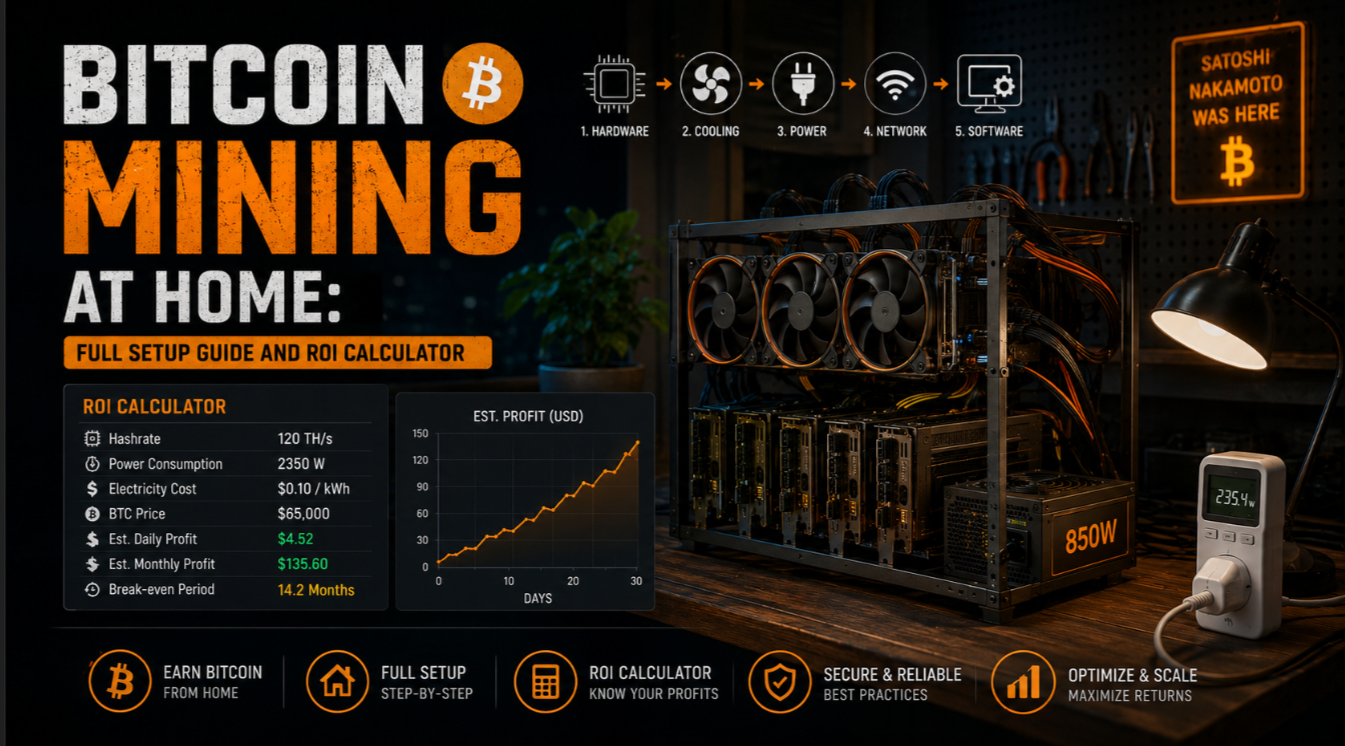
Daily revenue = (your hashrate / network hashrate) × daily block rewards × BTC price
In 2026, daily block rewards total approximately 450 BTC (3 BTC per block × 144 blocks/day after the April 2024 halving). With a network hashrate of 700 EH/s, an S19 XP at 140 TH/s has a share of 140 TH / 700,000,000 TH = 0.00000002 of the network, earning roughly 0.0000045 BTC per day, or about $0.45 at $100,000/BTC.
Daily electricity cost = power draw (kW) × hours × electricity rate ($/kWh)
An S19 XP at 3.01 kW running 24 hours costs 72.24 kWh/day. At $0.10/kWh that is $7.22/day. At $0.05/kWh it is $3.61/day. The difference between those two rates is the entire profit margin for home miners.
Use online calculators like Whattomine or Nicehash's profitability tool to check current numbers. Always input your actual electricity rate — not the national average. Also account for pool fees (typically 1–2%), and the cost of a dedicated circuit and cooling.
Electricity rate: the single most important variable
A Bitcoin miner breaks even or profits entirely on the margin between what it earns and what it pays for electricity. At $0.04/kWh, almost any modern ASIC is profitable. At $0.15/kWh, almost none are. The typical US residential rate is $0.13–0.17/kWh — at those rates, home mining is nearly always unprofitable at current difficulty.
- Solar power: If you have excess solar capacity during daytime hours, mining can absorb that free or very cheap electricity. The challenge is matching the miner's 24/7 draw with solar's variable output.
- Time-of-use rates: Some utilities offer very cheap off-peak rates (late night / early morning). Running miners only during those windows can improve margins.
- Industrial or agricultural rates: Businesses or farms sometimes have access to 3-phase power at significantly lower rates. Mining is increasingly common in rural areas for this reason.
- Natural gas / stranded energy: Some home miners use generators on cheap natural gas, or are near hydroelectric or wind facilities with surplus production.
If your local electricity rate is above $0.08/kWh and you do not have a special arrangement, the numbers rarely work for a single-machine home setup in 2026. The machines are profitable in the aggregate — industrial miners prove that — but the economics require scale and cheap power.
Infrastructure requirements for home ASIC mining
A single Antminer S19 draws 3 kW continuously. That is the equivalent of 30 incandescent light bulbs running nonstop. Your home electrical system must be able to support this safely.
- Install a dedicated 20A or 30A 240V circuit for each ASIC. Do not run miners off standard household 15A circuits.
- Use a PDU (power distribution unit) rated for the miner's power draw, not a standard power strip.
- Ensure the room has adequate airflow: ASICs push out roughly 3 kW of heat continuously. A garage or basement with intake and exhaust fans works. A bedroom does not.
- Use a network-connected power meter to monitor actual consumption and detect faults.
- Keep the miner firmware updated — Bitmain and MicroBT release patches that improve efficiency and fix bugs.
Noise is a serious home-mining challenge. The Antminer S19 XP runs at approximately 75 dB(A) — comparable to a vacuum cleaner — continuously. Sound-dampening enclosures (DIY or commercial) are available and can reduce this to around 55–60 dB at the cost of additional cooling complexity.
Pool selection: where to point your hashrate
Joining a mining pool is essential for home miners. The probability of solo-mining a Bitcoin block with a single consumer ASIC is astronomically small — statistically, you might wait decades. Pools aggregate hashrate and share rewards proportionally. See our solo vs pool mining breakdown for the detailed probability analysis.
- Foundry USA Pool: Largest pool by hashrate (~30% of global share). US-based, FPPS+ payout model, strong reputation.
- Antpool: Operated by Bitmain. Second or third by hashrate. FPPS model. Some controversy around centralisation.
- F2Pool: Long-established pool, global presence. PPS+ payout model. Good track record.
- Braiins Pool (formerly Slushpool): The oldest Bitcoin pool. Score-based payout, transparent, open-source mining firmware (Braiins OS).
Compare pools on fee structure (PPS vs PPLNS vs FPPS), minimum payout threshold, and transparency of hashrate distribution. Avoid small or anonymous pools with no track record.
Payback period: realistic scenarios
Let's model two scenarios for an S19 XP bought used at $1,800:
Scenario A — $0.06/kWh electricity (cheap):
- Daily revenue: ~$0.45 (at $100k BTC, 140 TH/s)
- Daily electricity: $0.06 × 72.24 kWh = $4.33
- Daily profit: $0.45 − $4.33 = −$3.88 (unprofitable)
At $100k BTC, even $0.06/kWh is marginal. Profitability improves significantly if BTC rises to $150k–200k.
Scenario B — $0.03/kWh electricity (industrial/solar):
- Daily revenue: ~$0.45
- Daily electricity: $0.03 × 72.24 kWh = $2.17
- Daily profit: $0.45 − $2.17 = −$1.72 (still tight)
Mining profitability is highly sensitive to BTC price and difficulty. At $200k BTC with the same difficulty, revenue roughly doubles. Many home miners treat mining as a way to accumulate BTC at a discount relative to spot price, rather than generating fiat profit. See current Bitcoin price and Bitcoin forecast to factor price trajectory into your projections.
Tax and legal considerations for home miners
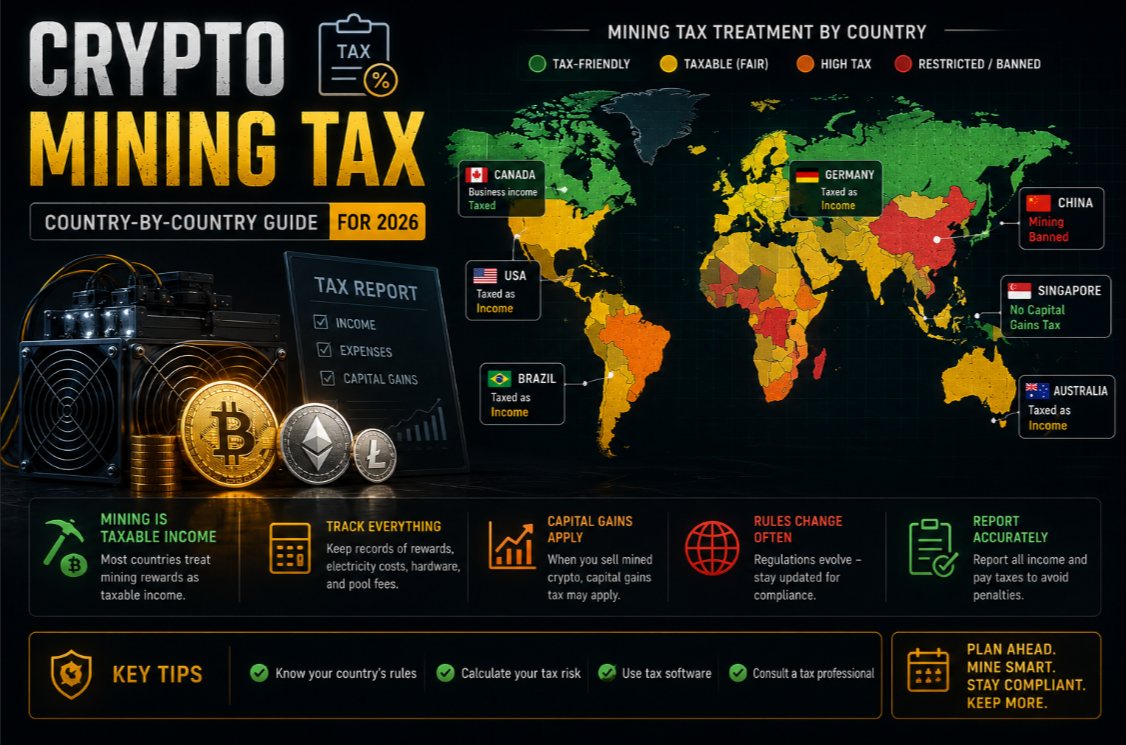
In most jurisdictions, mined cryptocurrency is taxable income at the fair market value at the time of receipt. This means every day you receive a pool payout, that amount is reportable income. When you later sell the mined BTC, you also owe capital gains tax on any appreciation since the mining date.
Keep detailed records: daily payout amounts (in BTC and USD), electricity costs (deductible as a business expense if mining is conducted as a business), hardware costs (may be depreciable), and any other associated costs. Consult a tax professional familiar with cryptocurrency in your jurisdiction. Our mining tax guide covers the rules in eight countries.
Is home Bitcoin mining worth it in 2026?
Home Bitcoin mining is viable only in specific circumstances: very cheap electricity (under $0.05/kWh), a rising BTC price conviction, or a strategic preference for accumulating BTC through mining rather than buying. For the majority of people with standard residential electricity, it is not profitable at current network difficulty and BTC price.
The opportunity is real for people with excess solar, agricultural power access, or proximity to cheap hydro. For everyone else, buying BTC directly is likely more capital-efficient than mining hardware. Run the numbers honestly before purchasing equipment.
This article is for educational purposes only. Mining profitability depends on factors that change daily including BTC price, network difficulty, and electricity rates. Not financial advice.