What is an EOA and why it has limits
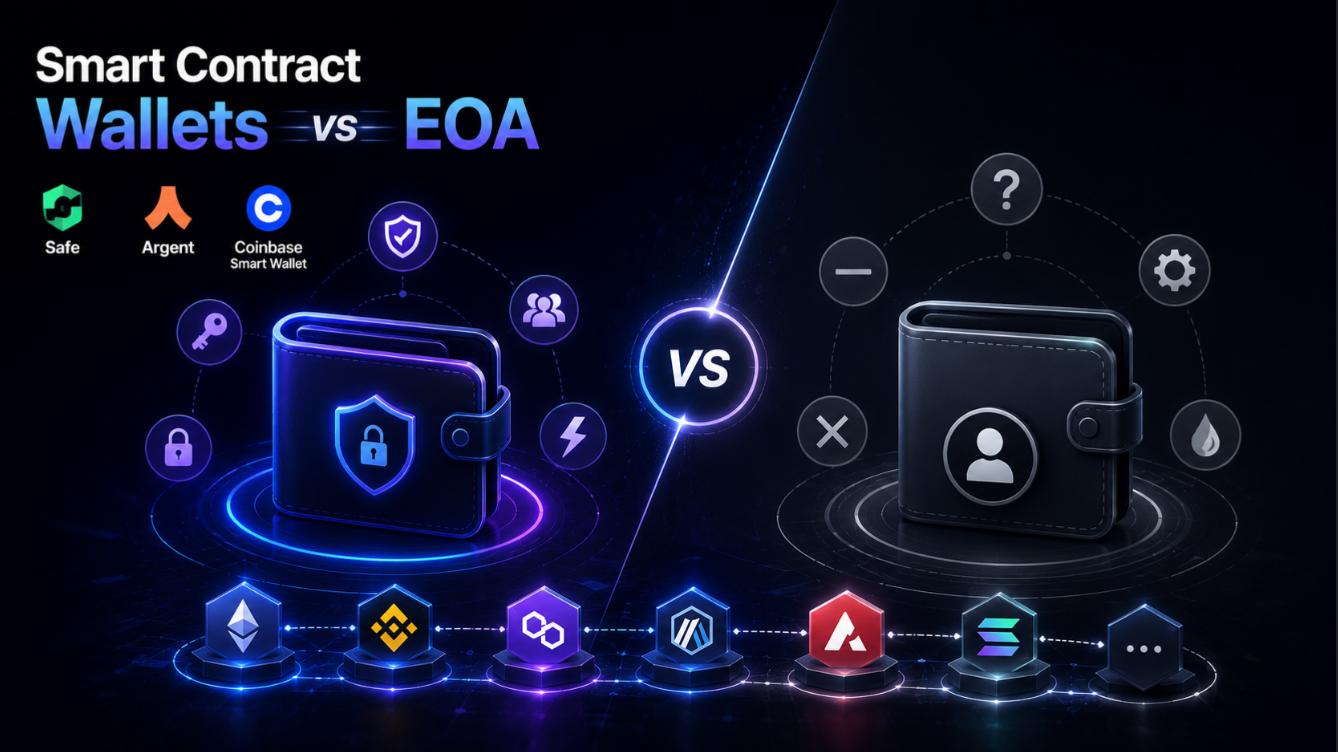
An Externally Owned Account (EOA) is the wallet type that powers MetaMask, Ledger, and virtually every crypto wallet most users have ever touched. An EOA is controlled by a single private key — whoever holds the key controls the funds. That simplicity is also its weakness: one lost seed phrase or compromised key and every asset is gone instantly, with no recovery mechanism.
EOAs cannot have built-in spending limits, cannot require multi-party approval, cannot enforce time delays on large transfers, and cannot be recovered without the seed phrase. These constraints are acceptable for small balances but become unacceptable when holdings grow.
What is a smart contract wallet
A smart contract wallet replaces the single private key with programmable logic deployed on-chain. Instead of "whoever has this key can do anything", a smart contract wallet enforces custom rules: require two of three co-signers, limit daily transfer amounts, whitelist addresses, enforce a 24-hour delay on new payees, or allow social recovery via trusted guardians.
The wallet's address is a smart contract, not a key. You interact with it through one or more signing keys, but the contract code defines what is ultimately allowed. This means rules can be updated, signers can be rotated, and recovery can be built-in without moving funds to a new address.
Safe — the institutional standard for smart contract wallets
Safe (formerly Gnosis Safe) is the most widely deployed smart contract wallet in crypto. It powers over $100 billion in assets across more than one million deployed instances, including the treasuries of Aave, Uniswap, and most major DAOs. Safe is a multi-signature wallet: you define a threshold (e.g., 2-of-3) and all transactions above that threshold require approval from multiple signers.
Safe modules allow advanced features: spending modules that enforce daily limits, delegate modules for timelocked operations, and recovery modules that allow a designated guardian to rotate a lost signing key. The codebase has been audited by multiple firms and has been battle-tested since 2018 with no funds lost to smart contract exploits.
- Best for: Teams, DAOs, protocols, high-net-worth individuals who want multi-sig custody.
- Chains: Ethereum, Arbitrum, Optimism, Base, Polygon, Gnosis Chain, and 10+ others.
- Cost: One-time deployment gas fee; no ongoing fees.
- Key feature: Programmable multi-sig with an extensive module ecosystem.
Argent — smart wallet designed for everyday users
Argent targets individual users who want smart contract wallet benefits without multi-sig complexity. Its signature feature is Guardian-based social recovery: you designate trusted friends, other wallets, or a hardware device as guardians. If you lose your phone, guardians can approve a signing key rotation to a new device — no seed phrase required.
Argent enforces daily transfer limits and whitelisted address protections. Any transfer to an address not on your whitelist triggers a 24-hour security lock unless a guardian approves. Argent v3 is built on zkSync Era and offers very low gas fees alongside full smart wallet functionality.
- Best for: Individual users who want recovery options and security guardrails.
- Chains: zkSync Era (primary), Starknet.
- Key feature: Guardian recovery — no seed phrase required for account restoration.
- Trade-off: Chain-limited; not ideal for Ethereum mainnet or Solana users.
Coinbase Smart Wallet — the ERC-4337 newcomer
Coinbase Smart Wallet is built on ERC-4337 (Account Abstraction), the Ethereum standard that allows smart contract wallets to be created without a prior EOA. Users can sign in with a passkey (Face ID, fingerprint) instead of a seed phrase. Gas can be sponsored by dApps, and the wallet supports EIP-7702 for cross-chain smart account linking.
Because ERC-4337 uses a separate "bundler" infrastructure, Coinbase Smart Wallet can interact with any ERC-4337-compatible dApp without needing the dApp to be modified. Coinbase sponsors gas for new users, making onboarding gasless. Recovery is via passkey backup — synced through device ecosystems like iCloud Keychain.
- Best for: New users and dApp developers building gasless onboarding flows.
- Chains: Ethereum, Base, Optimism, Arbitrum, Polygon.
- Key feature: Passkey sign-in, gasless transactions via Coinbase sponsorship.
- Trade-off: Passkey recovery depends on device/cloud ecosystem security.
ERC-4337 Account Abstraction — the standard unifying smart wallets
ERC-4337 is the Ethereum standard that enables smart contract wallets to work like EOAs in the dApp ecosystem — same address, same UX, but programmable logic underneath. Before ERC-4337, smart wallets required dApps to explicitly support them. Now any ERC-4337 wallet can interact with any dApp that processes standard Ethereum transactions, because the wallet's UserOperations are bundled into standard calls before hitting the chain.
ERC-4337 enables: passkey signing, batched transactions (approve + swap in one click), gas payment in any token (paymasters), and session keys for gaming or trading bots. This standard is the foundation for most new consumer wallets launched since 2024.
EOA vs smart contract wallet: security comparison
- Single point of failure: EOA — one key, one catastrophic failure mode. Smart wallet — programmable threshold, guardian recovery.
- Phishing resistance: EOA — zero protection once a key is signed. Smart wallet — can enforce transaction simulation and address whitelisting.
- Recovery: EOA — impossible without seed phrase. Smart wallet — guardian rotation, passkey backup, multi-sig rotation.
- Spending limits: EOA — none. Smart wallet — programmable daily limits.
- Smart contract risk: EOA — none. Smart wallet — contract vulnerability risk (mitigated by audits).
- Gas cost: EOA — cheaper per transaction. Smart wallet — additional overhead for smart contract execution and bundlers.
When to choose an EOA wallet
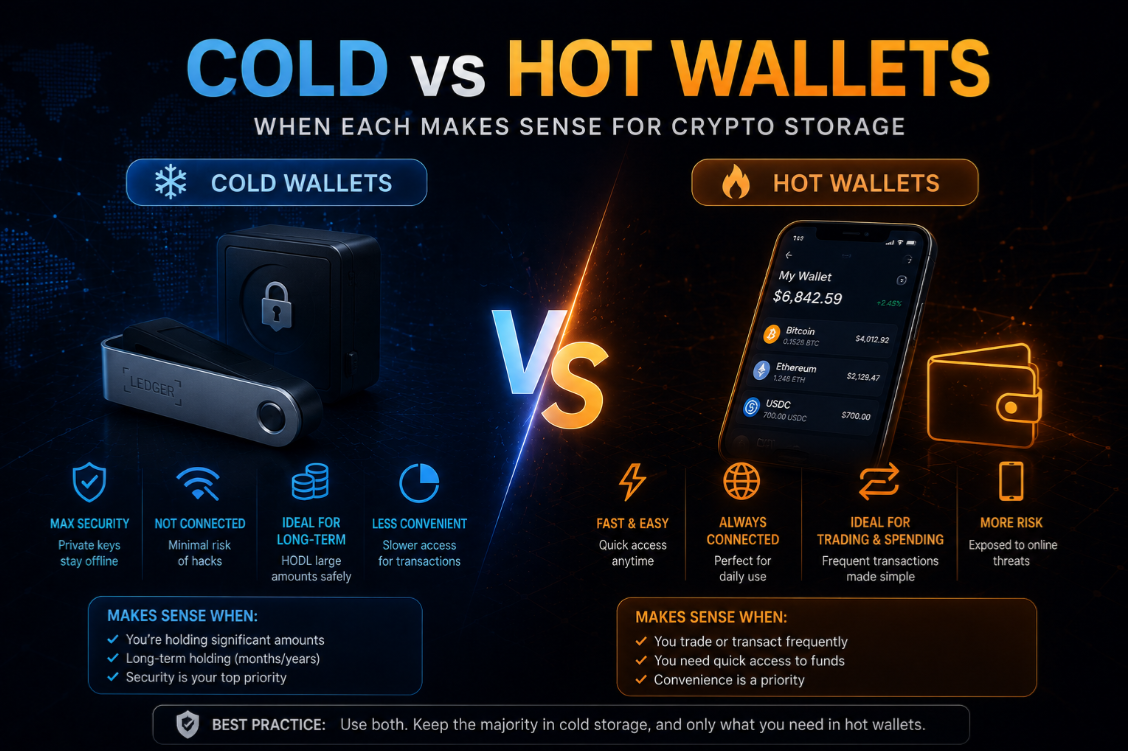
EOAs remain the right choice for interacting with DeFi protocols that may not fully support smart wallet transaction formats, for users on chains where smart wallets have limited deployment, and for cases where absolute simplicity and cost minimisation matter more than recovery features. Use a hardware wallet like Ledger to protect an EOA from key compromise — our Ledger review covers setup and best practices in detail.
When to upgrade to a smart contract wallet
Consider upgrading to a smart contract wallet when you manage more than $10,000 in crypto, when you need team-controlled treasury funds, when you want social recovery without writing down a seed phrase, or when you are building a dApp and want to offer users a better onboarding experience. For portfolio management across multiple protocols, see our wallet ratings page.
The future: EIP-7702 and EOA-to-smart-wallet upgrades
EIP-7702 (included in the Pectra upgrade) allows existing EOA addresses to temporarily act as smart contract wallets for individual transactions, without full migration. This means long-time Ethereum users can retain their familiar address while gaining smart wallet features — batch transactions, gas abstraction, and session keys — on demand.
The boundary between EOA and smart contract wallet is blurring. Most analysts expect smart wallet adoption to surpass EOAs in new wallet creation within two years, while EIP-7702 bridges the existing EOA user base into the smart wallet ecosystem without requiring address changes.
Choosing between Safe, Argent, and Coinbase Smart Wallet
- Need multi-sig for a team or DAO: Safe — unmatched track record and module ecosystem.
- Individual user, want recovery without seed phrase: Argent (zkSync) or Coinbase Smart Wallet.
- Building a dApp with gasless onboarding: Coinbase Smart Wallet (ERC-4337 native, Base-first).
- Need Ethereum mainnet and broad chain support: Safe or Coinbase Smart Wallet.
- Want the simplest option with hardware security: EOA + Ledger hardware wallet.
This article is for educational purposes only. Smart contract wallets reduce but do not eliminate risk. Always verify wallet security independently before storing significant assets.