
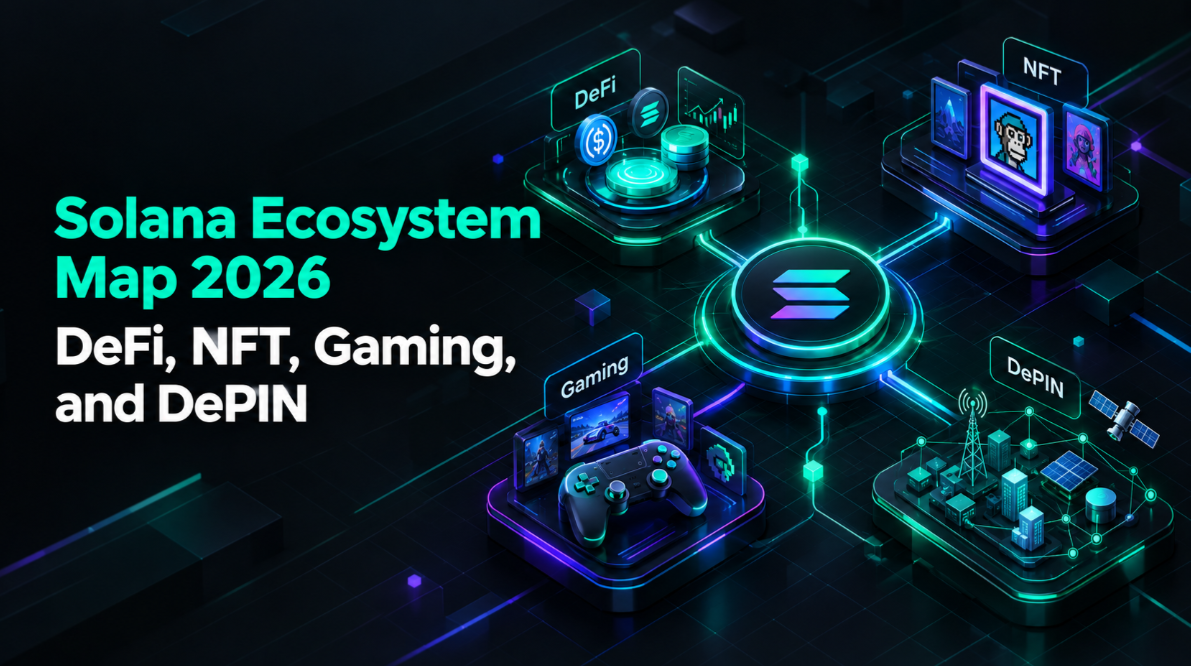
Why Solana became a multi-vertical ecosystem
When Solana launched in 2020 it was positioned purely as a high-throughput payments and trading chain. Six years later it hosts one of the most diverse blockchain ecosystems in existence — spanning decentralised finance, NFT marketplaces, on-chain gaming, and a fast-growing category called decentralised physical infrastructure networks (DePIN). The common thread is speed and cost: Solana processes transactions in 400 milliseconds at fees measured in fractions of a cent, making micro-interactions viable that would be economically impossible on Ethereum mainnet.
Understanding the ecosystem map matters for any investor, builder, or user evaluating SOL exposure. Each vertical has its own leading protocols, token incentives, and risk profile. This guide covers the four main pillars of the Solana ecosystem as of 2026 and highlights the key projects in each.
DeFi on Solana: depth and native liquidity
Solana DeFi has matured into a genuinely competitive alternative to Ethereum's DeFi stack. Total value locked across Solana protocols exceeded $8 billion by early 2026, with a handful of native protocols dominating activity.
Jupiter Exchange is the dominant swap aggregator, routing trades across all Solana DEXs to find the best execution price. Jupiter processes hundreds of millions of dollars in daily volume and has added limit orders, dollar-cost averaging (DCA), and perpetuals trading to its suite. It is the de facto DeFi entry point for most Solana users.
Raydium is the leading automated market maker (AMM) on Solana, providing concentrated liquidity pools and acting as the liquidity backbone for many new token launches via its LaunchLab and permissionless pool creation. Raydium's integration with centralised order book liquidity gives it a unique hybrid model.
- Kamino Finance: Automated liquidity management and lending. Kamino's multiply vaults allow leveraged yield strategies on top-tier assets.
- MarginFi: Over-collateralised lending protocol with a community-driven points programme that became a model for ecosystem user acquisition.
- Drift Protocol: Decentralised perpetuals and spot margin exchange with a cross-margined risk engine.
- Sanctum: Liquid staking aggregator that allows new liquid staking tokens (LSTs) to be bootstrapped with deep instant liquidity.
NFTs on Solana: from PFPs to compressed tokens
Solana became a major NFT chain in 2021 thanks to near-zero minting costs compared to Ethereum. Collections like Degenerate Ape Academy, Okay Bears, and Mad Lads built large communities. The NFT ecosystem is anchored by two marketplaces: Tensor (a pro-trader platform with advanced analytics and liquidity pools) and Magic Eden (the consumer-friendly gateway with cross-chain reach).
A technical breakthrough called compressed NFTs (cNFTs), introduced via the Metaplex Bubblegum protocol, reduced minting costs to fractions of a cent per token. This unlocked mass-distribution use cases — game items, loyalty points, community credentials — that were previously not economically viable. Millions of cNFTs have been airdropped to Solana wallets as part of protocol user acquisition campaigns.
- Metaplex: The NFT standard layer on Solana. Provides token metadata, compressed NFT infrastructure, and creator royalty enforcement tools.
- Tensor: Professional NFT trading with AMM liquidity pools, portfolio analytics, and a native TNSR governance token.
- Magic Eden: Consumer marketplace with multi-chain reach. The dominant platform for retail NFT buyers on Solana.
Gaming on Solana: real ownership, on-chain economies
Web3 gaming on Solana moved past the play-to-earn speculation of 2021–2022 toward sustainable game designs where blockchain is used selectively for true asset ownership rather than as a reward-emission engine. Several studios are building games where in-game items are NFTs that players genuinely own, trade, and use across game versions.
Star Atlas is the most ambitious Solana game — a space strategy MMO with an on-chain economy powered by two tokens (ATLAS and POLIS). Development has been slow but the game demonstrates what fully on-chain economies can look like. Aurory, Genopets, and Nyan Heroes represent a generation of studios building production-quality games with Solana wallets as the backend for asset ownership.
The Solana Mobile Saga phone — and its successor — created a hardware-native gaming distribution channel. Games distributed via the Solana dApp Store can integrate wallet signing without the friction of browser extensions, making mobile gaming the most promising growth vector for Solana gaming in 2026.
DePIN: Solana as the coordination layer for physical infrastructure
DePIN (decentralised physical infrastructure networks) is one of the fastest-growing categories in crypto and Solana hosts a disproportionate share of it. DePIN projects use token incentives to bootstrap and maintain real-world infrastructure — wireless networks, compute grids, storage systems, sensor networks, and energy grids.
- Helium: Migrated to Solana in 2023. Coordinates a decentralised IoT and 5G wireless network spanning hundreds of thousands of hotspots globally. HNT is the native token.
- Render Network: Distributed GPU rendering marketplace migrated to Solana. Connects GPU owners with 3D artists and AI workloads. RNDR/RENDER token.
- io.net: Decentralised compute marketplace aggregating underutilised GPUs from data centres and miners. IO token.
- Hivemapper: Decentralised mapping network. Drivers install dashcams and earn HONEY tokens for contributing street-level imagery.
- GEODNET: Decentralised GPS correction network providing centimetre-level precision for autonomous vehicles and drones.
DePIN is uniquely suited to Solana because micro-payments to thousands of hardware contributors require a chain where fees are near-zero. Paying a driver $0.003 for a map tile is only economically rational when the transaction costs $0.00025.
Stablecoins and payments infrastructure
Solana has become a major stablecoin settlement layer. USDC on Solana — issued by Circle — sees billions in monthly transfer volume. PayPal's PYUSD stablecoin launched on Solana in 2024, citing throughput and fee advantages. Visa piloted USDC settlement on Solana for merchant payments.
The combination of sub-second finality and sub-cent fees makes Solana arguably the most practical public blockchain for stablecoin payments today. For a full price overview and ecosystem metrics see the Solana market page.
Consumer apps and social layers
Beyond DeFi and infrastructure, Solana is attracting consumer apps that use blockchain as a backend for ownership and monetisation. Dialect (messaging with token-gating), Blink (shareable on-chain actions embeddable in any web page), and Crossmint (NFT checkout for mainstream audiences) represent the consumer layer.
Solana Actions and Blinks — introduced in 2024 — allow any Solana transaction to be embedded as a link shareable on Twitter/X, email, or any website. A user can mint an NFT, make a payment, or vote in a DAO directly from a tweet without leaving the app. This is a significant UX breakthrough for crypto adoption.
Ecosystem risks and concentration concerns
Despite its breadth, the Solana ecosystem has concentration risks. A large portion of DeFi TVL and trading volume flows through a small number of protocols (Jupiter, Raydium, Kamino). NFT volume is dominated by two marketplaces. The gaming sector remains pre-revenue.
Network outages — Solana suffered multiple full halts in 2022 — have become rarer since the Firedancer client work began, but validator client diversity remains lower than Ethereum. The ecosystem's growth is also tightly correlated with SOL price: falling SOL price reduces TVL in dollar terms and token incentives lose purchasing power.
For a long-term price outlook and risk analysis see the Solana price forecast.
How to navigate the Solana ecosystem as a new user
- Get SOL via a centralised exchange and withdraw to a self-custody wallet.
- Phantom wallet is the most widely used Solana wallet — browser extension and mobile app with built-in swap and NFT support.
- Use Jupiter for all token swaps to ensure best execution across all DEXs.
- Start with established protocols (Kamino, MarginFi) before exploring new launches.
- Follow on-chain analytics via Dune dashboards and Solscan to understand where activity is concentrating.
Summary: Solana ecosystem at a glance 2026
- DeFi: $8B+ TVL, anchored by Jupiter, Raydium, Kamino, Drift
- NFTs: compressed NFTs enabling mass distribution; Tensor and Magic Eden as marketplaces
- Gaming: Star Atlas, Aurory, Solana Mobile as native distribution channel
- DePIN: Helium, Render, io.net, Hivemapper — micropayment-native use cases
- Stablecoins: USDC, PYUSD — billions in monthly on-chain settlement
- Consumer: Blinks/Actions, Dialect, Crossmint — UX-focused adoption layer
This article is for educational purposes only. Not financial advice. Crypto carries significant risk of loss. Always conduct your own research.