Why solo staking Ethereum matters
Solo staking means running your own Ethereum validator node at home or in a dedicated server, depositing exactly 32 ETH, and earning protocol rewards without relying on any third party. It is the most decentralised and maximally trust-minimised way to participate in Ethereum's proof-of-stake consensus. Solo stakers are the backbone of Ethereum security — the more independent validators exist, the harder the network is to attack or censor.
Since Ethereum's Merge in September 2022, the network has been secured entirely by staked ETH. As of 2026 there are over one million active validators, but a significant share runs through large liquid staking protocols. Solo validators remain essential: they maintain geographic and client diversity, neither of which large pooling services can guarantee.
The 32 ETH requirement and why it exists
Each validator slot requires a deposit of exactly 32 ETH — no more, no less. This fixed amount ties voting weight to skin in the game: validators that misbehave lose a portion of their 32 ETH through slashing or inactivity penalties. The 32 ETH threshold was chosen as a balance between accessibility (lower than Bitcoin mining capital costs) and Sybil resistance.
If you hold less than 32 ETH, solo staking is not directly possible. The alternatives are liquid staking via Lido (any amount), or pooled staking through services like Coinbase cbETH. For those intent on solo staking without the full 32 ETH, DVT-based protocols such as Obol Network and SSV Network allow shared validator setups where multiple participants co-operate on one validator key.
Hardware requirements for running a home validator
The Ethereum Foundation recommends the following minimum hardware for a reliable home validator:
- CPU: Modern quad-core processor (Intel Core i5/i7 10th gen or AMD Ryzen 5/7 equivalent). More cores help during periods of high network load.
- RAM: 16 GB minimum; 32 GB strongly recommended, especially with Geth or Nethermind execution clients that are memory-hungry.
- SSD: 2 TB NVMe SSD minimum (Ethereum state grows ~1.5 TB per year). 4 TB gives comfortable headroom through 2027.
- Internet: Stable broadband with at least 25 Mbps up/down and a static IP or reliable dynamic DNS. Low upload bandwidth is the most common home staker bottleneck.
- UPS: An uninterruptible power supply is strongly recommended — even brief power cuts cause attestation misses and small inactivity penalties.
Popular hardware choices in 2026 include the Intel NUC 13 Pro, the Beelink SER6 Pro (AMD), and purpose-built mini PCs from DappNode. A dedicated machine for staking only reduces security risk versus running a validator alongside other software.
Execution and consensus client software — diversity is critical
A full Ethereum node consists of two clients that communicate over the Engine API: an execution client (formerly "Eth1") and a consensus client (formerly "Eth2"). You must run one of each.
Execution clients in active use: Geth (majority client — avoid if possible), Nethermind, Besu, Erigon, and Reth. Consensus clients: Prysm (large market share), Lighthouse, Teku, Nimbus, and Lodestar. Client diversity is a network-level security property: if any single client exceeds ~33% of the network, a bug in that client could disrupt finality. Running a minority client is an act of public goods contribution.
- Recommended combination (2026): Nethermind + Lighthouse or Besu + Nimbus — both pairs avoid contributing to any supermajority client.
- Avoid: Geth + Prysm — two majority clients stacked together carries higher correlation risk.
Validator key management and security
When you generate validator keys using the Ethereum staking CLI, you produce two types of keys: the validator signing key (used for attestations and proposals — must be online) and the withdrawal credentials (used only to move funds out — should be kept offline).
Store your mnemonic phrase (24 words) on paper or a metal backup in a physically secure location, completely offline. Never store it digitally. The keystore JSON file for the signing key is loaded into your consensus client and protected by a password. Use a strong, unique password stored in a local hardware password manager or printed and stored separately from the mnemonic.
- Generate keys offline using the official ethereum/staking-deposit-cli or EthStaker's wagyu-key-gen tool.
- Back up the mnemonic to two physically separate secure locations.
- Import only the keystore file to your validator machine — never the mnemonic.
- Set withdrawal credentials to a 0x01 (BLS-to-Execution) address pointing to a hardware wallet you control.
- Never run the same validator key on two machines simultaneously — this guarantees a slashing event.
Understanding slashing: what triggers it and what it costs
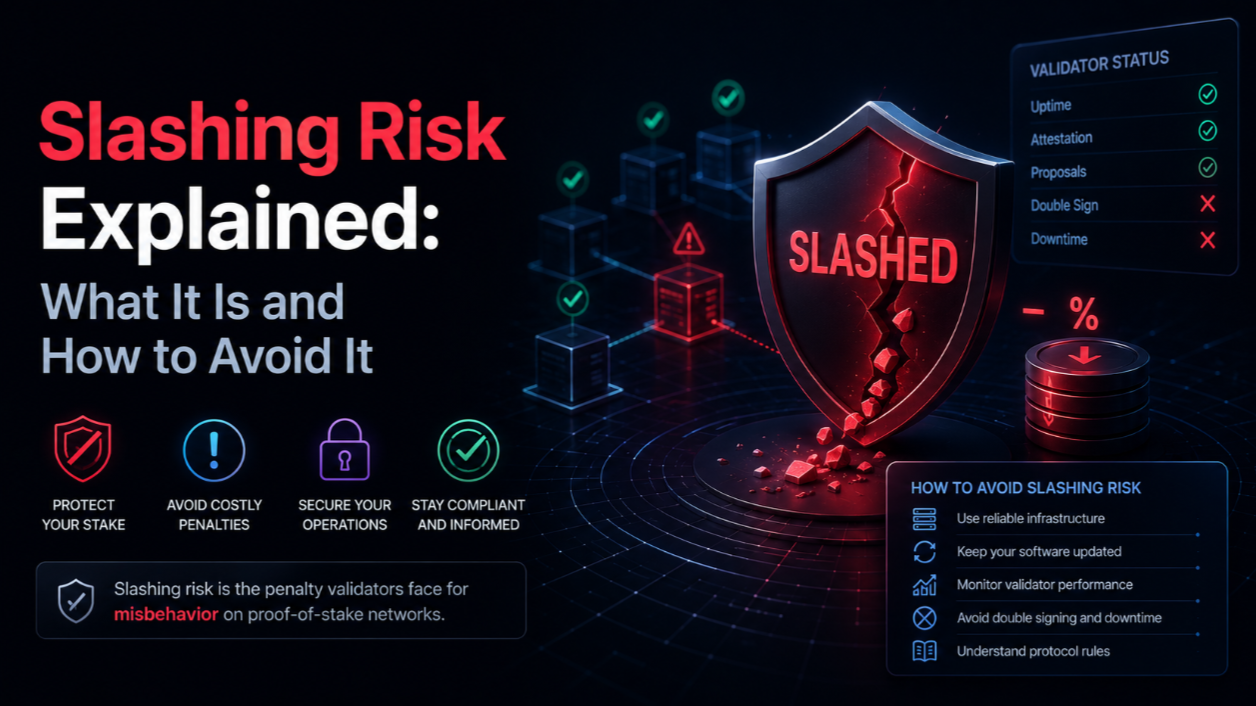
Slashing is a severe penalty for provably malicious or contradictory validator behaviour. There are two slashable offences:
- Double voting (equivocation): Signing two different blocks for the same slot, or two different attestations that conflict. This is always triggered by running the same validator key on two nodes simultaneously.
- Surround voting: A specific attestation pattern where one attestation "surrounds" another, indicating contradictory views of the chain. This is rarer and typically accidental.
When slashed, a validator immediately loses at least 1/32 of its effective balance (1 ETH on a full 32 ETH balance) and is queued for forced exit after roughly 36 days. During that window, a "correlation penalty" scales with how many other validators are slashed in the same window — if only you are slashed, the penalty stays small. If thousands are slashed simultaneously (correlated failure), penalties can reach the full 32 ETH.
The most common cause of accidental slashing is migrating a validator to a new machine without properly stopping the old instance first. Always wait several epochs after stopping the old node before starting the new one. Tools like EthStaker's slashing protection database exporter help carry slashing protection history across client migrations.
Inactivity penalties and missed attestations
Slashing aside, the day-to-day concern for solo stakers is inactivity. Validators earn rewards for timely attestations in every epoch (approximately every 6.4 minutes). Missing an attestation costs roughly half the reward you would have earned. Sustained downtime triggers an inactivity leak — a growing penalty designed to slowly bleed out offline validators until the network reaches a 2/3 participation threshold.
In practice, 99%+ uptime is achievable on consumer hardware. A validator offline for one hour loses its rewards for that hour but faces no dramatic penalties. The break-even point where you recover missed rewards upon coming back online is typically within 12–24 hours for short outages.
Staking rewards: how much can you earn
Validator APR in 2026 sits in the 3.5–4.5% range, fluctuating with the total number of active validators. The more validators, the lower the per-validator issuance reward. On top of issuance, validators that propose blocks earn tips (priority fees) paid by users — these are variable and averaged over time. MEV (maximal extractable value) via MEV-boost further supplements income for validators running the MEV-boost relay software.
For a 32 ETH position at 4% APR, annual income is approximately 1.28 ETH per year before taxes. Running MEV-boost has historically added 0.1–0.3 ETH annually but introduces relay trust assumptions. Compare this to liquid staking returns on Lido at roughly 3.8% (after Lido's 10% protocol fee) or Coinbase cbETH at around 3.2% after a 25% fee — solo stakers earn more while contributing more to decentralisation.
DVT: staking without a single point of failure
Distributed Validator Technology (DVT) allows a validator's signing key to be split across multiple machines using threshold cryptography. Obol Network and SSV Network implement this: a validator key is split into 4 shares, requiring 3 of 4 nodes to sign. If one node goes down, the others continue attesting — eliminating the single-machine risk of traditional solo staking.
DVT is increasingly used by home stakers in clusters and by protocols like Lido DAO to distribute validator operation across independent node operators. For home stakers, DVT is still early-stage but represents the future of resilient self-custody staking.
Monitoring your validator
Beaconcha.in is the standard validator explorer — search your validator index to see attestation performance, balance history, and proposed blocks. Set up email alerts for missed attestations. Grafana + Prometheus dashboards are available for all major client pairs and provide real-time metrics on sync status, peer count, CPU/memory usage, and validator balance.
The EthStaker community on Reddit and Discord is the most active solo staker support community, with setup guides for every client combination, hardware recommendation threads, and real-time support during network events.
Withdrawals and how to exit
Since the Shapella upgrade in April 2023, validators can fully withdraw their stake. Partial withdrawals (excess above 32 ETH) are processed automatically every few days. Full exits require submitting a voluntary exit message signed by your validator key, after which you wait in a queue (typically hours to days depending on exit demand) before your 32 ETH is released to your withdrawal address.
This guide is for educational purposes only. Solo staking carries real financial and operational risk. Always test on a testnet before staking mainnet ETH. Not financial advice.