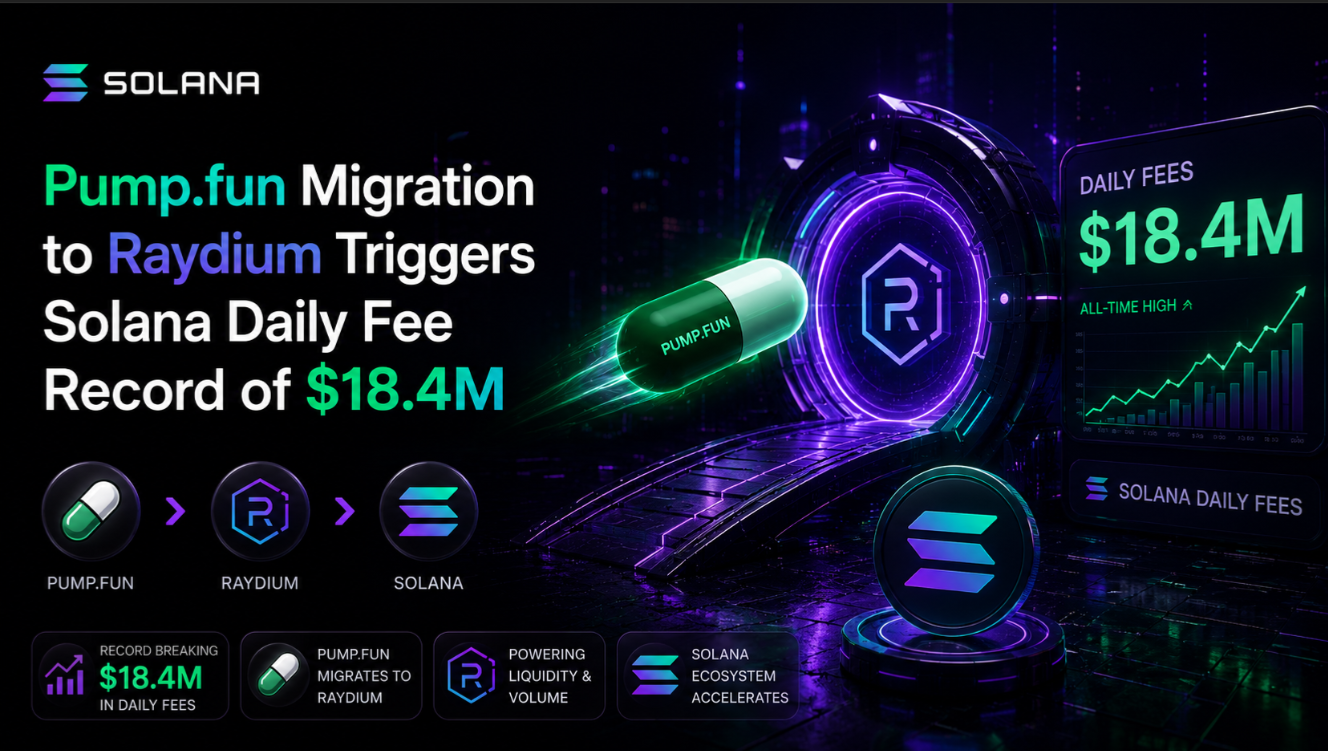
A structural shift is underway in Solana's on-chain economy. Pump.fun, the meme-coin launchpad that became Solana's single largest fee-generating protocol in 2025, has completed its migration to a new execution model that routes graduated tokens directly onto Raydium's AMM pools. The change has triggered a record daily fee event for both protocols — and reshaped how analysts think about Solana's on-chain revenue stack.
What Changed: Pump.fun's Graduation Model
Pump.fun tokens progress through a bonding-curve phase before "graduating" to a decentralised exchange. Previously, graduated tokens moved to Pump.fun's internal AMM (Pump Swap), which kept fee revenue siloed within Pump.fun's ecosystem. Under the new model, graduated tokens are automatically listed as Raydium CPMM (constant product market maker) pools with initial liquidity seeded from the bonding-curve proceeds.
The migration means Raydium receives the organic trading volume that previously went to Pump Swap. Raydium's 0.25% swap fee accrues to LP providers and the RAY buyback mechanism. Pump.fun retains its creation and graduation fees. Both protocols win, but the network-level effect is what dominates the story.
Record Daily Fees: The Numbers
On April 14, 2026 — the first full day of the new routing model — Solana's on-chain fee trackers recorded a combined protocol revenue of $18.4 million across Pump.fun, Raydium, and Jupiter (which routes trades through Raydium pools). That figure exceeded any single-day record in Solana's history, including the peak meme-coin frenzy of late 2024.
- Pump.fun creation + graduation fees: $6.2M
- Raydium swap fees (Pump.fun-graduated pools): $7.1M
- Jupiter aggregator routing fees: $5.1M
- Total: $18.4M (single-day record as of April 2026)
For context, Solana's total protocol fee revenue in all of Q1 2023 was $22 million. The network now earns that in two days. The comparison illustrates the scale of meme-coin-driven activity as a revenue engine — and the efficiency gains from consolidating liquidity on Raydium rather than splitting it across two AMMs.
Raydium's RAY Buyback Mechanism
Raydium allocates a portion of swap fees to a RAY buyback treasury. As graduated Pump.fun pools generate volume, the buyback pressure on RAY increases mechanically. In the week following the migration, RAY's price rose 28% — from $3.40 to $4.35 — while open interest on RAY perpetuals doubled on platforms like Jupiter Exchange.
The feedback loop is straightforward: more Pump.fun graduates → more Raydium volume → more RAY buybacks → higher RAY price → more validator and LP profitability → more network investment. Critics note this loop is highly dependent on sustained meme-coin creation velocity, which is historically volatile.
Impact on Solana's Fee Market and SOL Validators
Solana validators earn priority fees from congestion and base fees from transaction processing. The record-fee day coincided with a 15% spike in Solana network priority fees, as traders competed for block space to execute on new pool launches. Validator revenue that day was estimated at $2.1 million — approximately 80% above the prior 30-day average.
Higher validator revenue creates two beneficial effects for the Solana network: it increases staking incentives (attracting more validators) and reduces sell pressure from validators who previously operated at thin margins. When validators are profitable, they are less likely to immediately sell SOL rewards — an oft-overlooked dynamic in network security economics.
Phantom Wallet and the UX Layer
Most Pump.fun users never see the underlying AMM mechanics. They trade through Phantom Wallet's built-in swap interface or the Pump.fun web app, which abstracts pool routing entirely. Phantom's integration is notable: the wallet now displays meme-coin portfolio values, Raydium pool positions, and LP fee earnings in a unified dashboard — a UX move that has accelerated retail participation in liquidity provision.
Phantom reported 12 million monthly active users in April 2026, with meme-coin-related transactions representing approximately 35% of swap volume through the wallet. That share has grown from 18% in Q4 2024, underscoring how central the Pump.fun/Raydium/Phantom stack has become to Solana's retail economy.
Sustainability Questions
The record fee day raises a legitimate question: is meme-coin-driven revenue a durable foundation for Solana's on-chain economy? The bull case argues yes — retail speculation is a persistent feature of every financial market, and Solana has uniquely low costs that make micro-speculation viable at scale. The bear case notes that meme-coin cycles are boom-bust by nature, and a quieter market would expose how dependent the fee record is on one narrow category of activity.
The more interesting structural story is the consolidation itself. By routing graduated tokens to Raydium, Pump.fun has created a liquidity concentration that benefits the entire Solana DeFi stack — Jupiter routers, Raydium LPs, and eventually institutional market-makers who can now access meaningful depth in meme-coin pairs. That structural improvement persists regardless of whether meme-coin velocity sustains.