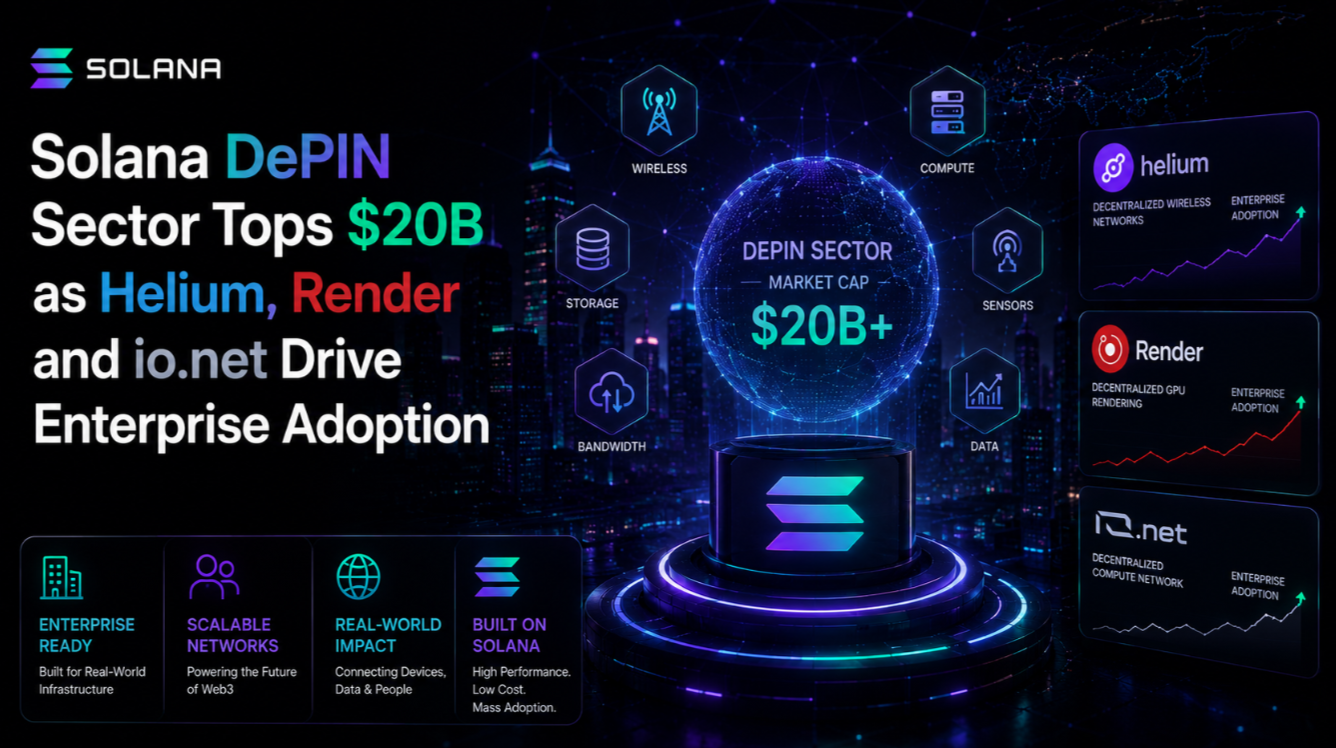
Solana's Decentralised Physical Infrastructure Network (DePIN) sector has crossed $20 billion in combined market capitalisation, cementing the blockchain as the dominant home for real-world hardware coordination protocols. The milestone arrives as DePIN transitions from a crypto-native experiment to a mainstream infrastructure model, attracting enterprise contracts, municipal partnerships, and venture backing from outside the usual crypto VC set.
Defining the DePIN Sector on Solana
DePIN protocols coordinate physical hardware — wireless nodes, compute GPUs, storage drives, solar panels, mapping vehicles — through on-chain token incentives. Contributors deploy hardware, earn tokens, and the network aggregates their supply into a permissionless service layer. Solana became the preferred home for DePIN because its transaction costs and throughput are the only L1 economics that make per-device micropayment feasible at scale.
The $20 billion figure aggregates market caps across Solana-native DePIN tokens including Helium (HNT/MOBILE/IOT), Hivemapper (HONEY), Render Network, Akash Network, io.net, and more than 40 smaller protocols. Helium alone accounts for $4.2 billion after migrating from its own L1 to Solana in 2023.
Helium's Enterprise Pivot: From Retail to Carrier-Grade
Helium Mobile, built on Helium's Solana-native token stack, has signed commercial roaming agreements with two US regional carriers. These contracts allow Helium's 300,000+ community-deployed hotspots to offload carrier traffic — with each data transfer logged on Solana and compensated in MOBILE tokens. This is the first time a public blockchain serves as the billing layer for regulated telecom infrastructure at scale.
The carrier deals validate the DePIN model beyond crypto-native users. When a traditional telecom's subscribers are unknowingly routing through Helium's permissionless network, the line between "blockchain experiment" and "infrastructure" disappears.
Hivemapper and the Road-Mapping Race
Hivemapper has mapped over 12 million kilometres of road globally using dashcam-equipped vehicles whose drivers earn HONEY tokens per verified kilometre. In April 2026, Hivemapper announced its first enterprise data licensing deal with a logistics firm covering EU routing data — a $4.2 million annual contract paid in fiat, with HONEY burned to reflect demand.
The burn mechanic is notable: it links real-world data revenue to token supply reduction, creating a deflationary pressure that doesn't depend solely on speculative demand. This model — enterprise fiat revenue → token burn → delegator reward — is increasingly the template other DePIN projects are adopting.
GPU DePIN: Render and io.net Compete for Compute
Decentralised GPU compute is the fastest-growing DePIN sub-sector. Render Network facilitates distributed GPU rendering for 3D artists, AI model training, and video processing. io.net aggregates underutilised GPU capacity from crypto miners, data centres, and consumer machines into clusters that ML teams can rent at 40–60% below AWS prices.
Combined, Render and io.net have processed over 8 million GPU-hours in Q1 2026, representing roughly $45 million in annualised compute revenue — up 3× from Q1 2025. The growth is driven partly by AI training demand, where teams are increasingly willing to use permissionless compute for non-sensitive workloads.
- Render Network: 180,000 active GPUs, $18/GPU-hour average rate
- io.net: 240,000 aggregated GPUs, $12/GPU-hour for commodity H100s
- Combined annualised revenue run-rate: ~$45M (Q1 2026)
- YoY growth: 3× revenue, 2.5× active GPU count
Why Solana Won the DePIN Race
The technical reasons are well-known: Solana's sub-cent transaction costs and 400ms finality make per-device ledger entries economically viable. A Hivemapper dashcam logging 50 GPS coordinates per minute would cost $3/day per device on Ethereum L1 at current gas prices. On Solana, that same logging costs under $0.01/day.
But the less-discussed factor is developer tooling maturity. Solana's Anchor framework, now on v0.30, has become the standard DePIN development stack. Its combination of Rust-based program structure, client-side TypeScript libraries, and Compressed NFTs (for device registration at near-zero cost) solves the three hardest engineering problems in DePIN simultaneously.
Risks and the Road to $50B
Not every DePIN project will survive. Hardware-dependent protocols face margin compression as device manufacturers enter the space with proprietary hardware. Regulatory risk is highest for telecom DePIN (Helium faces FCC scrutiny) and potentially storage DePIN if CSAM content surfaces in decentralised stores.
Despite risks, the structural tailwinds are compelling. Enterprise technology buyers increasingly want cost-effective, permissionless infrastructure as a hedge against hyperscaler vendor lock-in. AWS, Azure, and Google Cloud set the price floors; DePIN protocols undercut them using idle hardware. If even 2% of the $500 billion global cloud infrastructure market shifts to DePIN over five years, the sector's market cap would need to reach $100 billion to price in that demand.
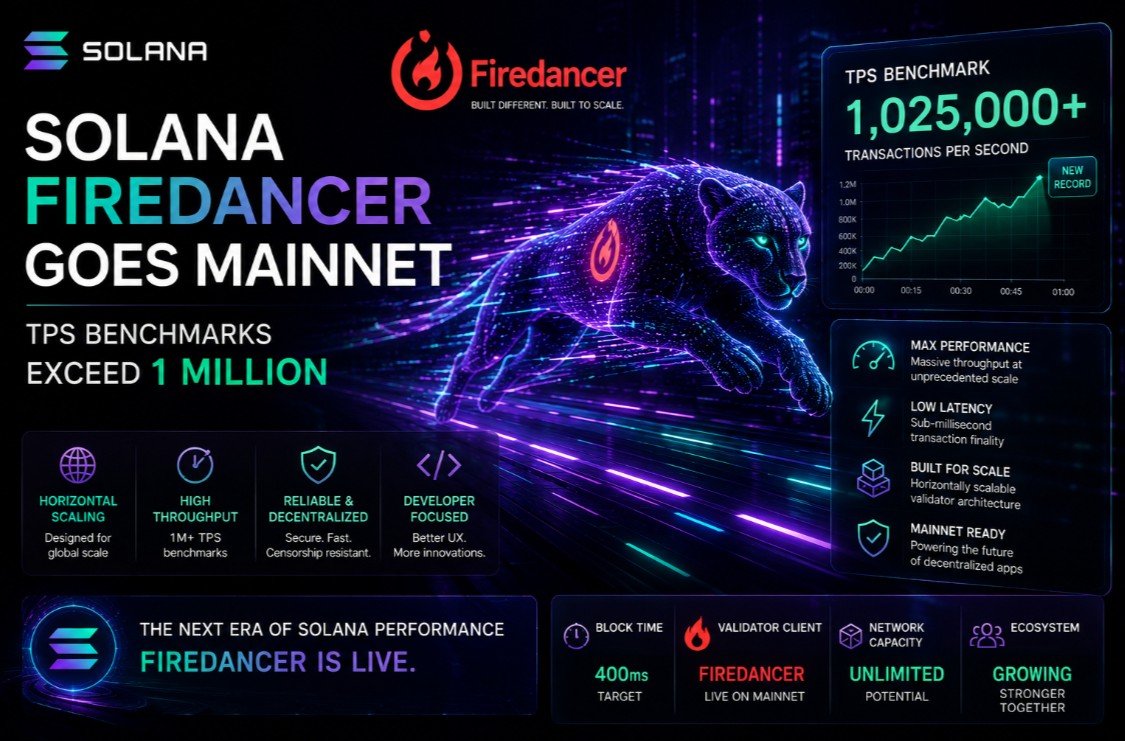
The $20 billion milestone is a waypoint, not a destination. Solana's DePIN ecosystem has the technical foundation, enterprise adoption proof points, and developer momentum to grow substantially — provided the network maintains its throughput advantages. With Firedancer on mainnet, that throughput advantage just widened considerably. See also the Solana price forecast for long-term projections on the SOL token.