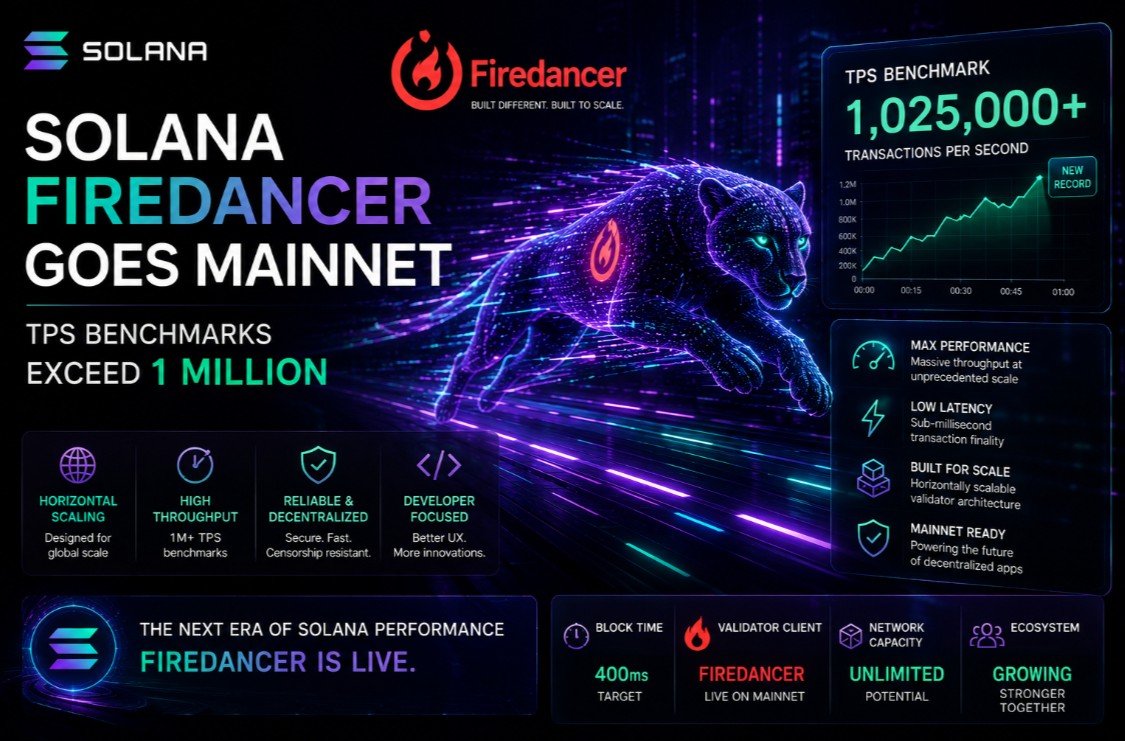
Solana's Firedancer validator client has gone live on mainnet, marking the most consequential infrastructure upgrade in the network's history. Built by Jump Crypto, Firedancer is an independent reimplementation of the Solana validator from scratch in C and C++, delivering throughput benchmarks exceeding one million transactions per second (TPS) in controlled conditions. That number is not a typo — and its real-world implications are only beginning to surface.
What Firedancer Is and Why It Matters
Most blockchains run a single validator client — the reference implementation that all nodes use. Ethereum learned a hard lesson about this: when Geth dominated 80% of validator share, a single bug could have taken the chain offline. Ethereum now promotes client diversity as a security imperative. Solana historically faced the same concentration risk with its original Labs-built client (now known as Agave).
Firedancer solves both problems simultaneously: it introduces client diversity, and it does so with a client that is dramatically faster. The Agave client tops out at roughly 65,000 TPS under ideal conditions. Firedancer's internal benchmarks have recorded 1.2 million TPS on dedicated testnet hardware — nearly 20× more throughput. Even at conservative mainnet performance, early data shows Firedancer nodes processing 2–4× more transactions per block.
Validators running Firedancer also report lower CPU usage and more predictable block times, which reduces the risk of the leader-slot skips that occasionally cause user-facing delays. For DeFi protocols dependent on reliable finality, this translates directly into fewer failed arbitrage windows and smoother liquidation cascades.
The 1M TPS Benchmark: Real or Marketing?
Skeptics immediately questioned whether 1M TPS benchmarks reflect anything achievable in production. The honest answer is: not yet — but the gap is closing faster than critics expected.
Mainnet Solana processes a mix of vote transactions, compute-heavy DeFi interactions, NFT mints, and token transfers. Vote transactions alone account for ~50% of all TPS. Firedancer's architecture separates vote-handling and execution pipelines, meaning as the cluster migrates more stake to Firedancer nodes, effective execution throughput scales without vote traffic being a bottleneck.
- Testnet benchmarks: 1.2M TPS (Jump Crypto internal, 128-core hardware)
- Devnet observed peak: 420,000 TPS (April 2026)
- Mainnet day-1 observed: ~85,000 TPS (partial Firedancer adoption)
- Projected mainnet at 50% Firedancer stake share: ~250,000–350,000 TPS
The trajectory points clearly in one direction. As more validators upgrade, aggregate throughput will keep climbing. Solana Foundation has set a soft target of 50% Firedancer stake adoption within 12 months of mainnet launch.
Network Effects: DePIN, Gaming, and Real-Time Finance
The practical question is what applications unlock at 250,000+ TPS that weren't viable at 65,000. Three sectors stand out.
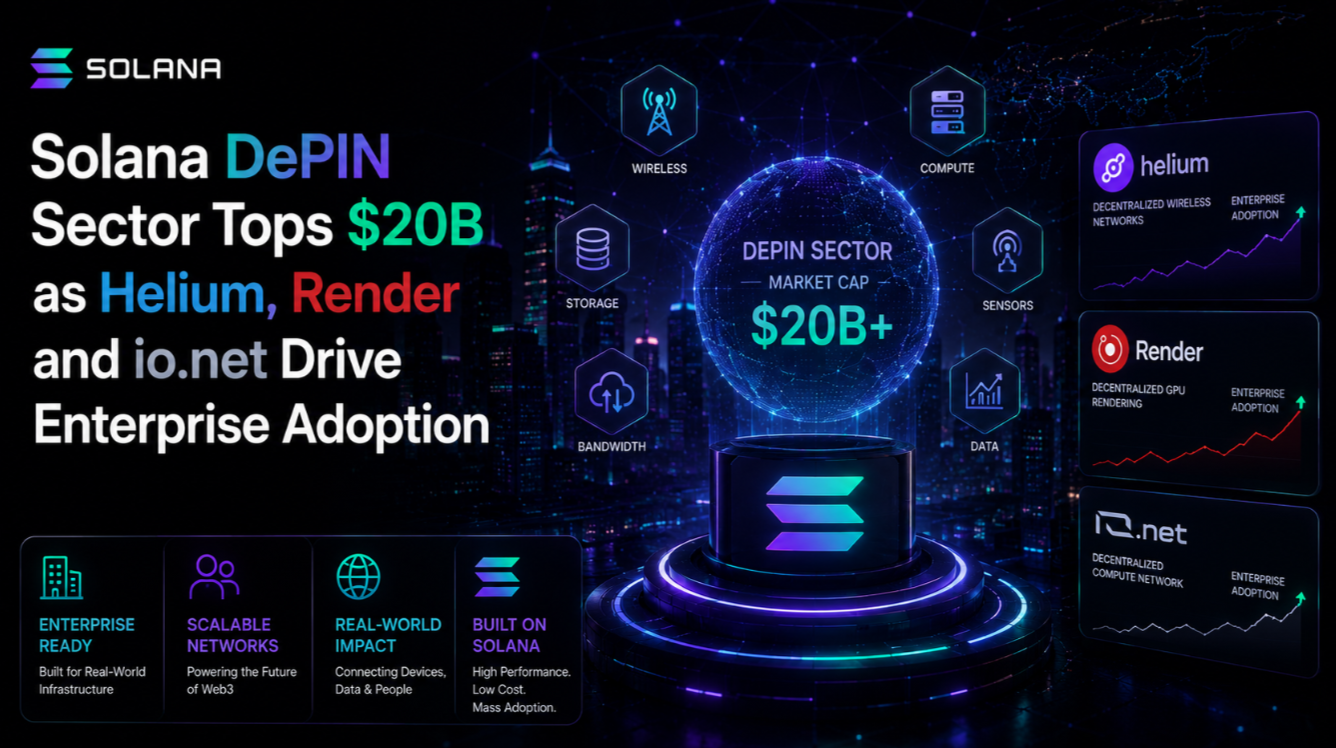
DePIN (Decentralised Physical Infrastructure Networks) — projects like Helium, Hivemapper, and Render generate millions of microtransactions from physical devices. At current TPS, burst demand from 10,000 simultaneous device pings can cause congestion. Firedancer effectively removes that ceiling.
On-chain gaming — fully on-chain game state requires sub-400ms confirmation for playable UX. Solana already achieves ~450ms median block time; Firedancer's lower variance pushes that to a more consistent sub-350ms window, making real-time PvP feasible on a public blockchain for the first time.
Real-time DeFi — high-frequency order books on platforms like Jupiter Exchange and Raydium benefit immediately. More throughput means tighter spreads, smaller queue depth, and lower priority-fee bidding wars for arbitrageurs. End users should see gas fees fall 15–30% as congestion eases.
Client Diversity and Security Implications
Having two production-grade, independent clients means a critical bug in Agave will not halt the chain — Firedancer nodes would continue producing blocks. Conversely, a Firedancer bug would not affect Agave nodes. This 2-of-2 diversity model is already considered best practice in Ethereum's ecosystem and Solana is now the only high-throughput L1 that can claim it.
Jump Crypto has open-sourced Firedancer under the Apache 2.0 license. Independent security researchers have begun auditing the codebase, and three firms have already published partial audit reports covering the networking and consensus layers. No critical vulnerabilities were found in those reviewed sections.
Validator Economics and Staking Yield
Running Firedancer is more resource-intensive at hardware provisioning but cheaper per transaction at scale. Early benchmarks show Firedancer consuming 40% less CPU per validated transaction than Agave at equivalent TPS. This means validators can either reduce hardware spend at current load, or handle significantly more throughput on the same infrastructure.
For SOL stakers, this matters indirectly: more efficient validators extract less from the fee pool, leaving a larger share for delegators. Staking APY on Solana currently sits at 5.2–5.8%. Firedancer's efficiency gains could nudge effective delegator yield 10–15 basis points higher over 12 months as the network stabilises.
Roadmap: What Comes After Mainnet Launch
Jump Crypto has outlined three phases post-mainnet launch:
- [object Object] (Q2 2026): Bug fixes, QUIC networking improvements, and stake-weighted connection improvements to resist spam under load.
- [object Object] (Q3 2026): Complete feature parity with Agave's runtime including all BPF opcodes and syscalls. Unlocks any protocol that uses advanced compute features.
- [object Object] (Q4 2026): The hybrid Frankendancer client (Firedancer networking + Agave execution) will be retired as Firedancer's execution layer reaches full parity.
The roadmap implies that by end-2026, Solana mainnet will have two fully independent, production-grade clients. That milestone would make Solana's client diversity story comparable to Ethereum's — a meaningful rebuttal to one of the most persistent infrastructure criticisms of the network.
Performance benchmarks cited are from Jump Crypto's public test reports and independent devnet observations as of April 2026. Mainnet figures will evolve as Firedancer stake share grows.