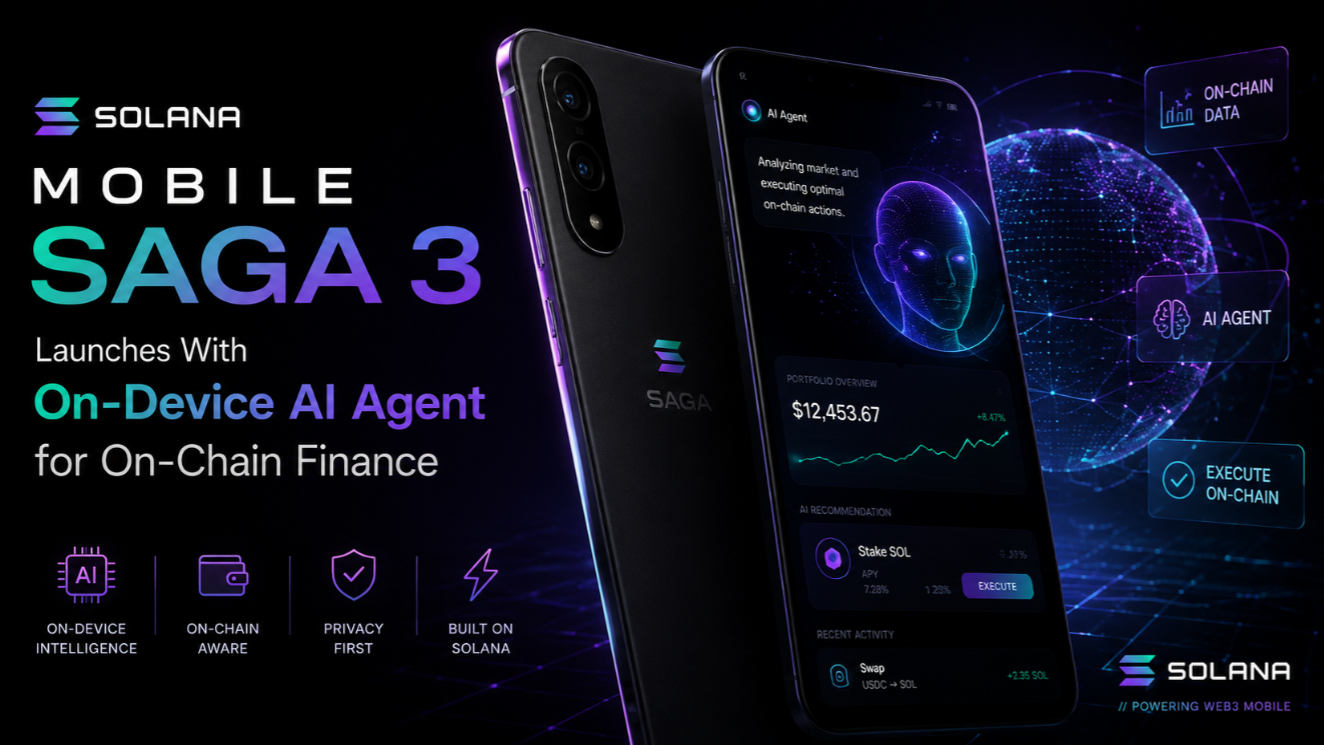
Solana Mobile has unveiled the Saga 3 smartphone, the third generation of its crypto-native Android handset. Building on the cult success of Saga 1 and the mainstream momentum of Saga 2 (which sold 400,000 units), Saga 3 introduces the first hardware-native AI agent framework on any blockchain-integrated phone — a development that could redefine what a "crypto wallet" means in the age of on-chain AI.
What Is Saga 3 and Who Is It For?
Saga 3 is an Android 17 smartphone with a Snapdragon 8 Elite 2 processor, 16GB RAM, and a dedicated Secure Enclave 2.0 chip for private-key storage. It ships with the Solana dApp Store pre-installed — a curated marketplace that bypasses Google Play's 30% fee and enables direct token-gated app distribution. The headline new feature is the Mobile AI Agent Layer (MAAL), a locally running framework that coordinates on-chain actions via natural language instructions.
The target audience has expanded with each generation. Saga 1 was for developers and crypto-native power users. Saga 2 reached DeFi traders and NFT collectors. Saga 3 targets a broader set: professionals who manage on-chain assets alongside traditional finance, creators monetising content via tokenised IP, and early-adopter consumers interested in AI-assisted financial management.
The AI Agent Layer: Architecture and Capabilities
MAAL runs a quantised 7B-parameter language model locally on the Snapdragon's NPU (Neural Processing Unit), with zero network inference calls for privacy-sensitive operations. The model is fine-tuned on Solana program ABI schemas and can parse natural language commands like "swap 50 USDC for SOL when the price drops below $150" into signed transaction bundles — without the user manually constructing or approving each step.
The agent connects to the Phantom wallet SDK (and other Solana wallets via the Mobile Wallet Adapter 3.0 standard) and can interact with any on-chain protocol that has registered an agent-compatible intent schema. At launch, 23 protocols have registered schemas including Jupiter Exchange, Raydium, Kamino Finance, and Drift Protocol.
- DCA (dollar-cost averaging): "Buy $100 of SOL every Monday at 9am" → agent constructs recurring signed transactions
- Yield routing: "Move my idle USDC to the highest-yield Solana lending pool" → agent queries Kamino, Marginfi, Save, executes optimal allocation
- Portfolio alerts: "Sell 10% of my JUP if it drops 20% in 24 hours" → agent monitors on-chain price oracle, executes conditional swap
- Content monetisation: "Mint my photo as a compressed NFT and list it for 0.1 SOL" → end-to-end on-chain content creation from the camera app
Hardware Security: Secure Enclave 2.0
The most critical improvement for the crypto-native use case is the Secure Enclave 2.0, which stores private keys in hardware-isolated memory that is inaccessible even to the Android OS layer. Key signing occurs inside the enclave; the private key never enters application memory. This architecture matches the security model of hardware wallets like Ledger while maintaining smartphone UX.
The enclave supports multi-party computation (MPC) key splitting, allowing users to optionally back up a key share to a separate Solana-backed cloud service without ever exposing the full key. Recovery requires both device hardware and the cloud share — a seedphrase-free recovery model that addresses the most common reason non-technical users lose crypto funds.
dApp Store: Token-Gated Distribution and Creator Economics
The Solana dApp Store on Saga 3 now supports token-gated app distribution: developers can require users to hold a specific token or NFT to download an app. This creates a new distribution primitive — imagine a trading terminal that's only accessible to holders of a protocol's governance token, or a creator's private community app gated by their fan token.
Developer economics improve significantly: the dApp Store takes 0% platform fee on direct SOL/USDC transactions (versus Google Play's 30% cut on in-app purchases). For subscription apps, developers keep 94% of revenue, with 6% going to Solana Mobile. Early data from Saga 2 shows that 40% of dApp Store developers earn more per-user than equivalent Google Play apps despite smaller user bases.
Market Positioning and Pre-Order Data
Saga 3 launched pre-orders at $599 (early access) and $699 (standard) in April 2026. Within 72 hours, pre-orders exceeded 180,000 units — nearly half of Saga 2's total lifetime sales. Solana Mobile has partnered with three regional distributors in Southeast Asia and Latin America, targeting markets with high mobile-first crypto adoption and relatively weaker Google Play penetration.
The phone's ecosystem play is central to Solana's long-term thesis: if millions of users access DeFi, token-gated content, and AI agents through a Solana-native device, the network accumulates a user base that is structurally sticky in a way that web-app users are not. Hardware creates retention in a way that browser extensions never have.
Challenges: AI Agent Risk and Regulatory Uncertainty
Autonomous on-chain agents that can sign transactions without per-action approval raise new risk questions. If the agent misinterprets a command or is manipulated by a malicious dApp, it could execute unwanted transactions. Solana Mobile has implemented transaction simulation previews before each agent-initiated action and spending caps configurable per protocol. But the attack surface is genuinely new and will require community-level security research.
Regulatory uncertainty is the second challenge. Financial regulators in the EU and US are still determining whether AI agents that execute financial transactions on behalf of users require a money-transmission licence. Solana Mobile's position is that the device is a tool and the user retains control — a similar argument to how hardware wallets are classified. Whether regulators agree remains to be seen.