What does "minting an NFT" actually mean
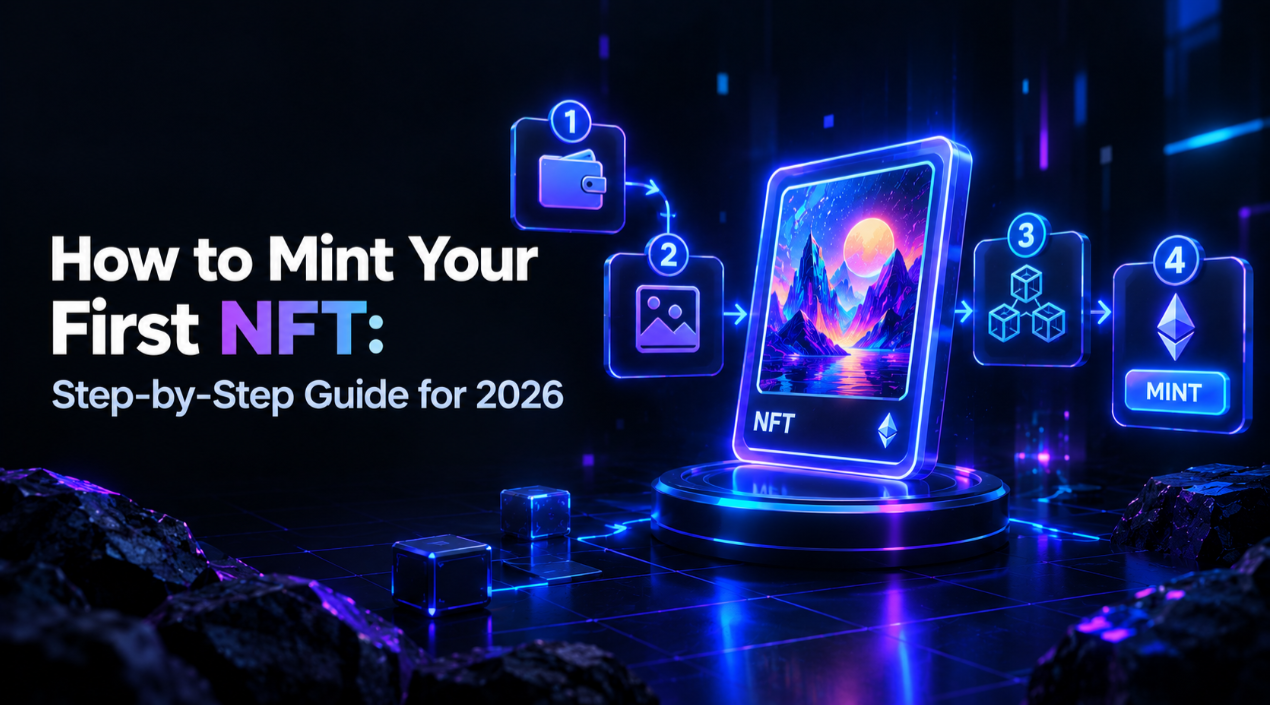
Minting an NFT means writing a new token record to a blockchain. When you mint, a smart contract creates a permanent on-chain entry that links a unique token ID to your wallet address and usually to a metadata file — a JSON document pointing to your image, audio, or video. That combination of on-chain ownership record and off-chain (or on-chain) metadata is the NFT.
Before you mint anything, it helps to understand what you are actually buying or creating. An NFT is not the image itself — it is a certificate of ownership recorded on the blockchain. The underlying media can live on IPFS, Arweave, or a centralised server. If that server goes offline, your NFT exists but the media it points to may disappear. This is why storage choice matters.
Choose a blockchain: Ethereum, Solana, or alternatives
Ethereum is the original NFT chain and still hosts the most prestigious collections. Gas fees on Ethereum mainnet can range from $5 to $80+ per mint depending on network congestion. Layer 2 solutions like Base, Arbitrum, and Polygon bring gas costs under $0.10. Most new creators now launch on L2s first.
Solana has grown into the second-largest NFT ecosystem. Minting on Solana costs a fraction of a cent in SOL and transactions confirm in under a second. The trade-off is a less mature secondary market outside of Magic Eden. For creators targeting volume and low friction, Solana is compelling. Bitcoin Ordinals and Runes have also emerged as a serious NFT medium — covered in a separate guide below.
Set up a self-custody wallet
You cannot mint an NFT without a crypto wallet. For Ethereum and EVM chains, MetaMask (browser extension) or Rabby Wallet are the most common choices. For Solana, Phantom or Backpack are standard. Never use an exchange wallet — you cannot sign smart contract transactions from a custodial account.
- Download the wallet extension from the official site (always verify the URL).
- Create a new wallet and write down your 12 or 24-word seed phrase on paper. Never store it digitally.
- Fund your wallet with a small amount of ETH or SOL to cover gas fees.
- Test with a small transaction before committing to a large mint.
Pick a marketplace or deploy your own contract
For most creators, using a marketplace is the practical starting point. OpenSea supports lazy minting — the NFT is not written to the blockchain until someone buys it, so you pay no upfront gas. Blur NFT caters more to professional traders but also supports creator minting. Magic Eden is the dominant Solana platform and has expanded to Ethereum and Bitcoin Ordinals.
Advanced creators deploy their own ERC-721 or ERC-1155 smart contract for full control: custom royalty logic, allowlists, reveal mechanics, and on-chain metadata. Tools like Manifold Studio and thirdweb let you deploy contracts without writing Solidity. You keep 100% of primary sales with no platform commission but pay deployment gas ($50–$500 on mainnet, under $5 on L2).
Prepare your metadata and media
The standard NFT metadata schema (ERC-721 metadata JSON) includes: name, description, image (URL to the media file), and an attributes array of trait objects. Example: {"trait_type": "Background", "value": "Cosmic Blue"}. Traits drive rarity rankings and are displayed on marketplaces.
- Image format: PNG, GIF, MP4, or SVG. Max file size varies by platform (OpenSea supports up to 100MB).
- Storage: IPFS via Pinata or NFT.Storage is standard for decentralised hosting. Arweave offers permanent storage for a one-time fee.
- Collections: For generative PFP collections, tools like HashLips Art Engine or Style Protocol handle layered image generation and metadata export at scale.
The minting process on OpenSea step by step
- Connect your wallet to OpenSea. Click "Create" in the top nav.
- Upload your media file. Fill in the name, description, and external link.
- Add properties (traits) in the Properties section — these become searchable filters.
- Set supply: 1 for a 1/1 unique piece; higher for editions.
- Choose blockchain: Ethereum, Base, Polygon, Solana, or others.
- Click Create. For lazy minting, no gas is required at this stage.
- To sell, click "Sell" on your item, set a price, and sign the listing transaction. Gas is charged here on Ethereum mainnet.
Gas fees explained: when and how much you pay
On Ethereum mainnet, gas fees vary with network demand. Minting a single NFT via a standard ERC-721 contract typically costs 50,000–150,000 gas units. At 20 gwei gas price and ETH at $3,000, that is $3–$9. During peak demand (high-profile mint events), prices spike dramatically — some popular mints have cost $300+ in gas alone.
Strategies to reduce gas: mint on L2 (Base, Arbitrum, Polygon), use off-peak hours (early UTC morning on weekdays), use lazy minting where available, and batch transactions where the contract supports it. Always check the NFT Marketplaces ratings before choosing a platform — fee structures vary significantly.
Setting royalties on your NFTs
Royalties allow creators to earn a percentage of every secondary sale. The ERC-2981 royalty standard lets you encode a royalty recipient address and percentage directly in the contract. Most marketplaces read this and enforce it — but not all. The royalty wars of 2022–2023 saw several major platforms make royalties optional. Today, on-chain royalty enforcement via contracts that block transfers on non-compliant marketplaces has made a comeback.
Set royalties at the time of contract deployment (typically 5–10% for art, 2.5–5% for PFPs). Once set in the contract, they are permanent. If you use a marketplace-hosted minting tool, check whether you can set a custom royalty percentage or are locked to the platform default.
Verify your collection and avoid scams
After minting, verify your collection on major marketplaces to unlock a blue checkmark and higher visibility. OpenSea verification requires meeting minimum volume thresholds. Before any mint, always verify the contract address on Etherscan or Solscan — scammers deploy fake contracts that look identical to legitimate projects. ApeCoin ecosystem projects are frequently impersonated; always confirm contract addresses via official project channels.
After the mint: listing, promoting, and building community
Minting is just the beginning. Organic discovery on marketplaces is difficult without an existing audience. Twitter/X and Discord remain the primary channels for NFT community building. List your collection on Rarity Tools, NFT Calendar, and relevant directories. Consider a pre-launch allowlist campaign to reward early supporters with discounted or free mints.
Track your sales, floor price, and volume using analytics tools covered in our free NFT tools guide. Engagement matters more than speculative hype in 2026 — projects with active communities and clear utility retain value far better than pure art plays.
Common mistakes first-time minters make
- Skipping storage research: Uploading media to a centralised server without a backup plan. Use IPFS at minimum.
- Ignoring gas timing: Minting at peak hours on mainnet and paying 10x the necessary gas cost.
- No metadata planning: Launching without well-designed traits makes your collection invisible to rarity filters.
- Wrong network: Deploying on mainnet when L2 would save $200+ in gas for the same result.
- Seed phrase photos: Photographing your seed phrase or storing it in iCloud. Physical paper only.
This article is educational only. NFT values can go to zero. Never invest more than you can afford to lose entirely.