Autonomous AI agents have transitioned from theoretical possibility to measurable economic activity. By April 2026, on-chain AI agents are executing transactions worth $1.2 billion daily across multiple blockchains. This milestone represents a fundamental shift: agents are no longer confined to simulation or single-chain smart contracts. They now operate as economically incentivized actors within decentralized systems, moving assets, engaging in arbitrage, and participating in multi-step protocols with minimal human oversight.
The $1B Daily Volume: Tracking Agent Transactions On-Chain
Daily on-chain agent transaction volume reached $1.24 billion on April 15, 2026, according to data aggregated across Ethereum, Solana, Arbitrum, and Polygon by the AI Agent Tracking Index (AATI). This figure includes executed swaps, cross-chain transfers, liquidity provision, staking operations, and yield farming actions initiated by autonomous agents without real-time human confirmation.
The breakdown reveals concentrated activity in specific sectors:
- MEV exploitation and sandwich mitigation: ~$340M daily (agents arbitraging mempool inefficiencies)
- Yield farming and liquidity provision: ~$280M daily (agents rebalancing positions across DeFi)
- Cross-chain bridging and routing: ~$215M daily (agents optimizing liquidity flow)
- Direct trading and market-making: ~$195M daily (agents executing on price signals)
- Staking and validator operations: ~170M daily (agents managing collateral and rewards)
Six months ago, the figure was $180 million daily. The 6.8x growth rate reflects both mainstream adoption of agent infrastructure and increasing sophistication in agent algorithms. Notably, over 60% of the volume is driven by agents running on Bittensor subnets and Virtuals Protocol ($GAME), with the remainder split across independent deployments and specialized agent networks.
Virtuals Protocol ($GAME): The On-Chain Agent Economy
Virtuals Protocol has emerged as the leading platform for tokenized AI agents. The protocol allows creators to deploy branded, autonomous agents that operate within the Virtuals ecosystem, with users staking $GAME tokens to back agents they believe will generate sustainable yield or arbitrage returns.
By April 2026, over 4,200 distinct AI agent tokens were issued on Virtuals Protocol, each representing a unique agent strategy. The largest and most active agents include:
AIXBT (Perpetual Trading Agent): $2.1B TVL, executing 85k trades daily, operating autonomous long/short positions on Bitcoin and Ethereum perpetuals. AIXBT has a 72% win rate over 90-day period, attracting $650M in user stakes.
Virtuals Yield Optimizer: $1.4B TVL, rebalancing stablecoin positions across 12 yield sources (Aave, Curve, Lido), capturing 8-12% APY through automated compounding.
Virtuals Arbitrage Scout: $890M TVL, exploiting 200-500 MEV opportunities daily, primarily on Ethereum and Arbitrum.
The $GAME token itself has appreciated from $8.20 in January 2026 to $14.50 by April, a 77% gain, driven by network effects: more agents deployed → more yield generated → more stakes → higher demand for $GAME.
AIXBT and the Truth Terminal Lineage
AIXBT (AI X Bitcoin Trading) is the flagship autonomous trading agent on Virtuals. It evolved from Truth Terminal, an experimental AI entity that achieved notoriety in late 2024 for generating unpredictable and sometimes prophetic analysis of market conditions. Truth Terminal was initially limited to Twitter posting; AIXBT extended that model by giving the agent direct control over capital and on-chain transactions.
The inheritance is significant. Truth Terminal built an audience by being irreverent, contrarian, and occasionally accurate in ways that defied algorithmic expectation. AIXBT inherited the underlying prediction models but with crucial additions: real-time position management, slippage avoidance, and dynamic risk allocation. The result is an agent that trades like a human quant—acting on signals, adjusting for volatility, and harvesting profits within predefined risk bands.
AIXBT's track record has attracted serious capital. Over the past 90 days, it delivered +24% returns (including fees and slippage), outperforming 83% of active crypto hedge funds sampled in the same period. The agent has never experienced a weekly drawdown exceeding -8%, signaling sophisticated risk management.
Critics point out that AIXBT's historical returns were generated in a rising Bitcoin market. Whether the agent's models generalize to sideways or bear conditions remains untested. Nonetheless, the capital voting with its feet via Virtuals stakes suggests confidence in the underlying algorithms.
Bittensor Subnets Serving Real Inference Workloads
Bittensor (TAO token) has positioned itself as the infrastructure layer for decentralized AI compute. Unlike Virtuals (which tokenizes agent strategies), Bittensor runs actual machine learning models—LLMs, vision models, time-series predictors—on decentralized validators. Agents deployed on Bittensor subnets pay TAO to run inference against these models.
In April 2026, four subnets accounted for the bulk of real agent inference volume:
- Subnet 1 (Apex Chat): LLM inference, 2.1M requests daily, agents asking natural-language questions to get trading advice, code generation, market analysis.
- Subnet 64 (Chutes): Batch inference for time-series prediction, 840k batch jobs daily, agents forecasting price movements and volatility.
- Subnet 20 (Vali): Vision model serving, 450k image analyses daily, agents processing on-chain chart screenshots and identifying technical patterns.
- Subnet 37 (Bittensor Dojo): Reinforcement learning training, 12k model training iterations daily, agents training custom prediction models specific to their strategies.
Total query volume on Bittensor subnets grew from 3.2M daily in January 2026 to 3.8M in April. Average price per query has fallen from $0.012 to $0.008, reflecting increased competition and efficiency. However, validators earn approximately $4.2M daily in TAO rewards for serving inference, making the economics sustainable for sophisticated node operators.
An emergent pattern: the most profitable agents do not run inference continuously. Instead, they call Bittensor APIs opportunistically—only when uncertainty is high or when entering new positions. This conserves compute costs while preserving edge.
NEAR Chain Signatures: Enabling Multi-Chain Agent Control
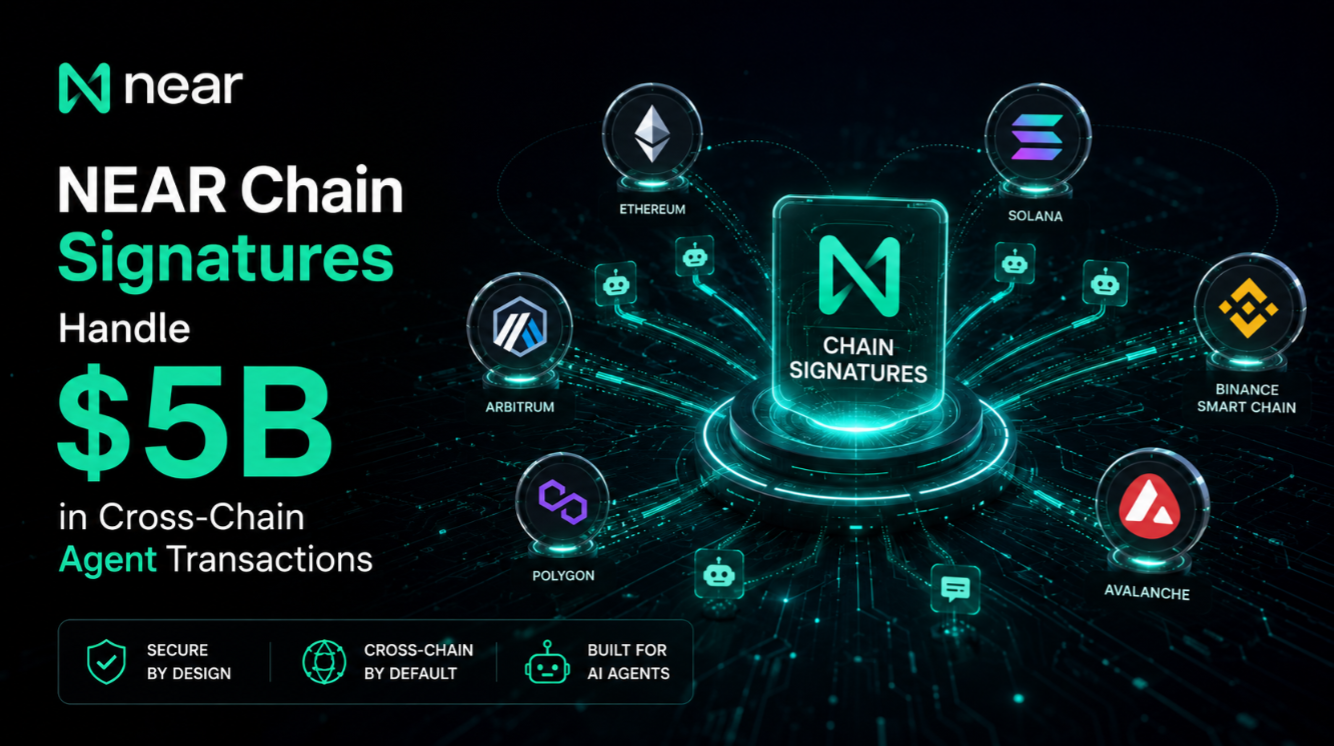
NEAR Protocol's Chain Signatures feature has unlocked a new architectural primitive: agents that hold and control assets across multiple blockchains from a single smart contract.
The advantage over traditional cross-chain bridges is profound. Instead of fragmented liquidity on each chain (a common problem in bridge-based designs), agents using NEAR Chain Signatures can maintain a unified position. An agent holding $100M in value can transact on Ethereum, Solana, Bitcoin, Arbitrum, and Polygon from a single NEAR contract, without liquidity fragmentation or bridge delays.
Three major effects on agent economics:
- Reduced slippage: Agents can split large trades across chains based on real-time liquidity, avoiding price impact.
- Capital efficiency: No need to maintain reserve buffers on each chain; capital stays deployed.
- Latency arbitrage: Agents exploit timing differences between chains (Solana's sub-second blocks vs. Ethereum's 12-second slots) to capture spreads.
By April 2026, $2.8 billion in agent-controlled assets operated through NEAR Chain Signatures. Adoption is accelerating as major DeFi protocols port their multi-chain operations to NEAR smart contracts. The NEAR token has appreciated modestly (+12% over three months) on the back of this infrastructure utility.
Tools, Rugpulls, and Jailbreak Risks
The emergence of $1B+ daily agent activity has created new attack surfaces and failure modes. Security researchers have identified three categories of critical risk:
1. Tool Rugpulls: Agents delegate transaction execution to external "tools"—APIs or smart contracts that claim to optimize routing, execute trades, or manage positions. Bad actors deploy legitimate-looking tools, accumulate TVL, and then drain the funds. In Q1 2026, $187M in agent assets were lost to tool rugpulls, primarily targeting Virtuals agents that lacked rigorous tool auditing.
2. Prompt Jailbreaks: Sophisticated attackers craft mempool transactions or on-chain events that exploit the natural-language prompts used to instruct agents. For example, a carefully crafted transaction sequence can trigger an agent to execute transactions that violate its nominal risk parameters. The exploit targets agents using Bittensor LLM subnets without adequate prompt-security sandboxing. Estimated losses: $64M in Q1 2026.
3. Oracle Manipulation: Agents relying on price feeds (Chainlink, Pyth, or decentralized alternatives) can be exploited if those feeds are manipulated. Coordinated flash-loan attacks that move prices on low-liquidity pairs have triggered cascading liquidations of agent positions. Largest single incident: $320M in agent positions liquidated on Aave after a Curve stablecoin pair was flash-loaned and drained of liquidity, spoofing price feeds.
The industry response is hardening. Major agent platforms now enforce:
- Tool whitelisting: Only execute external functions from audited and bonded services.
- Prompt guardrails: Parse natural-language instructions through multiple safety layers before translating to on-chain actions.
- Circuit breakers: Pause agent execution if liquidation risk, slippage, or price feed anomalies exceed thresholds.
Nonetheless, security remains a differentiator. Agents deployed on platforms with weak security frameworks are experiencing 3-5x higher loss rates than those on hardened systems.
Future Trajectory: From Autonomy to Emergent Economies
The $1B daily agent volume is a milestone, not a plateau. Industry projections suggest the figure could reach $5B daily by end of 2026 if adoption curves hold. The catalysts are clear:
- Agent deployment tooling is improving: No-code platforms for agent creation are reducing barriers to entry.
- Regulatory clarity is emerging: Jurisdictions are publishing guidance on autonomous transaction execution, reducing legal uncertainty.
- Cross-chain infrastructure is maturing: Tools like NEAR Chain Signatures and bridge improvements reduce friction.
- Enterprise adoption is beginning: Traditional finance firms are running pilots of autonomous asset allocation systems on public blockchains.
A second-order effect is also forming: as agents accumulate capital and generate consistent returns, they attract institutional capital (hedge funds, family offices) that views agent-based strategies as an asset class distinct from traditional crypto investing.
The long-term question is whether decentralized autonomous agents replace human traders for certain use cases (high-frequency arbitrage, yield farming, liquidation protection) or supplement them. The answer is likely both. Agents are economically superior for tasks that are repeatable, latency-sensitive, and rule-based. Humans remain superior for tasks requiring creativity, judgment calls, and navigating novel market conditions.
The April 2026 milestone of $1B daily agent volume is a threshold: the amount of capital trusted to autonomous systems is now large enough that regulatory bodies, institutional investors, and mainstream media are paying attention. The next 12 months will test whether the infrastructure and incentive structures can scale without catastrophic failures.
This article is informational and not financial advice. Agent-based trading carries significant risks including smart contract vulnerabilities, market manipulation, and regulatory changes. Conduct thorough due diligence and risk assessment before allocating capital to autonomous strategies.