What is a DEX aggregator?
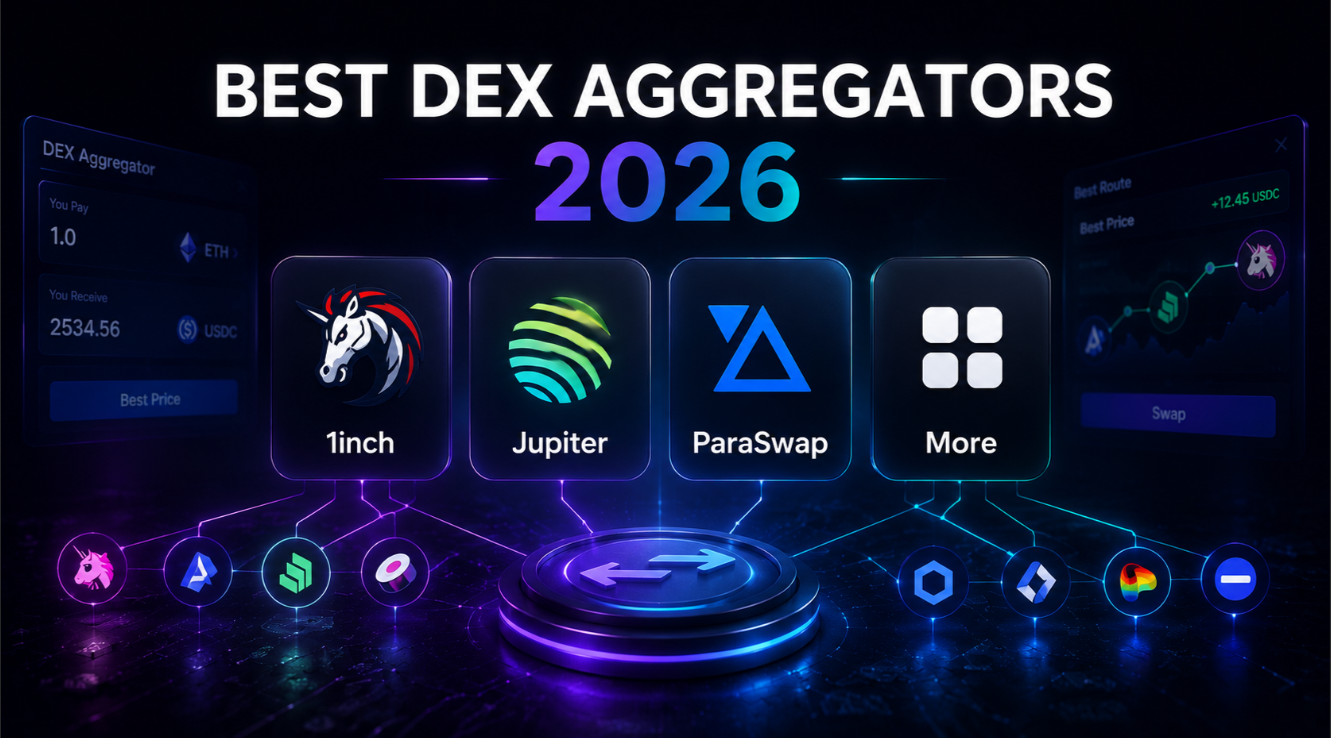
A DEX aggregator is a routing layer that queries multiple decentralized exchanges simultaneously and splits or redirects your trade across whichever combination of liquidity sources produces the best net outcome — highest output tokens, lowest slippage, and minimal fees. Instead of manually checking Uniswap, Curve, Balancer, and a dozen other pools, you send a single transaction to the aggregator and it handles the routing logic on-chain.
The concept emerged from a simple problem: DeFi liquidity is fragmented. Any single AMM (automated market maker) holds only a slice of total on-chain liquidity for a given trading pair. A large swap routed entirely through one pool incurs severe price impact. An aggregator mitigates this by finding paths through multiple pools — sometimes chaining through two or three intermediate tokens — to execute the trade at a price that no single AMM could match alone.
By 2026, DEX aggregators collectively route a substantial share of on-chain spot trading volume across Ethereum, Solana, BNB Chain, Arbitrum, and Base. For traders executing swaps above $10,000, using an aggregator rather than a single DEX can save anywhere from 0.1% to several percentage points depending on the token pair and market conditions. For market context on the underlying protocols, see Uniswap market data and 0x protocol market data.
How aggregators find the best swap routes
Routing is the core intellectual property of every DEX aggregator. The process unfolds in milliseconds and involves several distinct algorithmic steps that run off-chain before a transaction is ever submitted on-chain.
- Liquidity source indexing — The aggregator continuously indexes reserves, tick data, and virtual reserves from every supported AMM and order book. For Ethereum, this can mean tracking state from 40+ protocols across Uniswap v2/v3/v4, Curve, Balancer, Bancor, DODO, and others in real time.
- Path enumeration — Given an input token A and output token B, the router enumerates direct A→B paths as well as multi-hop paths (A→C→B, A→C→D→B) through intermediary tokens. The number of viable paths grows exponentially with the number of protocols and tokens, so aggregators prune the search space using heuristics.
- Split routing — For large trades, sending 100% through one pool creates price impact. The optimizer models splitting the trade: e.g., 60% via Uniswap v3 0.05% pool, 30% via Curve 3pool, 10% via a Balancer weighted pool. The optimal split is found by solving a convex optimization problem that balances marginal price impact across pools.
- Gas cost accounting — Each additional hop in a route costs gas. A multi-hop route that saves 0.3% on price impact but costs $8 more in gas is only beneficial for trades above a certain size. Production aggregators model expected gas costs per route and subtract them from the output estimate to find the true best net outcome.
- MEV and sandwich protection — A submitted transaction with a wide slippage tolerance is a target for MEV bots that insert buy orders before and sell orders after your trade (the "sandwich attack"). Leading aggregators integrate private transaction relays (Flashbots Protect, MEV Blocker, Jito on Solana) to submit swaps outside the public mempool, neutralizing front-running.
The best route at quote time may not be the best route at execution time — on-chain state changes between your API call and your transaction being mined. Good aggregators set realistic slippage defaults and implement partial fill tolerance to handle this gracefully.
1inch: the multichain aggregation pioneer
1inch launched in 2020 and established the template that most subsequent aggregators have followed. Its Pathfinder algorithm performs multi-hop, split-route optimization across the broadest set of liquidity sources of any aggregator on Ethereum and EVM-compatible chains. In 2026, 1inch supports Ethereum, Arbitrum, Optimism, Base, BNB Chain, Polygon, Avalanche, Gnosis Chain, and several other networks.
1inch Fusion is the protocol's standout feature. Rather than submitting a normal transaction that exposes intent to the mempool, Fusion works on a Dutch auction model: you sign a gasless order specifying your input token, desired output, and a decay curve that increases the available "resolver bonus" over time. Professional resolvers — MEV searchers and market makers who have staked 1INCH tokens — compete to fill the order at or better than your minimum price, absorbing gas costs themselves. The trade settles at the best available price within the auction window (typically 30–120 seconds). For users, the result is zero gas fees on the swap, inherent MEV protection, and often better prices than a standard aggregator route on large trades.
1inch Limit Orders allow conditional fills at a target price, also executed gaslessly through the resolver network. The 1INCH governance token controls protocol parameters, fee tiers, and resolver staking requirements. The 1inch Wallet (mobile) integrates the full aggregation and Fusion stack with a non-custodial wallet and hardware wallet support.
- Supported chains: Ethereum, Arbitrum, Optimism, Base, BNB Chain, Polygon, Avalanche, Gnosis, and more
- Fusion mode: gasless, MEV-protected, Dutch-auction settlement
- Liquidity sources: 300+ across all supported chains
- Token: 1INCH (governance + resolver staking)
- API: free tier available for developers; production use requires API key
Jupiter: the dominant aggregator on Solana
Jupiter is the default swap layer for the Solana ecosystem. Its V6 routing engine aggregates liquidity from Orca, Raydium, Meteora, Phoenix, and virtually every other Solana DEX into a single interface. Jupiter's architecture takes advantage of Solana's sub-second finality and low transaction costs to offer split-route, multi-hop swaps with significantly lower latency than equivalent routes on Ethereum mainnet.
Jupiter's DCA (dollar-cost averaging) feature automates recurring purchases at configurable intervals, making it a complete swap infrastructure layer rather than just a spot aggregator. Jupiter Limit Orders provide conditional execution without gas overhead beyond the initial deposit. The Jupiter API is the backbone of the Solana DeFi ecosystem — most Solana wallets (Phantom, Solflare, Backpack) and yield protocols route through Jupiter under the hood.
The JUP governance token launched in early 2024 with one of the largest airdrops in DeFi history and controls a DAO that governs fee parameters, liquidity incentives, and new product launches. In 2026, Jupiter has expanded into perpetuals (Jupiter Perps), a launchpad (Jupiter LFG), and a stablecoin initiative (SUSD), making it the most vertically integrated DEX infrastructure on any chain.
- Network: Solana exclusively
- Sources: Orca, Raydium, Meteora, Phoenix, Lifinity, and others
- Extra features: DCA, Limit Orders, Perpetuals, Launchpad
- Token: JUP (governance, DAO treasury)
- API: free, used by most Solana ecosystem apps
ParaSwap: institution-grade routing on EVM chains
ParaSwap differentiates itself from 1inch through its ParaSwapPool — a proprietary private liquidity network where market makers post competitive quotes that are only accessible through ParaSwap routing. These private market maker quotes often beat on-chain AMM prices for common trading pairs, especially at medium sizes ($5,000–$500,000), because market makers can price risk more efficiently than passive AMM pools.
The Augustus Swapper smart contract, ParaSwap's on-chain settlement layer, is audited by multiple security firms and has processed hundreds of billions in cumulative volume since 2020. ParaSwap's Delta mode implements intent-based gasless swaps similar to 1inch Fusion, where professional solvers compete to fill signed orders. ParaSwap is the preferred aggregator for several major institutional DeFi desks and is integrated as the default swap layer in MetaMask Portfolio.
ParaSwap supports Ethereum, Polygon, BNB Chain, Avalanche, Arbitrum, Optimism, and Base. The PSP governance token has a reduced emission schedule in 2026 after the DAO voted to realign incentives toward protocol fee revenue. ParaSwap's API is developer-friendly, with dedicated rate limits and SLA options for enterprise integrators.
- Chains: Ethereum, Polygon, BNB Chain, Avalanche, Arbitrum, Optimism, Base
- ParaSwapPool: private market maker liquidity inaccessible via other aggregators
- Delta mode: gasless, solver-settled intent swaps
- Institutional integrations: MetaMask Portfolio, major DeFi desks
- Token: PSP (governance)
OpenOcean: the broadest cross-chain coverage
OpenOcean earns its place in the 2026 aggregator landscape through sheer breadth of chain support. While 1inch and ParaSwap focus on high-volume EVM chains, OpenOcean covers 30+ networks including Solana, Sui, Aptos, Near, Tron, Harmony, and multiple EVM rollups. For traders who regularly operate across non-EVM ecosystems or smaller chains where no dedicated aggregator exists, OpenOcean provides a consistent interface.
OpenOcean's routing algorithm (D-STAR) performs split-route optimization across AMMs and order books on each supported chain. For cross-chain swaps, OpenOcean integrates bridge aggregators (Li.Fi, Socket) to find optimal cross-chain paths. The OOE governance token incentivizes liquidity and funds protocol development.
Trade execution quality on high-volume chains like Ethereum and Arbitrum is competitive with but not consistently superior to 1inch or ParaSwap. OpenOcean's strongest use case is for traders working on emerging chains where the specialist aggregators have no presence. Gas estimates and slippage warnings are reliable across all supported chains.
- Chains: 30+ including Solana, Sui, Aptos, Near, Tron, and all major EVM networks
- Algorithm: D-STAR split-route optimizer
- Cross-chain: integrates Li.Fi and Socket for bridge routing
- Best for: non-EVM ecosystems and emerging chain coverage
- Token: OOE (governance)
KyberSwap: concentrated liquidity and dynamic fees
KyberSwap operates on two levels: it is both a DEX aggregator routing across external protocols and a native AMM (KyberSwap Elastic) that provides its own concentrated-liquidity pools. This dual structure means KyberSwap can direct a portion of flow through its own pools when they offer the best rate, generating protocol fee revenue while simultaneously providing competitive execution.
KyberSwap Elastic uses dynamic fee tiers that adjust based on market volatility — fees tighten during calm markets to attract volume and widen during volatile periods to protect LPs from impermanent loss. The protocol's smart order routing aggregates external sources (Uniswap, Balancer, Curve, Sushiswap) alongside its own pools. KyberSwap supports Ethereum, Polygon, Arbitrum, Optimism, BNB Chain, Avalanche, Base, and Scroll.
In November 2023, KyberSwap suffered a $48 million smart-contract exploit targeting a specific edge case in the Elastic pool tick-crossing logic. The DAO subsequently restructured, migrated affected LPs, and deployed a fully audited v2 of Elastic in 2024. By 2026, the protocol has rebuilt significant TVL and the incident remains a critical case study in AMM smart-contract risk. For DeFi risk assessments across protocols, see the
- Chains: Ethereum, Polygon, Arbitrum, Optimism, BNB Chain, Avalanche, Base, Scroll
- Native AMM: KyberSwap Elastic with dynamic fees and concentrated liquidity
- Aggregation: routes across external AMMs + own pools
- Token: KNC (Kyber Network Crystal — governance)
- Note: underwent security incident in 2023; reviewed and relaunched in 2024
Matcha by 0x: professional-grade order flow
0x protocol is the infrastructure layer; Matcha is its consumer-facing interface. The 0x API aggregates liquidity from 100+ on-chain sources and also integrates 0x's proprietary Request-for-Quote (RFQ) system, where professional market makers provide quotes on demand for specific order sizes. RFQ liquidity frequently offers tighter spreads than AMM pools for sizes between $1,000 and $100,000 because market makers can adjust quotes based on real-time inventory and hedging costs.
Matcha's "Auto" routing mode evaluates all available sources — on-chain AMMs, aggregated liquidity, and RFQ quotes — simultaneously and executes through whichever combination produces the best net output. Gasless swaps via 0x Gasless API allow users to sign an order and have a third-party filler submit the transaction, covering gas in exchange for a small portion of the positive slippage recovered.
Matcha supports Ethereum, Arbitrum, Optimism, Base, Polygon, BNB Chain, Avalanche, and Celo. The 0x API is widely used by institutional and retail wallets — Coinbase Wallet, Trust Wallet, MetaMask, and Robinhood have all integrated 0x at various points for swap routing. ZRX is the governance token for the 0x protocol DAO, which controls fee parameters and treasury allocation.
- Chains: Ethereum, Arbitrum, Optimism, Base, Polygon, BNB Chain, Avalanche, Celo
- RFQ system: professional market maker quotes for medium-to-large order sizes
- Gasless mode: filler-submitted transactions via 0x Gasless API
- Integrators: Coinbase Wallet, Trust Wallet, MetaMask, Robinhood
- Token: ZRX (governance)
Comparing slippage, gas costs, and MEV protection across aggregators
Choosing an aggregator is not just about finding the best quoted price — execution quality, gas efficiency, and protection from front-running attacks all affect your final outcome. This section compares the five major aggregators across these three dimensions.
Slippage and price impact:
- 1inch Fusion: best-in-class for Ethereum and EVM chains on large trades due to resolver competition that extracts positive MEV and passes it back to users.
- Jupiter: best on Solana — sub-cent gas costs allow micro-split routing that is impractical on Ethereum, producing consistently tight fills even on illiquid pairs.
- ParaSwap: often wins for mid-size trades ($5K–$100K) when ParaSwapPool market makers are active; can lag on smaller trades where private market maker quotes are unavailable.
- 0x / Matcha: RFQ quotes are highly competitive for tokens with active institutional market makers; less consistent on long-tail tokens.
- KyberSwap: competitive on pairs with high KyberSwap Elastic TVL; less consistent when routing falls back to external sources.
- OpenOcean: optimal for non-EVM chains; EVM execution quality is adequate but rarely leads.
Gas costs:
- 1inch Fusion and 0x Gasless: zero gas for the swapper; fillers/resolvers pay gas and are compensated through positive slippage.
- Standard aggregator transactions (1inch Classic, ParaSwap non-Delta, KyberSwap): gas costs 30%–80% higher than a direct DEX swap due to the routing contract overhead. For small trades under $500 on Ethereum mainnet, gas cost can eliminate any price improvement from aggregation.
- Jupiter on Solana: gas is negligible (fractions of a cent); aggregation overhead is irrelevant.
- L2 aggregation (Arbitrum, Optimism, Base): gas is low enough that routing overhead rarely matters; aggregation benefits apply cleanly at nearly any trade size.
MEV and sandwich protection:
- 1inch Fusion: inherent MEV protection — Dutch auction orders are not broadcast to the public mempool.
- 0x Gasless / Matcha: gasless orders are not visible in the mempool; filler competition provides natural MEV resistance.
- ParaSwap Delta: intent-based, solver-settled — not visible in standard mempool.
- 1inch Classic / ParaSwap standard / KyberSwap / OpenOcean: normal on-chain transactions. Users should enable Flashbots Protect (Ethereum) or MEV Blocker RPC to route transactions through a private relay and avoid sandwiching.
- Jupiter: Jito block engine on Solana routes most high-value transactions; Jito tips improve inclusion speed while MEV is partially neutralized through bundle mechanics.
Aggregator vs single DEX: when does aggregation actually help?
Aggregators add value proportional to trade size and token illiquidity. For small, common-pair trades on a well-capitalized single DEX, the routing overhead — in gas costs and contract complexity — may produce a worse outcome than going directly to Uniswap v3 or Orca. Understanding when aggregation helps ensures you use the right tool for the right trade.
Use a direct DEX when:
- Trade size is under $500 on Ethereum mainnet — gas savings from optimal routing rarely offset the aggregation contract overhead.
- You are trading a top-5 pair (ETH/USDC, ETH/USDT, BTC/USDT) on a well-liquidity-provisioned venue like Uniswap v3 or Curve — these pools are often the best available route anyway.
- You need guaranteed execution with a specific AMM for smart contract interaction (e.g., providing LP into Uniswap directly).
- You are executing on Solana for very small trades where the difference is sub-cent regardless of routing.
Use an aggregator when:
- Trade size exceeds $2,000 on Ethereum or $10,000 on any chain — split routing begins to outperform any single venue at meaningful sizes.
- You are trading a mid- or long-tail token that has liquidity scattered across multiple pools.
- You want automatic MEV protection without manually configuring a private RPC.
- You are executing on an L2 (Arbitrum, Optimism, Base) where gas is cheap enough that routing overhead is negligible at almost any size.
- You want gasless execution via Fusion, Delta, or 0x Gasless and have no gas token available.
For a structured comparison of DEX and DeFi protocol quality scores, the DeFi ratings and Exchange ratings cover key metrics including smart-contract audit history, DAO governance quality, and TVL stability.
How to use a DEX aggregator safely
DEX aggregators are powerful but they interact with multiple smart contracts, handle significant token approvals, and operate in an adversarial on-chain environment. Following a clear safety process protects your funds from phishing, approval exploits, and user error.
- Verify the URL before connecting your wallet. Aggregator phishing sites mimic the UI of 1inch, Jupiter, and Matcha with near-identical domains (1-inch.io, jupit3r.exchange). Always type the URL directly or use bookmarks: app.1inch.io, jup.ag, app.paraswap.io, matcha.xyz. Check the domain certificate and look for the official social media verification badge on the aggregator's Twitter/X profile.
- Use a dedicated wallet for DeFi trading. Separate your DeFi trading wallet from your long-term holdings wallet. Fund the trading wallet with only what you need for active trades. A compromised approval on one wallet should not put your entire portfolio at risk.
- Review and revoke unnecessary token approvals. When you approve a token for use by an aggregator contract, that approval persists indefinitely unless revoked. Use revoke.cash or Etherscan's token approval tool regularly to audit and remove stale approvals. Aggregators that support permit2 (Uniswap's batched, expirable approval standard) are preferred because approvals can be scoped to specific amounts and expire automatically.
- Understand slippage settings before executing. The default slippage tolerance (0.5%–1%) is appropriate for most major-pair trades. For volatile or low-liquidity tokens, you may need to increase tolerance to 3%–5% to avoid failed transactions — but wider tolerance makes you a larger sandwich target. Use a private RPC (Flashbots Protect on Ethereum) when setting slippage above 1% for standard transactions.
- Simulate the transaction before signing. Browser extensions like Pocket Universe, Fire, and Revoke.cash's simulation feature show the expected token movements for a transaction before you confirm it in your wallet. This catches malicious approval requests or mis-routed transactions that would result in unexpected token loss.
- Check the aggregator's audit status and bug bounty. Before trusting an aggregator with large trades, verify that its core routing contract has been audited by at least two independent firms and that a live bug bounty program is active. All major aggregators (1inch, Jupiter, ParaSwap, Matcha/0x) meet this standard; smaller or newer aggregators may not. For ratings-level assessments, see the DeFi ratings.
- For Uniswap v4 hooks and novel AMM structures, verify pool legitimacy. Uniswap v4's hook architecture allows arbitrary code to execute on swap callbacks. A malicious hook pool that appears in aggregator routing could drain funds. When an aggregator routes through unfamiliar pool addresses, verify the pool on Uniswap's official interface before executing large trades through it. See the Uniswap review for a full breakdown of v4 architecture and hook risks.
DEX aggregators are one of the most mature and battle-tested infrastructure layers in DeFi. 1inch, Jupiter, ParaSwap, and Matcha collectively process billions of dollars in volume per month with minimal incidents when users follow proper security hygiene. The core advice is straightforward: verify URLs, manage approvals, simulate before signing, and size trades according to the liquidity depth shown in the routing preview. For live price data on the aggregator tokens themselves, see 1inch market data and Jupiter market data.