What is crypto staking?
Staking is the process of locking up cryptocurrency to participate in the security of a proof-of-stake (PoS) blockchain and earn rewards in return. Unlike proof-of-work mining, which requires energy-intensive hardware, staking uses your existing tokens as collateral. Validators are selected to propose and attest to new blocks in proportion to the amount they have staked — the more tokens you commit, the greater your chance of earning block rewards.
For most retail holders, running a validator directly is impractical: Ethereum requires 32 ETH (~$80,000 at 2026 prices) to operate a solo validator, Solana demands high-performance server hardware, and Cardano expects technical knowledge of pool operations. The ecosystem has responded by building three parallel infrastructure layers that make staking accessible to anyone with a wallet: native on-chain delegation, liquid staking protocols, and centralized exchange staking products.
In 2026, total value staked across all PoS networks exceeds $400 billion. Ethereum alone has over 33 million ETH staked, Solana has more than 430 million SOL delegated, and Cardano maintains one of the highest staking participation rates of any major network at nearly 70% of circulating supply. This guide walks through every major platform and network, compares yields, and explains the risks you must understand before committing capital. For live market data, see the Ethereum market page, Solana market page, and Cardano market page.
Native staking vs liquid staking vs CEX staking: how they differ
Before comparing specific platforms it is essential to understand the three structural approaches. Each offers a different trade-off between yield, custody, liquidity, and complexity.
- Native staking — You delegate directly to a validator or run your own node on-chain. Rewards go to your wallet; custody stays with you. The main drawbacks are minimum stake requirements, unbonding periods (ranging from ~2 days on Solana to 21 days on Cosmos), and limited composability — staked tokens cannot be used in DeFi until unstaked.
- Liquid staking — A protocol (Lido, Rocket Pool, Jito, Marinade) stakes your tokens and gives you a receipt token (stETH, rETH, JitoSOL, mSOL) that represents the staked position plus accrued rewards. The receipt token is freely transferable and usable as DeFi collateral. Yield is slightly lower than native staking (protocol takes a fee), but liquidity is immediate.
- CEX staking — Coinbase Earn, Kraken Staking, Binance Earn stake your tokens on your behalf. Setup is trivial; no wallet required. The trade-off: you surrender custody to the exchange, yields are often lower due to platform fees, and regulatory risk is highest — several major exchange staking products have faced enforcement actions in the US in 2023–2025.
Rule of thumb: if you value maximum yield and sovereignty, go native or liquid. If you value simplicity and are comfortable with exchange custody risk, CEX staking is the easiest entry point — but read the terms carefully for lock-up conditions and withdrawal timelines.
Lido Finance: the dominant liquid staking protocol
Lido is the largest liquid staking protocol by total value locked, holding over 30% of all staked ETH and significant positions in staked SOL and POL (Polygon). When you deposit ETH into Lido, you receive stETH — a rebasing token whose balance increases daily as staking rewards accumulate. The protocol routes deposited ETH to a curated set of professional node operators and charges a 10% fee on rewards.
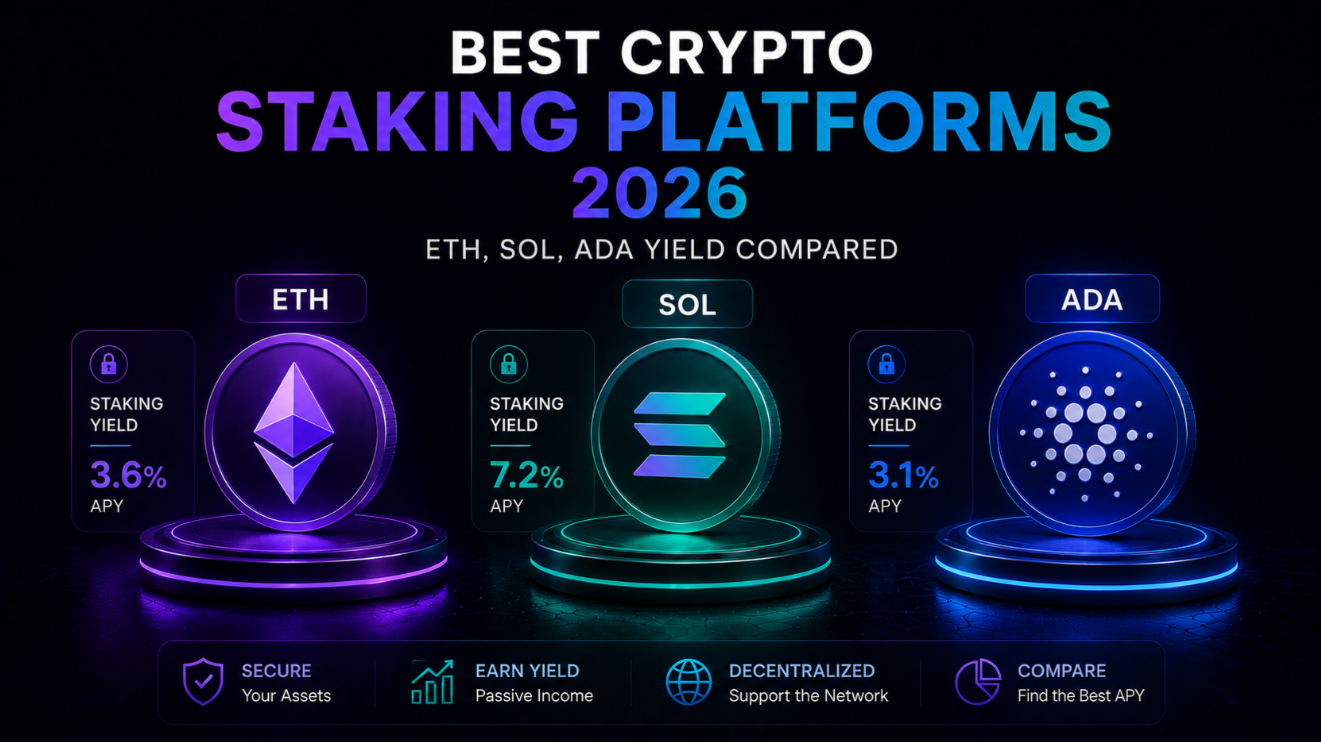
Base Ethereum consensus-layer staking yield in 2026 sits around 3.5%–5% APY. After Lido's 10% protocol fee, net stETH holders receive approximately 3.2%–4.5% APY. The real value proposition is composability: stETH is accepted as collateral on Aave, used in Curve and Balancer liquidity pools, and forms the base layer for liquid restaking protocols. You earn staking yield while keeping full DeFi optionality.
Lido's main criticism is centralization: its dominant market share gives it outsized influence over Ethereum's validator set. The Lido DAO governance token (LDO) allows token holders to vote on protocol parameters. For a deep-dive on platform quality, fees, and security, see the Lido review.
- Supported assets: ETH, SOL, POL
- ETH net APY: ~3.2%–4.5%
- Protocol fee: 10% of rewards
- Receipt token: stETH (rebasing) / wstETH (wrapped, non-rebasing)
- Audits: multiple (Sigma Prime, MixBytes, Oxorio, others)
Rocket Pool: decentralized ETH staking
Rocket Pool is the most credibly decentralized Ethereum liquid staking protocol. Instead of using a curated operator set like Lido, Rocket Pool allows anyone to become a node operator by pairing 8 ETH of their own capital with 24 ETH from the staking pool, and posting RPL tokens as a collateral bond. This design distributes validator operations across thousands of independent operators, eliminating the single-operator concentration risk present in custodial staking.
rETH is Rocket Pool's receipt token. Unlike stETH (which rebases), rETH is a non-rebasing token whose exchange rate against ETH increases over time as rewards accumulate — making it simpler for DeFi integrations and tax accounting. rETH yield typically tracks within 0.1%–0.2% of stETH yield (roughly 3%–4.5% net APY in 2026), with slight differences driven by commission structures.
Node operators earn both staking commissions (currently 14% of their minipool's staking rewards) and RPL token rewards, giving them higher total yields than passive depositors. For users who want a non-custodial, trust-minimized ETH staking option and are comfortable with slightly lower liquidity depth than Lido, Rocket Pool is the best alternative.
- Supported assets: ETH
- rETH net APY: ~3%–4.5%
- Protocol fee: variable commission to operators (~14%)
- Receipt token: rETH (non-rebasing, appreciating exchange rate)
- Governance: RPL token, on-chain DAO
EigenLayer: restaking ETH for higher yield
EigenLayer introduced restaking — the ability for ETH validators and liquid staking token holders to opt in to securing additional decentralized services (oracles, bridges, data availability layers, rollup sequencers) called Actively Validated Services (AVS). In exchange, restakers earn AVS-specific rewards on top of their base staking yield.
The mechanics: deposit ETH or a liquid staking token (stETH, rETH, cbETH) into EigenLayer's smart contracts, then delegate to an Operator who runs AVS software. Each AVS distributes rewards to operators and restakers. The added risk: if an operator misbehaves on an AVS with live mainnet slashing conditions, a portion of restaked capital can be slashed — this is on top of any Ethereum consensus-layer slashing risk.
As of 2026, combined restaking yield on stETH (base ETH staking + EigenLayer AVS rewards) ranges from 5% to 12% depending on which AVS the operator services. Liquid restaking protocols — ether.fi, Renzo, Kelp — tokenize the entire restaking position into another receipt token (eETH, ezETH, rsETH), allowing restakers to use their position as DeFi collateral while continuing to earn both layers of yield.
- Supported assets: ETH, stETH, rETH, cbETH, and other LSTs
- Total APY range: 5%–12% (base staking + AVS rewards)
- Additional risk: AVS slashing on top of consensus-layer slashing
- Liquid restaking tokens: eETH (ether.fi), ezETH (Renzo), rsETH (Kelp)
Jito and Marinade: liquid staking on Solana
Solana's liquid staking ecosystem mirrors Ethereum's but operates under different network dynamics. Solana uses a delegated proof-of-stake system where any SOL holder can delegate to a validator without lock-up — unstaking takes one epoch (~2–3 days). Native SOL staking yields 6%–8% APY in 2026, driven by inflation-schedule rewards and fee distributions.
Jito is the leading liquid staking protocol on Solana by TVL, distinguished by its MEV (maximal extractable value) rebate mechanism. Jito runs a block engine that captures MEV from Solana transaction ordering and distributes a portion of those MEV tips back to JitoSOL stakers. This pushes JitoSOL yields 0.5%–1.5% above standard native delegation, making it consistently one of the highest-yielding liquid staking options on any major network — roughly 7%–9.5% APY in 2026. JitoSOL is integrated into Solana DeFi (Marinade, Kamino, Drift) as collateral.
Marinade Finance was the pioneering Solana liquid staking protocol. It uses a stake pool that automatically distributes delegations across hundreds of validators according to a performance scoring system, improving network decentralization. mSOL yield (7%–8.5% APY) includes a bonus from the Marinade Native program which rewards direct native delegators as well as liquid stakers. Marinade also runs a "stake auction" where validators bid for delegation, directing fees back to stakers.
- Jito: JitoSOL APY ~7%–9.5%, MEV-boosted rewards, deepest Solana DeFi integration
- Marinade: mSOL APY ~7%–8.5%, 450+ validator distribution, stake-auction fee rebates
- Native SOL delegation (no liquid token): ~6%–8% APY, no smart-contract risk, 1-epoch unstaking
CEX staking: Coinbase Earn, Kraken Staking, Binance Earn
Centralized exchange staking remains the dominant entry point for retail holders who are unwilling to manage self-custody wallets. The three largest platforms — Coinbase, Kraken, and Binance — collectively manage hundreds of billions of dollars in staked assets across dozens of networks.
Coinbase Earn offers ETH staking (via cbETH), SOL, ADA, ATOM, DOT, and more. ETH staking on Coinbase yields approximately 2.6%–3.5% APY net of Coinbase's 25% fee — notably lower than Lido or native staking but backed by a US-regulated, publicly listed company. cbETH (Coinbase Wrapped Staked ETH) is a transferable ERC-20 that can be used in DeFi, bridging CEX convenience with on-chain optionality. Coinbase completed its settlement with the SEC in 2025 and continues to offer staking services under a registered framework.
Kraken Staking survived regulatory pressure by restructuring its US staking program and relaunching under updated compliance terms in late 2024. It offers ETH, SOL, ADA, DOT, and a range of smaller PoS assets. Kraken's ETH staking APY sits at 3.5%–4.5%, competitive with Lido. Non-US users have access to a wider asset menu and higher tiers. Kraken's long operational history and proof-of-reserves program give it a strong trust baseline.
Binance Earn offers the widest asset selection of any CEX, including flexible (no lock-up) and locked (fixed-term) options across ETH, BNB, SOL, ADA, MATIC, and dozens of smaller tokens. Locked ETH staking on Binance can yield up to 5%–6% APY, but lock-up periods of 30–120 days apply. Binance carries the highest counterparty risk of the three due to ongoing legal proceedings in multiple jurisdictions — users should factor exchange risk into the risk-adjusted yield calculation.
- Coinbase Earn: ETH ~2.6%–3.5% APY (25% fee), US-regulated, cbETH liquid
- Kraken Staking: ETH ~3.5%–4.5% APY, wide asset selection, strong compliance track record
- Binance Earn: ETH locked ~5%–6% APY, widest asset menu, higher counterparty risk
For a comprehensive comparison of exchange features, fees, and security ratings, see the Exchange ratings and Staking platform ratings.
Solana native staking: choosing the right validator
Native SOL staking is uniquely accessible: there is no minimum delegation amount, no lock-up beyond one epoch, and no smart-contract risk. You simply select a validator from the Solana Beach, Stakewiz, or Validators.app dashboards and delegate from any Solana wallet (Phantom, Solflare, Backpack). Rewards accumulate each epoch (~2–3 days) and are automatically re-staked unless you withdraw them.
Validator selection matters more on Solana than most networks because rewards are not uniform. Validators that skip blocks or fall below uptime thresholds earn reduced rewards for themselves and their delegators. Key metrics to evaluate:
- Vote credit score — percentage of votes cast vs. possible votes; target >95%
- Commission — most competitive validators charge 0%–8%; avoid >10%
- Skip rate — percentage of slots the validator was assigned but did not produce; target <3%
- Stake concentration — do not over-concentrate stake in the top 20 validators; Nakamoto coefficient health depends on distribution
- MEV commission — validators running Jito MEV infrastructure share MEV tips; check Jito dashboard for MEV APY addons
Top-performing validators in 2026 (by APY including MEV rebates): Marinade-curated pools, Jito-registered validators in the top quartile, and independent high-performance operators running on data-center-grade hardware with 99.9%+ uptime. Using the Marinade or Jito stake pools sidesteps the need to research individual validators — the protocols do it algorithmically.
Cardano stake pools: how ADA staking works
Cardano has one of the most user-friendly native staking systems of any major PoS network. ADA staking is non-custodial by design: when you delegate to a stake pool, your ADA never leaves your wallet. You retain full control of your funds; the delegation only assigns your stake's voting weight to the pool. There is no lock-up — you can spend, transfer, or re-delegate your ADA at any time, though rewards for the current epoch are based on your stake snapshot at epoch start (~5 days).
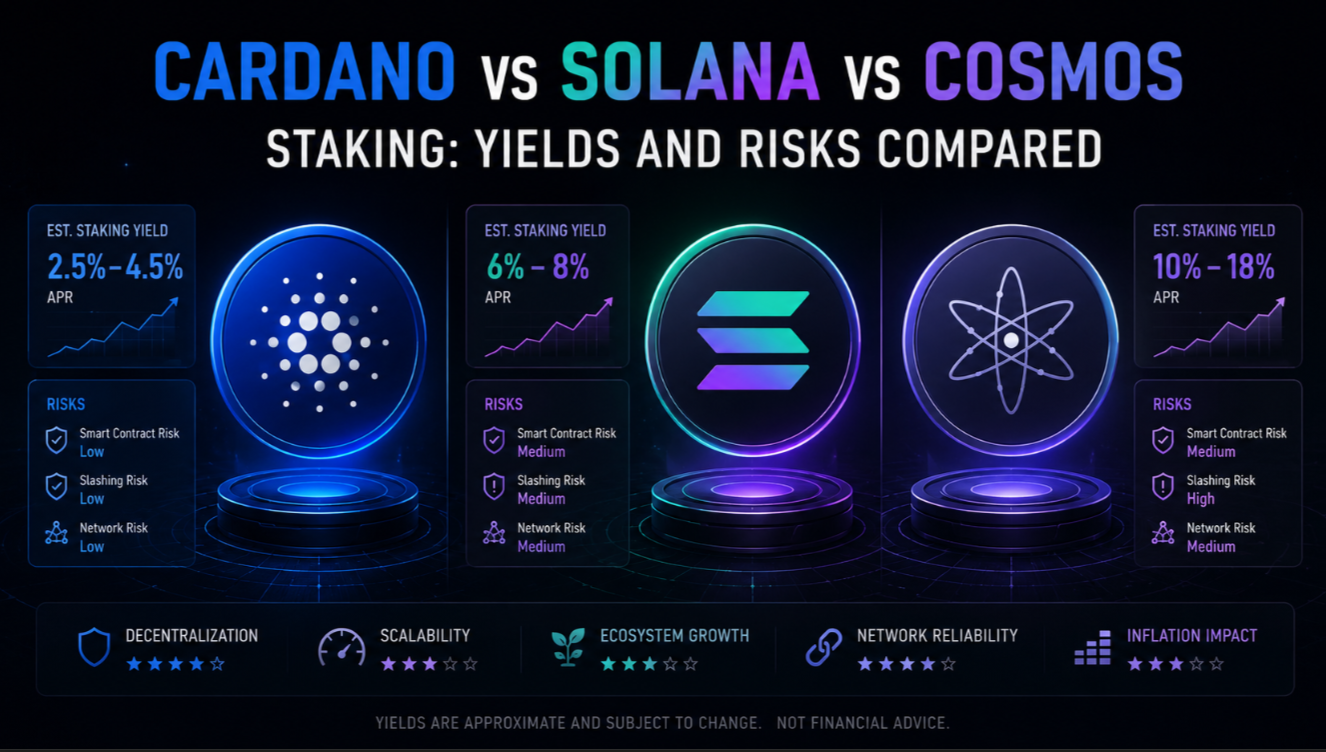
Cardano's annual staking yield in 2026 ranges from 3% to 5% APY, depending on pool performance, saturation, and declared costs. The network uses an incentive model that penalizes over-saturated pools (those above the saturation parameter, currently ~64 million ADA), encouraging delegation distribution across the ~3,000 active pools. Rewards are paid automatically into your wallet each epoch — no claiming transaction required.
Choosing a pool: look for pools with high pledge (operator's own ADA staked as skin-in-the-game), low variable fees (1%–3%), low fixed cost (minimum 170 ADA/epoch), and high uptime. Single-pool operators tend to offer slightly higher yields and contribute to decentralization more than multi-pool operators (entities that run hundreds of pools). Tools like ADApools.org, PoolPeek, and Cardanoscan provide performance dashboards.
- ADA native staking APY: ~3%–5%
- No lock-up, non-custodial, rewards auto-paid each epoch
- Saturation limit: ~64M ADA per pool — avoid over-saturated pools
- Recommended tools: ADApools.org, PoolPeek, Daedalus/Yoroi/Lace wallets
Staking with a hardware wallet: Ledger and Trezor
For holders with significant staking positions, hardware wallets provide the strongest security model. A hardware wallet (Ledger Nano X/S Plus, Trezor Model T/Safe 5) stores your private key in a secure element chip that never exposes the key to a connected computer — even if your PC is compromised, the attacker cannot sign transactions without physical access to the device and your PIN.
Most major PoS networks support hardware wallet staking through official wallet UIs or third-party integrations:
- Ethereum (ETH): Ledger Live supports staking via Lido directly. You interact with the Lido contracts from Ledger Live, and all transaction signing happens on the device. Alternatively, connect Ledger to MetaMask and use the Lido or Rocket Pool web UIs.
- Solana (SOL): Phantom and Solflare both support Ledger hardware signing. Delegate natively or use Jito/Marinade through the browser wallet while keeping keys on the Ledger.
- Cardano (ADA): Daedalus (full node) and Yoroi/Lace (light wallets) support hardware wallet staking via Ledger and Trezor. The non-custodial staking model means you never send ADA to any address — just sign a delegation certificate.
- Cosmos ecosystem: Keplr wallet integrates with Ledger for ATOM, OSMO, and other Cosmos SDK chains.
Hardware wallet staking adds a small UX friction (physically confirming each transaction on the device) but eliminates the single largest security risk in self-custody: hot wallet private key exposure. For holdings above $10,000 in staked value, the one-time cost of a hardware device is strongly justified.
Staking risks: slashing, lock-ups, and smart contracts
Staking is not risk-free. Understanding the specific risk vectors for each staking approach allows you to make informed decisions about position sizing and platform selection.
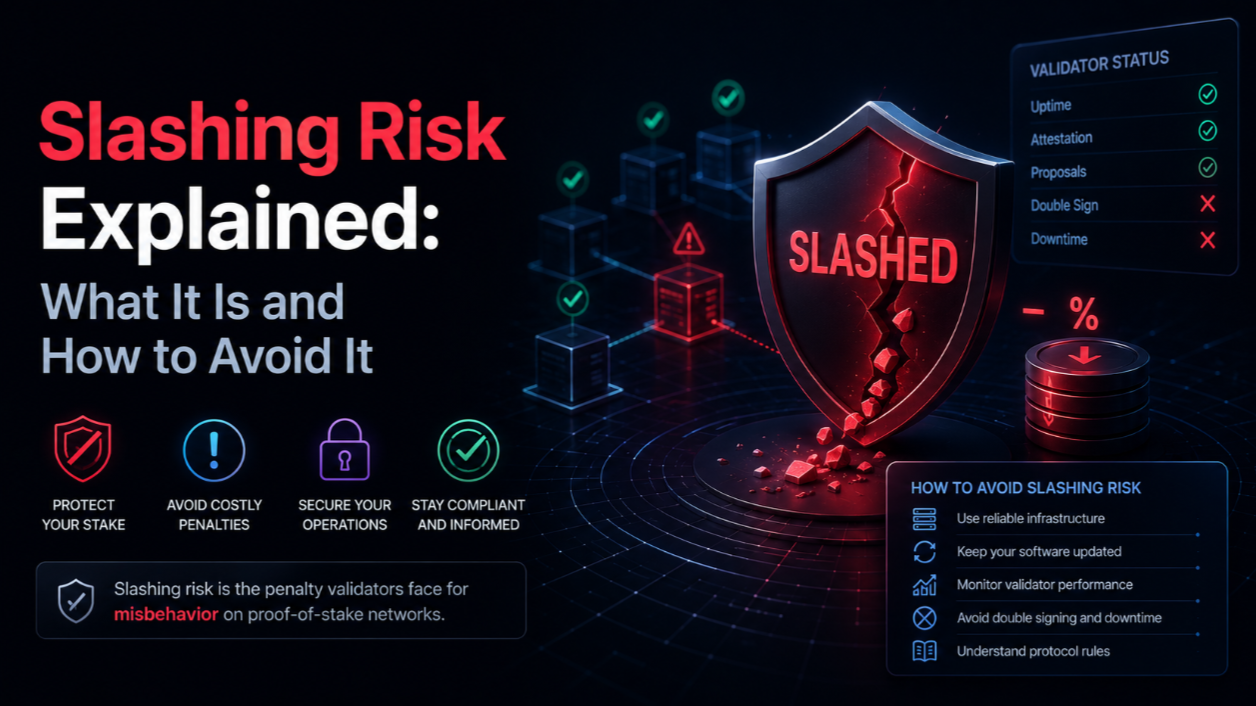
- Slashing — Proof-of-stake networks penalize validators for double-signing or equivocation (attempting to create two conflicting blocks). On Ethereum, a slashing event burns a portion of the validator's stake and ejects the validator from the active set. For ETH liquid stakers, Lido and Rocket Pool maintain insurance funds or bonding requirements to cover slashing events — in practice, slashing losses for large, professional operators are rare but not impossible.
- Unbonding / lock-up periods — Native staking on many networks requires waiting for an unbonding period before tokens are withdrawable: Ethereum withdrawals process in a queue (can take hours to weeks during high-exit demand), Cosmos chains impose 21-day unbonding, Polkadot 28 days. Liquid staking tokens bypass this by allowing you to sell the receipt token on the open market — but the token may trade at a discount to the underlying if demand for exit is high.
- Smart contract risk — Liquid staking protocols (Lido, Rocket Pool, Jito, Marinade) and restaking platforms (EigenLayer) run complex smart contracts. Any undetected bug could lead to a loss of funds. Mitigating factors: multiple independent audits, bug bounties, time in production, and the size of the insurance fund or operator bond.
- Validator / operator risk — Delegating to a poorly performing validator results in missed rewards. Delegating to a malicious validator (or one that gets slashed) can result in direct stake loss in slashing-enabled networks. Choose validators with long track records and clear incentive alignment.
- Regulatory risk — CEX staking products face the most direct regulatory exposure. Several major US staking programs have been suspended or restructured following SEC enforcement actions in 2023–2025. Non-US users are currently less affected, but regulatory postures are evolving globally under frameworks like MiCA in the EU.
- Liquidity risk — Even liquid staking tokens can depeg. The March 2023 stETH depeg during the banking crisis briefly traded stETH at a 2%–4% discount to ETH. Under extreme market stress, the secondary market for liquid staking tokens may not provide the immediate exit liquidity the name implies.
Tax and yield reporting for staking income
Staking income is taxable in most major jurisdictions. The IRS (US), HMRC (UK), and EU member state tax authorities under MiCA guidance generally treat staking rewards as ordinary income at the fair market value of the tokens at the time they are received. This section provides general information only — consult a qualified tax professional for advice specific to your jurisdiction and situation.
- When income is recognized — In most frameworks, rewards are taxable at receipt: each epoch on Cardano, each day for rebasing stETH, each time rewards are claimed from a CEX. For liquid staking tokens like rETH (non-rebasing, appreciating exchange rate), some jurisdictions may defer recognition until you sell or swap — but this interpretation is not universally settled.
- Disposal events — Swapping a liquid staking token (stETH → ETH, mSOL → SOL) is typically treated as a taxable disposal at the market price on the date of the swap, in addition to any staking income recognized. Wrapping stETH to wstETH may also be a disposal in some jurisdictions.
- Slashing losses — If your stake is slashed, the lost amount may be treated as a capital loss. Documentation of the slashing event (on-chain transaction hash, valuation at the time) is critical for claiming the deduction.
- Record keeping tools — Koinly, TaxBit, and Cointracker integrate directly with major staking wallets and CEX APIs to decode staking reward transactions. Manual tracking at scale is error-prone. Establish automated records from your first staking transaction.
- Country-specific notes — Germany treats staking rewards as miscellaneous income; Austria applies flat 27.5% on crypto gains including staking; the UK classifies staking rewards as miscellaneous income unless they amount to a trade. Rules change frequently; verify with current local guidance.
The EU's MiCA regulation (fully in force in 2025–2026) includes provisions that affect staking service providers operating in the EU, though the tax treatment of staking rewards remains a member-state responsibility. Document all staking positions, rewards, and disposals from day one.
How to start staking: a step-by-step guide
The following sequence is designed for users with basic crypto experience who want to start earning staking yield without taking on unnecessary platform or smart-contract risk. Do not skip steps.
- Start with native ADA staking on Cardano. ADA staking has no minimum, no lock-up, and no smart-contract risk — your ADA never leaves your wallet. Download the Lace wallet, delegate to a single-pool operator with high pledge and low fees, and observe reward accrual over 2–3 epochs. This teaches the mechanics of PoS staking with the least complexity. See the Cardano market page for current network data.
- Add liquid ETH staking via Lido. Once comfortable with delegation, deposit a small amount of ETH into Lido through the Lido website or Ledger Live. Review the Lido review first to understand the protocol's risk parameters, fee structure, and validator set. Observe stETH balance accrual daily.
- Explore native SOL staking or Jito. Connect a Phantom or Solflare wallet, acquire SOL, and either delegate to a high-performing native validator or deposit into the Jito stake pool for MEV-boosted yield. Check the Solana market page for current staking participation and yield data.
- Consider a CEX staking product for simplicity. If you are not ready for self-custody wallets, Coinbase or Kraken offer regulated, insured-deposit-institution-backed staking with no wallet setup. Accept that yields will be lower and you are trusting the exchange with custody.
- Research EigenLayer restaking as a next step. Only after you understand base ETH staking should you explore EigenLayer. Read the AVS documentation, check which AVS have live mainnet slashing, and only delegate to operators with verified track records. The additional yield (2%–6% above base) is real but so is the additional slashing surface.
- Review staking platform ratings before committing large positions. Before deploying significant capital, check the Staking platform ratings and Exchange ratings to compare platforms on security, yield, fees, and track record.
Staking is one of the most accessible ways to generate passive income from crypto holdings in 2026, with yields ranging from 3% APY on CEX ETH staking to 9%+ on Jito SOL staking with MEV rebates. The platforms and networks covered in this guide — Lido, Rocket Pool, EigenLayer, Jito, Marinade, Coinbase Earn, Kraken Staking, Binance Earn, native Solana validators, and Cardano stake pools — represent the most mature, most liquid, and most widely used options available. Start with the simplest approach for your network, understand the risks at each layer, and scale position sizes only after verifying platform security and your own tax obligations.